
Teaching & Learning
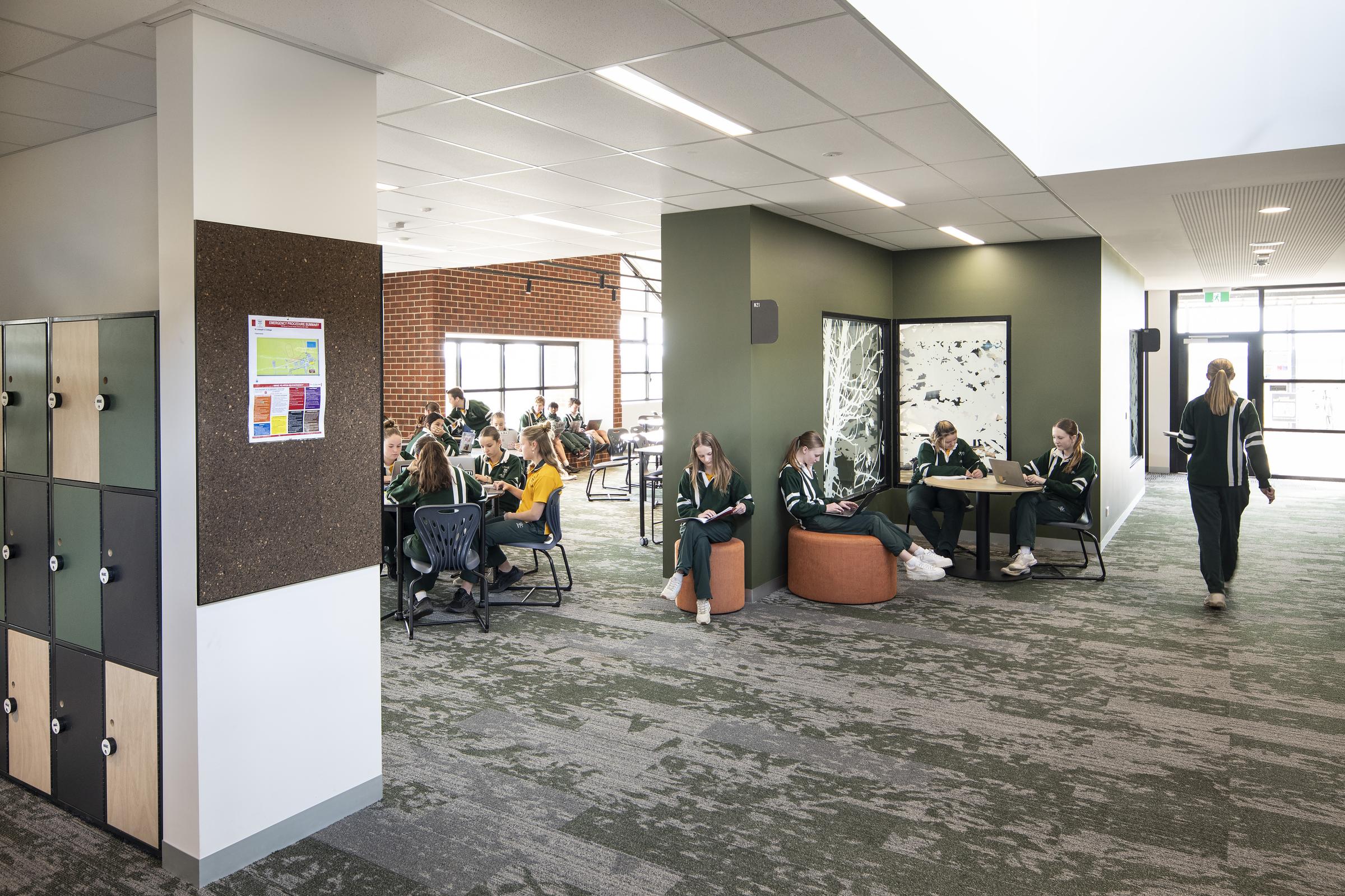
Laptop Free Week
Going Laptop-Free: What It Is, Why We're Doing It, and What the Research Says
From Monday 4 May to Friday 8 May, St Joseph's College will be running its first Laptop-Free Week. Across both campuses, students will be asked to set aside their laptops for the school day - working instead with pens, paper, whiteboards and physical resources.
How It Will Work
During Laptop-Free Week:
- Students may bring their laptop to school or leave it at home - the choice is theirs.
- If brought to school, laptops must remain in the student's locker for the entire day.
- All classes will be taught using pen, paper, whiteboards and physical textbooks.
- Teachers have planned their lessons accordingly - no student will be disadvantaged.
Year 12 students are an exception: they may use their laptops for independent study in the Ref only. We recognise the particular demands of VCE and have made this provision accordingly.
This is not a permanent change. It is a one-week trial - a deliberate experiment that we intend to reflect on together as a school community.
What the Research Tells Us
The decision to trial this week is grounded in a body of research that we have been engaging with seriously over recent months. Three findings in particular have shaped our thinking.
1. Handwriting helps learning stick
Research consistently shows that students who take handwritten notes retain information significantly better than those who type - and not just by a small margin. The reason matters: when we write by hand, we cannot keep up word-for-word, so we are forced to process, summarise and make sense of what we are hearing as we go. That cognitive work is the learning. Typing, by contrast, allows us to transcribe without ever having to understand.
"The act of writing by hand forces the brain to process and summarise rather than simply transcribe. That's where the real learning happens."
2. Multitasking is a myth
One of the most persistent myths about today's students is that they are natural multitaskers. The research is clear: multitasking does not exist. What we call multitasking is simply switching rapidly between tasks - and every switch carries a cost. Each time the brain redirects attention, it must disengage from one context and reload another, consuming time, energy and accuracy in the process. For students, this means that a lesson punctuated by notifications, open tabs and device checking is not a lesson in which deep learning is happening. The brain that is always half-elsewhere is never fully anywhere.
3. This Is Not About Being Anti-Technology
We want to be clear: we are not suggesting that laptops and devices have no place in education. They do, and we use them thoughtfully. But the research tells us that the conditions under which students learn best - sustained attention, quiet consolidation between lessons, a classroom free of competing stimulation - are increasingly difficult to maintain in a device-heavy environment.
Laptop-Free Week is an opportunity to restore those conditions for five days, to observe what changes, and to reflect on what we learn. We are treating it as an experiment, not a verdict.
How You Can Support at Home
We would welcome your partnership in this initiative. A few practical suggestions:
- Talk with your child about why we are doing this and what they notice during the week.
- If you are able to, consider a laptop-free evening at home - encouraging handwritten notes, reading from physical books, or study from paper rather than screens.
- For students in Years 9, 10 and 11: exams are approaching in Week 6. Handwriting what you know from memory - without notes - is one of the most effective study strategies available. This week is an excellent time to practise it.
- Ask your child at the end of each day: what did you notice? What felt different?
We are grateful for your continued trust and support. If you have any questions about Laptop-Free Week, please do not hesitate to contact the College.
Exam Revision
With Semester 1 exams approaching, here’s what the research says about effective revision — and a practical week-by-week plan to help you get there.
Semester 1 examinations begin at the end of Week 6 of Term 2. Year 9 students will sit exams in English, Maths, Humanities and Science on June 1 and 2 at Kildare Campus. Year 10 and 11 students have exams from 28 May - 5 June at Brigidine Campus. That means revision time starts now - and how you use it matters enormously.
Research in cognitive science is clear: the students who perform best are not necessarily the ones who study the most - they are the ones who study in the right way. Four strategies in particular are supported by strong evidence and are worth building into your revision routine.
THE RESEARCH
“The students who do best don’t study more - they study smarter. Consistent, targeted revision using proven strategies is what builds durable memory.”
Four strategies that actually work
1. Retrieval practice
Instead of rereading your notes, close them and try to recall as much as you can from memory. The act of retrieving information - even when it feels difficult - is what strengthens memory. This is why practice testing is the most evidence-backed study strategy known to researchers.
Try this: Brain-dump everything you know about a topic on a blank page, then check your notes for gaps.
2. Spaced practice
Cramming the night before produces weak, short-lived memories. Spreading your revision across multiple sessions over several weeks produces far stronger recall. Study a topic, then come back to it a few days later - each return strengthens the memory further.
Try this: Study one subject for 30 minutes, then move to another. Return to the first subject two days later.
3. Elaborative interrogation
Rather than memorising facts, constantly ask yourself why and how as you study. Forcing yourself to explain the reasoning behind something - not just what it is - builds genuine understanding, which is far easier to retrieve in an exam than bare facts.
Try this: After reading a key concept, stop and ask “why does this happen?” or “how does this connect to what I already know?”
4. Interleaving
Instead of studying one subject for hours at a time, mix subjects within a single session. It feels harder in the short term, but research shows it builds stronger recall and improves your ability to tell concepts apart - exactly what exams require.
Try this: 25 minutes of Maths, then 25 minutes of Science, then 25 minutes of Humanities - rather than 75 minutes of one subject.
A week-by-week plan
With exams beginning from 28 May, students have approximately six weeks of revision time from the start of Term 2. Here is a suggested framework for how to use it well.
Weeks 1–2 - Get organised
Collect all notes and teacher checklists. For each subject, identify the key topics and any gaps in your knowledge. Begin light retrieval practice - brain-dump each topic on a blank page and see what you already know. This is also the time to build your study schedule for the weeks ahead.
Weeks 3–4 - Build understanding
Work through each topic using elaborative interrogation - ask why and how, not just what. Review your practice exam questions and attempt them without notes. Use spaced practice by cycling through subjects across the week rather than focusing on one at a time. Return to topics from Weeks 1–2 and test yourself again.
Week 5 - Practise under pressure
Complete full practice exams under timed, exam-like conditions. Mark your own work against the checklist and identify any remaining gaps. Focus on interleaving - mix subjects within sessions rather than blocking one subject per day. Concentrate effort on the areas that need the most work, not the ones you already feel confident about.
Week 6 - Consolidate and rest
Light retrieval only - no new content. Review key formulas, definitions and concepts. The night before each exam, avoid cramming; sleep is when memory consolidates. Arrive in full uniform, eat breakfast, and trust the preparation you have put in over the previous five weeks.
What not to do
- Rereading notes - familiarity is not the same as memory.
- Highlighting everything without testing whether you can actually recall it.
- Studying with phone notifications on - distraction reduces learning quality significantly.
- Cramming the night before - sleep is when memories consolidate, and all-nighters impair performance.
Rhys Leslie
Director – Teaching and Curriculum