Term 1 Learning Summary
English
During the term, Year 4 students will be introduced to a new approach to the teaching and learning of English, following the introduction of the Ochre English program across the senior school. The program is aligned with the Victorian Curriculum 2.0 at Level 4 and incorporates teaching elements informed by the Science of Learning.
Reading
Across Term One, Reading lessons will centre on the novels Kensuke’s Kingdom by Michael Morpurgo and Leo and Ralph by Peter Carnavas. Students will strengthen their comprehension by exploring plot development, characters, settings and underlying themes. Students will learn how authors use structure and language to communicate opinions and influence readers. Teaching will explicitly address purpose, audience, and persuasive language features, with students given regular opportunities to practise and consolidate these skills through discussion and retrieval activities.
Writing
A strong focus on vocabulary development will support students to build understanding and confidence when engaging with both narrative and persuasive texts. In Writing and Spelling, students will create their own texts by planning, drafting, and refining their work, with attention given to organisation, precise word choice, and the correct use of spelling conventions, punctuation, and grammar. Learning experiences are designed using evidence-informed approaches drawn from the Science of Learning, including clear instruction, frequent feedback, and spaced practice, to ensure all students are supported to make consistent progress in English.
Speaking and Listening
In Speaking and Listening, students will participate in shared reading of the mentor texts, including in pairs, small groups and whole class settings. This allows students to develop confidence in expressing ideas, practise active listening, and build oral language skills through meaningful discussion. Through shared reading experiences, students are supported to deepen their understanding of texts, clarify meaning, learn from the perspectives of others and strengthen comprehension. These collaborative opportunities also foster positive communication skills and encourage students to engage thoughtfully and respectfully in learning and social conversations.
Key Vocabulary:
Literacy: The ability to interpret and interact with written communication.
Literature: Written works with educational or artistic value.
Grammar: The structure of the languages we speak and write, and how we can effectively use it to communicate with purpose.
Phoneme: The individual sounds in language represented by a letter or group of letters (eg. Throw has 3 phonemes - ‘th’, ‘r’ and ‘ow’)
Grapheme: The way we represent phonemes in written form.
How can you support your child’s English learning at home?
- Read with your child regularly at home, both reading to them and listening to them read.
- Ask questions about what they have read to build their comprehension skills.
- Have discussions about any new vocabulary encountered in text and in everyday life. Challenge them to use this new vocab in accurate sentences.
- Discuss the mentor texts they have been reading at school – although they are unable to take them home with them, they will be reading them every day and regular retrieval of information is a proven way to store knowledge in long-term memory.
Mathematics
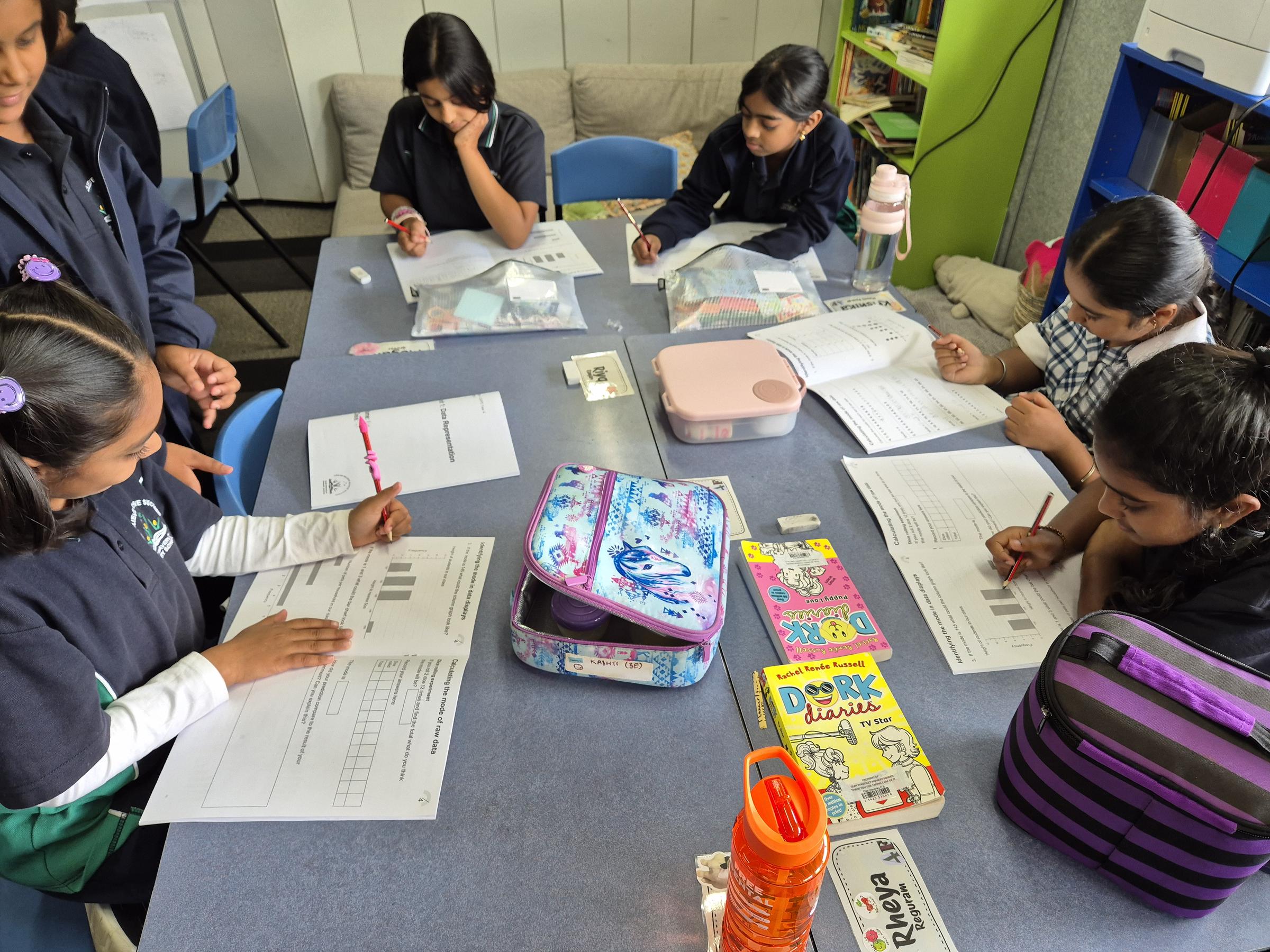
This term, we continue to embed Ochre Mathematics across the school, an explicit teaching approach that supports students to strengthen and retain their mathematical understanding throughout the year through the gradual release of responsibility. The students experience this during lessons as the ‘I do, We do, You do’ structure. Using Daily Reviews and planned opportunities for revision, this approach reinforces key concepts and promotes long-term learning. Ochre Mathematics is aligned with the Science of Learning, drawing on evidence-based research to support how students best acquire and consolidate new knowledge.
During Term 1, students will focus on developing their understanding of the following mathematical concepts:
- Data Representation
- Factors and Multiples
- Multiplication and Division
- Perimeter and Area
These focus areas will support students in building strong foundational skills and applying their mathematical thinking with increasing confidence across a range of learning contexts.
Key Vocabulary:
Data Representation | Factors and Multiples | Multiplication and Division | Perimeter and Area |
Box plot Data Graphs Label Scale Axis Frequency Interpret | Common factor/multiple Prime number Composite number Divisible | Product Quotient Remainder Distributive property Commutative property | Length Width Height Square units Formula |
How can you support your child’s Mathematics learning at home?
Data Representation:
Create a family survey: Have children collect data on family preferences (e.g., favourite meals or movies) and represent the results using bar graphs or pie charts.
Analyse real-world data: Look at weather forecasts, sports statistics, or grocery receipts and discuss how the data is represented.
Factors and Multiples:
Play number games:Use a deck of cards or dice to identify factors or multiples of a chosen number. For example, roll two dice, multiply the numbers, and find all factors.
Multiplication and Division:
Practice with real-world problems: Use grocery shopping or cooking to practice multiplication and division (e.g., calculating the total cost of multiple items or dividing a recipe).
Perimeter and Area:
Build with blocks: Use building blocks or LEGO to create shapes and calculate their perimeter and area.
Inquiry
Question:
How do we share our planet?
Global Goal 15: Life On Land
This term, students will engage in the Inquiry unit How do we share our planet? which centres on developing an understanding of shared responsibility for the Earth and the ways people are connected through their environments. The unit is framed around the United Nations Global Goal 15: Life on Land, with a focus on protecting ecosystems, conserving biodiversity, and considering how human actions impact the natural world.
Through this lens, students will explore the importance of sustainability, ethical decision-making, and collective responsibility in caring for land-based environments.
The learning journey begins with a geographical focus, where students investigate continents, countries, climates, and their distinctive features. Students will examine how humans adapt to different climates and environments, considering how cultures and communities respond to the challenges and opportunities presented by the land. Connections will also be made to Australia’s place in the world, including shared environmental issues such as land management, conservation, and the protection of native habitats.
As the unit progresses, students will explore how communities respond to geographical and environmental challenges that affect life on land, including natural disasters, urban development, and environmental degradation. Students will identify ethical issues linked to these challenges, consider different perspectives, and explore how values and beliefs influence decision-making. These discussions will support students to reflect critically on their own viewpoints while developing respect for the perspectives of others.
In the later stages of the unit, students will examine ethical responses to environmental issues related to Global Goal 15, such as deforestation, habitat loss, and land degradation. Through the analysis of case studies, students will investigate how communities locally and globally have responded to these issues and evaluate the effectiveness and consequences of different actions taken to protect land-based ecosystems.
The unit concludes with an opportunity for students to apply their learning in a meaningful way. Students will identify an issue connected to Life on Land, such as bushfires, land clearing, or biodiversity loss, and propose an informed and ethical response. Through persuasive writing and presentations, students will advocate for positive action, demonstrating an understanding of how individuals and communities can contribute to the protection of the natural environment.
By the end of the unit, students will have developed a deeper understanding of humanity’s responsibility to care for the land and the ethical considerations that guide sustainable practices. Students will have the opportunity to present their learning and proposed actions, showcasing their ability to think critically, act responsibly, and inspire positive change.
Key Vocabulary:
Geography: The study of the Earth's physical features, climates, and how humans interact with them.
Sustainability: Meeting current needs without compromising the ability of future generations to meet their own needs.
Climate: The typical weather conditions in a particular region over a long period.
Adaptation: Changes made by humans, plants, or animals to survive in a specific environment.
Interconnectedness: The way people, countries, and systems are linked and depend on each other.
Ethics: Principles that guide decisions about what is right or wrong.
Perspective: A particular way of thinking or viewing something based on values and experiences.
Challenge: A difficulty or problem that requires effort and decision-making to overcome.
Global Goal: Objectives set by the United Nations to create a better and more sustainable future for all.
Deforestation: The clearing or thinning of forests, often for agriculture or development.
Coral Bleaching: The loss of colour in coral reefs caused by changes in ocean temperatures or conditions.
Urbanisation: The increase in the number of people living in cities and urban areas.
- Action Plan: A detailed proposal for achieving a specific goal or solving a problem.
How can you support your child’s Inquiry learning at home?
Discuss Key Vocabulary and Concepts
Parents can engage their children in conversations about the key vocabulary from the unit, such as geography, sustainability, and ethics. Encourage them to explain these terms in their own words and relate them to real-world examples.
Explore Global and Local Issues Together
Read news articles or watch documentaries about topics like deforestation, coral bleaching, or rising sea levels. Discuss how these issues affect both local communities and the world and talk about ways people are working to address them.
Encourage Ethical Thinking
Present real-life scenarios related to environmental challenges and ask questions like, “What would you do in this situation?” or “What do you think is the most ethical choice and why?” This helps children practise forming and justifying their ethical perspectives.
Support Creative Problem-Solving
Help your child brainstorm solutions to environmental problems they are passionate about, such as reducing waste or protecting wildlife. Guide them in creating an action plan and encourage them to think about how these actions align with the Global Goals.
Wellbeing
The Resilience Project
During Term 1, students will participate in The Resilience Project, an initiative that supports the development of emotional awareness and personal resilience through explicit, practical learning experiences. The program centres on three foundational concepts (Gratitude, Empathy and Mindfulness) which support students in understanding and regulating emotions, forming positive relationships and approaching challenges with confidence and optimism.
Across the term, students will take part in a range of structured activities that embed these concepts into everyday classroom practice. They will be encouraged to recognise and express gratitude, consider and respect the feelings and viewpoints of others, and practise mindfulness strategies that promote calmness and focus during challenging moments. Through regular routines, reflections and discussions, students will be supported to strengthen their emotional wellbeing.
Families are also able to access further information through The Resilience Project at The Resilience Project at Home Hub.
Cyber Safety Project
In Term One, our Year Four learners are continuing their extremely important learning in the area of safety online through participation in the Cyber Safety Project. Through an overarching theme of responsibility, they will be exploring the world of safety and security, including understanding who they may find online and how that plays into the range of personal, private and public spaces on the internet. Students will also look at how passwords keep certain spaces safe and build a practical understanding of how to create stronger online security, as well as understanding what to when things may go wrong or feel uncomfortable.
Key Vocabulary:
Resilience: The ability to recover quickly from difficulties and adapt to challenges with a positive mindset.
Gratitude: The practice of being thankful and appreciating the good things in life.
Empathy: The ability to understand and share the feelings of others, showing kindness and consideration.
Mindfulness: The practice of staying present and fully engaging in the current moment, often used to reduce stress and improve focus.
Emotional Intelligence: The ability to recognise, understand, and manage one's emotions, and the emotions of others.
Digital Citizenship: The responsible and ethical use of technology and the internet, including respecting others online.
Privacy: The right to control personal information and ensure it is kept secure from others.
Cyber Safety: The practice of protecting oneself and others from risks when using the internet and digital devices.
Digital Footprint: The trail of data and information a person leaves behind when using the internet.
Self-regulation: The ability to manage one's emotions, behaviour, and reactions in different situations, especially under stress.
Wellbeing: The state of being comfortable, healthy, and happy, both physically and mentally.
How can you support your child’s Wellbeing learning at home?
Encourage Daily Gratitude Practices
You can help your child build a habit of gratitude by encouraging them to reflect on one thing they are grateful for each day. This could be shared during family meals or written down in a gratitude journal. This simple practice will help your child focus on the positive aspects of their day and build a more optimistic mindset.
Model Empathy and Active Listening
You play an important role in helping your child develop empathy. By modelling how to listen actively and respond thoughtfully to others, you can show them the value of considering other people’s feelings. Discuss real-life situations where empathy makes a difference and even try role-playing different scenarios to help them practise these skills at home.
Promote Mindfulness and Calmness
You can guide your child through simple mindfulness activities like deep breathing exercises or moments of calm during their daily routine. Helping them practice staying calm, focused, and present will be especially beneficial when they’re feeling stressed or overwhelmed.
Discuss Digital Safety Practices
As your child begins using Chromebooks in class, it’s important to reinforce the importance of digital safety at home. Discuss responsible online behaviour, the importance of respecting others, and keeping their personal information private. Setting clear guidelines for screen time and encouraging safe online choices will help them use technology in a responsible and secure way.