
Assistant Principal's Report
Katrina Spicer - Mental Health, Wellbeing and Inclusion.
Assistant Principal's Report
Katrina Spicer - Mental Health, Wellbeing and Inclusion.
Our Term 2 Reward Options have been selected by our school and house captains. Students will use the tokens they receive for demonstrating our school's expected behaviours, to vote for an end of term reward.
Students can vote for:
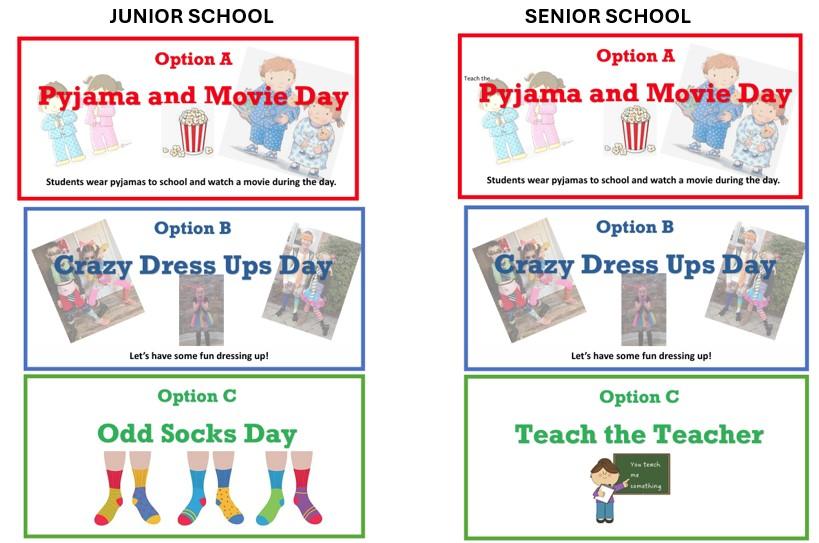
These rewards will be held during the last week of term 2.
At Wheelers Hill PS, we pride ourselves on educating the ‘Whole Child’. This means that not only do we highly value academic success, but we equally value Wellbeing and Social and Emotional Learning. Social and Emotional Learning (SEL) is embedded in the Victorian Curriculum through the Personal and Social Capabilities, but we enhance this learning through programs such as The Resilience Project, School-Wide Positive Behaviour Support and Restorative Practices. Through these programs, we aim to develop each student’s Emotional Intelligence.
For many years, IQ was viewed as the primary determinant of success. People with high IQs were assumed to be destined for great things and high achievement. However, some critics began to realise that this was not necessarily true and that there were other factors that influenced a person’s ability to succeed in life. It is now almost universally agreed that Emotional Intelligence is more important to attaining career and personal success than IQ.
IQ (Intelligence Quotient) represents abilities such as:
Quantitative reasoning
EQ (Emotional Quotient) is centred on abilities such as:
Relating to others
Inter-personal skills and the ability to manage one’s own emotions help us to better understand, empathise and negotiate with others.
There are five categories of Emotional Intelligence: Self- Awareness, Self-Regulation, Motivation, Empathy and Social Skills.
Self-Awareness:
The ability to recognise an emotion as it happens is the key to Emotional Intelligence. If you can identify your emotions, you can learn to manage them.
Self-Regulation:
We often have little control over when we experience emotions, but we can learn to manage the emotions we feel. We can all teach our children strategies that can help them to manage impulses, take responsibility for their actions and to learn to adapt to change.
Motivation:
Having clear goals and a positive attitude helps enormously with motivation. Although some people may have a predisposition to a negative attitude, it is possible to train the mind to think more positively.
Empathy:
The ability to recognise how other people feel is important to success in your life and career. Empathy helps with anticipating, recognising and meeting others’ needs and discerning the feelings behind the needs and wants of others.
Social Skills:
The development of good interpersonal skills is tantamount to success in life. ‘People skills’ are even more important now in this inter-connected world where communication takes place across platforms and across oceans. The ability to ‘sense’ how others are feeling, how to work as a leader or as part of a team, conflict resolution and effective communication skills are all essential skills that people with a high EQ possess.
Further reading:
Katrina Spicer
Assistant Principal for Wellbeing and Inclusion
katrina.spicer@education.vic.gov.au

By Dr Justin Coulson
What if everything you though you knew about resilience was... wrong? Or at least incomplete?
Resilience, to many, means when the going gets tough, the tough get going. If you're resilient, you go solo with that individual grittiness, push through the pain, and get it done. It's perseverance. It's getting up when you get knocked down. It's drinking some concrete and hardening up.
Perhaps this is true - sometimes. But experience and research point profoundly towards a different story: Resilience is relational.
What does this mean?
My personal trainer recently asked me to do a plank and push through two minutes of this horrible exercise. By 60 seconds, I wanted to stop. I was shaking. I felt uncomfortable. It hurt. But then I heard his voice: "Nice! You're halfway there. Only 60 seconds to go.
I steadied my self and pulled it together. By 90 seconds I was pretty sure I was done. Everything hurt. Then his voice: "You're doing super well. Super strong. Just 30 seconds left."
With 15 seconds to go I wanted to give up. I was making strange noises, gasping for air, and trying to tell him I hated him (but I couldn't form the words). "So close now. You're doing it. Let me count you down... 10, 9, 8, 7, 6, 5, 4, 3, 2, 1."
I collapsed. He high-fived the air because I couldn't lift my arm. And then I realised: while I was the one who did the exercise, he was the one who helped me show resilience. I would have quite at the halfway point without him. Resilience is relational.
The Research Backs This Up
Emmy Werner's groundbreaking Kauai Longitudinal Study followed 698 children born in 1955 for over 40 years. About 30% of these kids faced serious adversity - poverty, family discord, parental mental illness, perinatal complications, unemployment, drug-and-alcohol abuse. Two-thirds of these children struggled, just as you might predict. But one-third thrived despite the odds.
What mad the difference? Werner identified three clusters of protective factors, but relationships were woven through all of them:
It wasnt' their toughness or independence that saved them. It was... connection.
What This Means for Parents
The plank story isn't a parenting story. But the application is all about parenting. When your child can't do a maths problem, write an essay, read a tricky word, tie a shoelace, clean up a messy room, or figure out that difficult stanza in the song she's learning, telling them to 'toughen up' and figure it out themselves is precisely the opposite of what we ought to do.
Instead, remember resilience is relational. You are more likely to push through hard things when someone is there to support you. This doesn't mean doing it for them. My trainer didn't hold my plank position for me. But his presence, his voice, his belief in me kept me going.
When your child is struggling:
I know that some of you are thinking "I sit with my child and try to support them through their spelling or their cleaning up (or whatever it is) and they don't make progress. They just wail and complain and tell me they can't."
That's life sometimes. Here's what I know though. Once these emotions have calmed down, your support will bring them back for another bite at the cherry. They'll keep going when they've got someone in their corner. Be that strength when they don't have their own.
The Takeaway
Real resilience isn't forged in isolation. It's built through connection. So the next time your child faces something hard, don't step back. Step closer. Be their personal trainer. Count them down. High-five the air when they can't lift their arm. That's how resilience is built.. Together. One caveat: this only works when the struggle is worthwhile. Suffering through busywork "because it's on the curriculum" isn't resilience, it's just suffering. Your kids don't have to be resilient about everything.Be aware of what matters and what doesn't. But when the challenge matters? That's when you matter too.
