
Health | Parent Support

Keeping the Conversation Going with Teenagers
Kirsty Knight - Speech-language pathologist at The Gap SHS
Connecting with teenagers can sometimes feel challenging, particularly when questions are met with “fine”, “good”, or a shrug of the shoulders. While this is a very normal part of adolescence, maintaining connection and open communication remains incredibly important.
Parenting experts such as Maggie Dent remind us that connection often grows through small, everyday moments rather than big conversations. Teenagers are often more likely to talk when they feel relaxed and not under pressure. Some of the best conversations can happen:
- in the car
- while walking the dog
- during sport or cooking
- late at night
- side-by-side rather than face-to-face
Maggie Dent also speaks about the value of using “door openers” which are simple comments that invite conversation without pressure. Examples include:
- Tell me more about that.
- That sounds tough.
- Now that’s interesting.
- I’m here if you want to chat.
- Sounds like you’ve had a big day.
Other helpful communication tips include:
- listening without immediately trying to “fix” the problem
- avoiding too many questions in a row
- showing curiosity rather than judgement
- sharing small stories about your own day
- noticing effort, not just achievement
- keeping conversations short and natural rather than making them feel like a formal check-in
Perhaps most importantly, teenagers benefit from knowing trusted adults are available to listen when they are ready to talk. As Maggie Dent says, “Connection before correction” is often one of the most powerful tools we have with teenagers.
From a communication perspective, regular low-pressure conversations and shared moments help support teenagers’ confidence, language, emotional expression, and connection with the important adults in their lives. Good luck, and remember that even short, everyday interactions can have a powerful impact over time.
Ideas in this article were inspired by the work of Maggie Dent and contemporary research on adolescent connection and communication.
Why self-care is important, but not enough
Looking after yourself matters, but lasting happiness comes from something deeper.

Self-care has become a modern obsession. We’re encouraged to optimise our sleep, upgrade our morning routines and carve out more time for mindfulness, exercise and personal growth. None of this is bad advice. Looking after our own wellbeing matters enormously. But there’s something missing in our relentless pursuit of wellness.
When we treat wellbeing just as a personal project, something vital gets lost. The deeper truth – supported by both science and everyday experience – is that lasting happiness comes from combining self-care with caring for others.
Looking after ourselves gives us the capacity to support those around us. And when we help others, we discover a sense of meaning and connection that no amount of self-focused striving can provide. Happiness isn’t just something to pursue by ourselves, it’s something we create together.
Self-care as a foundation
Of course, this doesn’t mean self-care isn’t important. Learning to look after ourselves is a vital foundation for a good life. When we pay attention to our mental and physical wellbeing – getting enough rest, moving our bodies, noticing our thoughts and managing our emotions – we become more resilient and better able to cope with whatever life throws at us.
For many of us, this kind of inner work is long overdue. We’ve spent years running on autopilot, trying to live up to expectations and pushing through stress without pausing to recognise our own needs. Taking time to reflect, reset and build healthier habits can be genuinely transformative.
When we feel exhausted, overwhelmed or stuck in our own worries, it’s much harder to show up well for others. As the saying goes, you can’t pour from an empty cup.
Looking beyond ourselves
What’s missing from much of the conversation about wellbeing is the outward dimension. If we focus only on feeling better ourselves, we can end up trapped in self-absorption – constantly analysing our thoughts and chasing the next improvement.
Yet the more we focus just on our own happiness, the more elusive it can become. Modern research and ancient wisdom both point to something deeper. One of the most reliable ways to feel better is not to look inward, but to look outward.
When we do kind things for others – offering support, really listening or helping without expectations – it doesn’t just benefit the other person, it changes us too. We feel more connected and more purposeful. That’s what I experienced when my daughter and I started our weekly Friday delivery runs, collecting surplus food from nearby supermarkets and taking it to our local food bank.
Why helping makes life happier
There’s something profound here about what it means to be human. For all our emphasis on individualism and self-sufficiency, we’re fundamentally social beings.
Our wellbeing is closely tied to how connected we feel to others. We don’t just need security – we need belonging, shared aims and a sense that we matter. This is why generosity, empathy and togetherness can have such powerful, positive impacts.
When we take time to offer support or do something thoughtful, our attention shifts away from our own worries and towards something larger. People who regularly help others tend to report higher levels of happiness and life satisfaction. Acts of kindness boost our mood, reduce our stress and strengthen our connections. So our selfless acts turn out to be mutually beneficial.
The Dalai Lama expresses this beautifully:
“If you want others to be happy, practice compassion. If you want to be happy, practice compassion.”
Sadly, this runs counter to many of the messages we absorb every day. From a young age, we’re taught that success is about getting ahead of others. At school, it’s about grades and rankings. At work, it’s performance and competition. In consumer culture, it’s status and accumulation. The underlying story is that life is a ‘zero-sum’ game.
Thankfully this story is flawed and we’re more interconnected than we’re led to believe. When we support each other, trust grows and our kind acts ripple outwards. People who feel more connected are more likely to contribute positively to the world around them. They join in with local projects and campaign together for causes they believe in. So life becomes a ‘positive-sum’ game.
The positive feedback loop
Self-care and caring for others aren’t competing priorities, they’re intertwined.
When we take care of ourselves, we build the inner resources we need to show up well in the world. We’re calmer, less reactive and have more capacity to give. And when we use that capacity to support others, we experience a deeper sense of contentment.
So rather than being a trade-off, this is a positive feedback loop. Inner care creates the conditions for outer care. And helping others brings the meaning that makes life more worthwhile. Each strengthens the other.
The key is balance. Self-care isn’t selfish – unless that’s all you do. And caring for others isn’t a sacrifice when you have a healthy relationship with yourself. The big opportunity is to bring these two together. You can look after your own wellbeing not as an end in itself, but as a foundation for how you show up. And you can consciously care for others not out of obligation, but as a natural part of a fulfilling life.
When these two aims come into alignment, life feels less like a solo pursuit and more like a shared adventure. We’re not chasing a wellness fad, we’re choosing a life mission. So our inner quest subtly changes from “How can I be happier?” to something more expansive: “How can I make life happier, for myself and others?”
Circles of care
Above all this is about caring. Caring for ourselves, so we can cope well with the challenges of everyday life. Caring for others, so we build warm relationships and support each other. And caring for this precious world we all share together.
This way of living shapes how we show up each day in our homes, workplaces and communities. It’s understandable to feel overwhelmed by the scale of the challenges we face all around us. But we don’t need to fix everything to play our part.
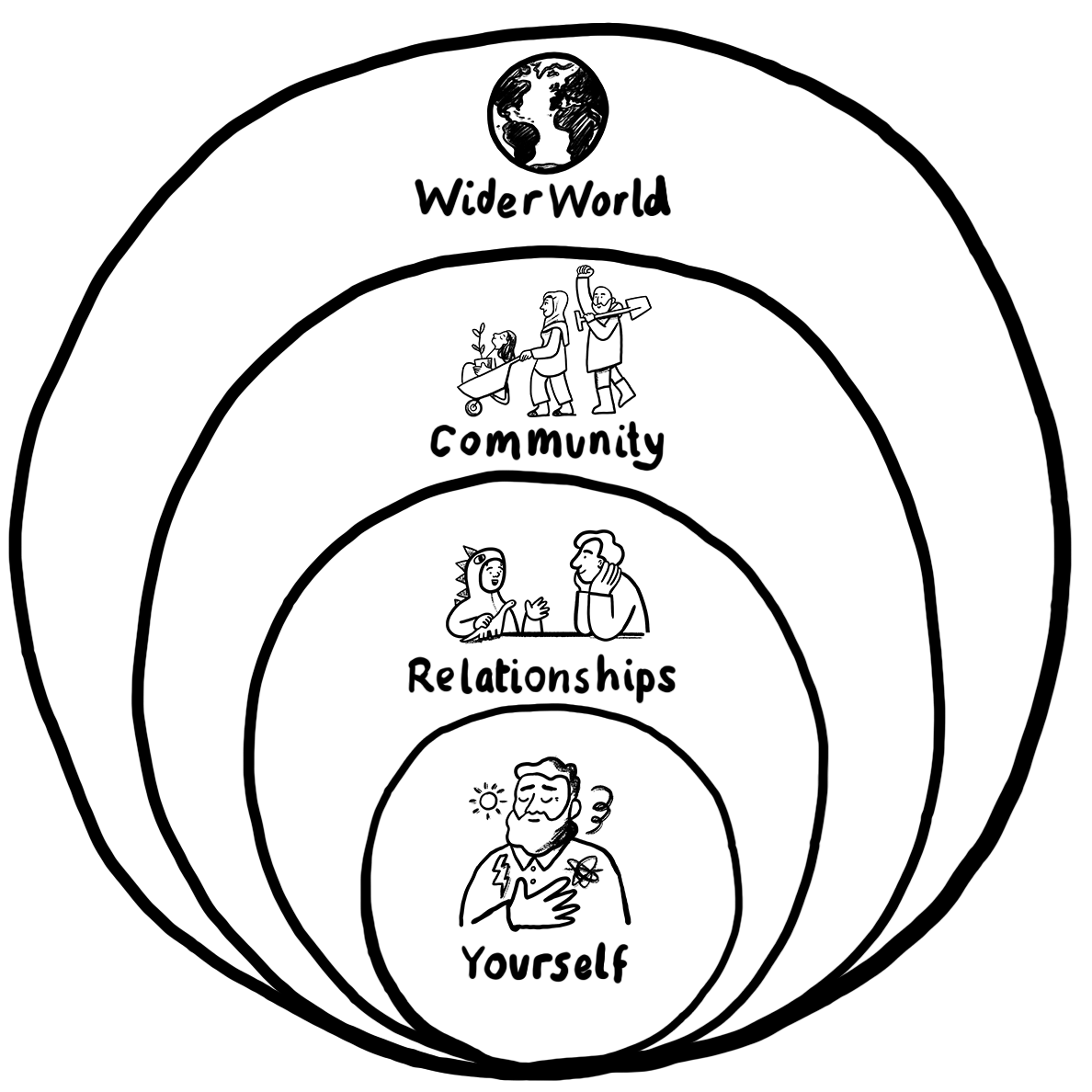
You can think of this is in terms of four concentric circles.
- The first circle is yourself – looking after your own wellbeing is the foundation. When you feel happier inside you’re better placed to look outwards.
- The next circle is your relationships – especially the people close to you. Through listening, warmth and authenticity, you can build healthy and stable relationships.
- Beyond that is your community – your workplace, neighbours and wider circles. By giving your time and getting involved you encourage trust and togetherness.
- Finally, there’s the wider world – the choices you make as a citizen, consumer or campaigner. You can contribute in countless small but meaningful ways.
We can’t do everything, but we can always do something.
Each kind word, each moment of patience, each small act of friendship or generosity. Those small actions repeated over time build momentum and ripple outwards. They shape conversations and shift attitudes. And we discover that life is more rewarding when we’re part of something bigger than ourselves.
So the real aim isn’t to feel better, but to live better together. When we take care of ourselves, we make life happier for others. And when we take care of others, we make life happier for ourselves too.