Learning Area News
Foundation
In Literacy, we have been exploring the letters 't' and 'a' and the sounds that they make. Students have enjoyed identifying words that begin with each sound and coming up with their own creative examples. We have also been practising the correct, lower-case letter formation of these letters, using both whiteboards and paper to strengthen writing skills.
In Numeracy, we have been using a range of concrete materials and visual representations to count, represent and subitise collections up to 10.
In Religion, our topic is, ‘Lent and Easter’. Students have been exploring the significance of Lent and Easter and will develop an awareness of signs and symbols associated with Lent and Easter.
In Inquiry we have been learning about our school rules:
1. Be on time & ready to learn
2. Wear the school uniform correctly (hats in Terms 1 & 4)
3. Behave safely & respectfully
4. Follow instructions
5. No smart devices
At home you could reinforce learning by:
- Read a story with someone at home.
- Practise writing your name with a capital letter at the start, followed by lower case letters (we may need an adult to assist/model this).
- Practise writing the letters ‘a’, ‘s’, ‘m’, and ‘t’ using lower case letters.
- Recite the days of the week.
- Count collections of objects around your home using one to one counting. Challenge yourself by identifying the new total when one more is added to your total. For example, one more than 4 is 5.
Year One
In Literacy, we have been learning about verbs. We have been learning that every sentence must have a verb. We have been generating sentences using who, action, object and where to create a complete sentence. We have been learning about the spelling choices for ee and ea words.
In Numeracy, we have been learning about counting and place value. We have been using 100s charts to count forwards and backwards and locate missing numbers. We have been making 3-digit numbers using MAB and ordering the numbers from smallest to largest.
In Religion our topic is ‘Lent and Easter’ we are learning that Lent as a special time in the Church. We have discussed the important signs and symbols associated with Lent and Easter.
In Inquiry our topic is History. We have designed and started to make a model town of Shepparton. Their designs are looking amazing!
At home you could reinforce learning by:
Literacy
- Practice reading and spelling our tricky words your, again and home.
- Listening to your child read each night.
Practice writing a sentence using the connector words 'but & and' to expand a sentence.
Numeracy
- Practise counting by 1's, 2's and 10's to one hundred.
- Pick a number under 100 and practice what number come before and after this number.
Year Two
In Literacy, we have been revising spelling choices using ‘igh', ‘_y’, ‘ i_e’ and ‘ow’, ‘oa,’ ‘o_e’.
The students have been orally sounding out and spelling words using these sounds.
In Numeracy, the students have been exploring turning quarter, half, three quarters and full turns in both clockwise and anticlockwise direction using clocks and shapes. The students have been introduced to calendars and have learnt about number of days between different dates on the calendar.
In Religion our topic is ‘Lent and Easter’ we are learning about the meaning of Holy Week and it's key days and symbols.
In Inquiry we have been learning about different ways to communicate. Students are learning to explain how communication changed with the invention of printing, postal services, the telegraph, telephone, and radio. The students have started to make their own paper radios.
At home you could reinforce learning by:
Literacy
- Practice reading and spelling our tricky words (caught, who, people, something, ask, why).
- Write a list of words with the spelling sound ígh', ‘_y’ and ‘í_e’spelling choice in words.
Listening to your child read their reader each night.
Numeracy
1. Practise turning an object in clockwise and anti-clockwise direction.
2. Draw a simple shape and practise turning it a quarter, half, three quarter and full turn in both directions.
3. Look at a calendar and talk about how many days there are from one date to the next date.
Year 3
In Literacy, we are beginning our new class text “Off We Go Around Australia”. This book will help introduce our new focus on explanatory texts, where students learn how to clearly explain information to the reader. Over the next two weeks students will be planning and writing their own explanatory text, beginning with a clear introduction and then developing a detailed body paragraph.
During SpellEx, students are continuing to develop their understanding of prefixes, base words and suffixes, learning how these word parts combine to build meaning. We are also exploring digraphs and homophones to strengthen spelling and word knowledge.
In Numeracy, we are beginning our new topic of Multiplication and Division. Students are learning to identify arrays and understand how rows and columns represent multiplication. Through hands-on activities we are exploring how multiplication and division are related and how arrays help us visualise these number relationships.
In Religion, we are continuing our Lent unit and focusing on Holy Week. Students are learning about the important events that occurred during this week and why it plays such a significant role in the Catholic calendar.
In Science, we have begun exploring Gravitational Forces. Students are learning about how gravity works and investigating the gravitational pull of both the Earth and the Sun, helping them understand how gravity affects objects and movement in our solar system.
Some homework activities could include:
Array builder:
Use small objects at home (lego, coins, pasta). Make arrays such as 3 rows of 4 or 2 rows of 6 and write the matching multiplication sentence.
Around Australia research:
Choose one Australian place you would like to visit. Write 3 interesting facts about it and explain why people might visit there.
Homophone hunt:
Find pairs of homophones (e.g., their/there, to/too/two). Write one correct sentence for each word.
Word builder challenge:
Create new words using prefix + base word + suffix (e.g., un + help + ful). Explain what the word means.
Gravity investigation:
Drop two safe objects from the same height (e.g., paper and a coin). Predict which will land first and explain what happened.
Reading fluency practice with a familiar text:
First read: Student reads once (adult tracks any tricky words).
Second read: Student reads again aiming for smoother reading.
Third read: Student reads with expression and pauses at punctuation.
Handwriting practice:
Practise neat, joined handwriting using horizontal joins between letters.
Year 4
Our Year 4 students continue to demonstrate great focus and enthusiasm in their learning. As we move further through the term, it has been wonderful to see students building confidence in their reading, writing, and mathematical thinking. They are becoming more independent learners who are willing to challenge themselves, ask thoughtful questions, and take pride in their progress.
Below is an overview of what we have been learning in English and Mathematics, along with some activities you can try at home to support these skills.
English
This week, we have begun reading our new class novel Leo and Ralph. Students are enjoying exploring the story and developing their comprehension skills as they follow the characters and events. Through our reading, we are discussing character actions, making predictions, and identifying important details within the narrative.
In writing, our focus has shifted to narrative writing. Students are learning how to create engaging stories by developing characters, organising events clearly, and using descriptive language.
At the sentence and grammar level, we have been focusing on:
- Direct speech and how dialogue is written in stories
- Independent and dependent clauses
- Writing clear sentence summaries to capture the main idea of a paragraph or section of text
These skills are helping students strengthen both their reading comprehension and their ability to write more detailed and structured narratives.
English Activities to do at Home
1. Direct Speech Practice (10 minutes) Ask your child to turn a simple sentence into direct speech.
Example: Leo was excited about the race.
Rewrite it as dialogue: “I can’t wait for the race!” said Leo.
Encourage them to:
- Use quotation marks
- Include who is speaking
- Add expression or emotion
2. One-Sentence Summary Challenge
After reading a short paragraph from a book, ask your child:
“Can you summarise this in one clear sentence?”
This helps them practise identifying the most important idea and expressing it clearly.
Mathematics
In Mathematics, we have now completed our Time unit. During this unit, students strengthened their understanding of:
- Reading time on analogue and digital clocks
- Calculating elapsed time
- Solving real-life time problems
We have now begun our new unit on multiplication and division.
A key focus is understanding how arrays can help us visualise multiplication and division. Arrays allow students to see how numbers can be organised into rows and columns, helping them build stronger number sense and problem-solving strategies.
Students are also working on developing fluency with their 3, 4, 5, 6, 7, and 8 times tables, which will support them in solving more complex multiplication and division problems.
Maths Activities at Home:
1. Array Builder
Give your child a multiplication fact such as 4 × 6.
Ask them to draw an array with:
- 4 rows and 6 columns or
- 6 rows and 4 columns.
Discuss how both arrays show the same total.
You can also use small objects (coins, pasta, LEGO pieces) to build the array physically.
2. Times Table Quick Challenge
Choose a times table (3–8) and challenge your child to answer 10 quick questions.
Example:
- 3 × 7
- 6 × 4
- 8 × 5
Encourage them to explain how they worked it out, especially if they use strategies such as skip counting, doubling, or breaking numbers apart.
Thank you for your continued support at home. It is wonderful to see the students continuing to grow in confidence and independence as learners, and we look forward to more exciting learning experiences in the coming weeks.
Year 5
A word from the Year Five Team
We have had a busy two weeks with NAPLAN being the buzz word. Whilst we had a slight hiccup to start with all went smoothly and our children did their best as they wrote a narrative in 50 minutes, answered comprehension questions on various readings, tested their spelling, punctuation and grammar skills and ended up making their way through 42 numeracy questions. Well done boys and girls for an amazing effort. Results will come out later in the year with each children receiving a written summary of their results. We will keep you updated when these come in.
War Horse, our class novel has come to an exciting climax, and we have been enthralled by the events of Joey and Albert as they navigated World War One. We are currently writing persuasive texts with the prompt Should horses have been used in World War One. We have some great points of view with excellent argument to support their opinions. These will be published using our new laptops which the children are so excited to use.
In mathematics we have been focusing on Multiplication and Division, exploring a variety of strategies and algorithms to solve problems. We know that the product is the answer to a multiplication problem. Do you know what the answer to a division problem is? Ask your child as they should!
Space is our current science topic, and we are exploring galaxies, black holes and the planets. In humanities we are concluding our study ‘Australia in the 1800’s’ as we are now completing a project on life in Australia as a free settler, convict or First Nations Person. The children have chosen which of the three they wish to create a diary, timeline or story board detailing life as a person form t eh 1800’s.
We continue to encourage our children to read each night for 20 minutes and spend 10 minutes each school night practicing their number facts – times tables. In class we have been focusing on the 8’s and 9’s.
Have great fortnight.
The Fabulous Year Five Teaching Team
Year 6
What's Been Happening in Year 6?
Literacy
In Literacy, we have been completing our persuasive writing, starting a new novel called “The Silver Donkey” and practicing adding depth to our writing with personification. We will soon begin planning and writing a fable to practice implementing the new writing techniques we’ve been learning.
Numeracy
In numeracy, we have continued to learn about the order of operations and began expanding our understanding of area. Students have been working on creating their own order of operations expressions and using a calculator to apply the order of operations appropriately. Additionally, students have been working on identifying the area of rectangles and composite rectangular based shapes.
Religious Education
In Religion, our topic remains, "How Can Lent Transform our Lives". Students have begun planning out their assessment art piece and accompanying description that will focus on a theme of their choice and the transformation from darkness to light within it using symbols and vocabulary learnt throughout the unit.
Science
In Science, we finished reversible and irreversible changes and have moved onto soluble and insoluble solutions. Students have investigated how heat influences changes for recycling.
Humanities
In Humanities, we have continued learning about the globe. Students have looked at some of the primary connections Australia has with other countries and the benefits of these connections.
At home you could reinforce learning by:
Independent/Guided Reading
It is the expectation in Grade 6 that your child practices reading independently or to a family member for 20 minutes a night minimum. This will help develop good routines for secondary school and reinforce reading fluency. Students are also welcome in the library at 8:30am every day to read to themselves or a staff member.
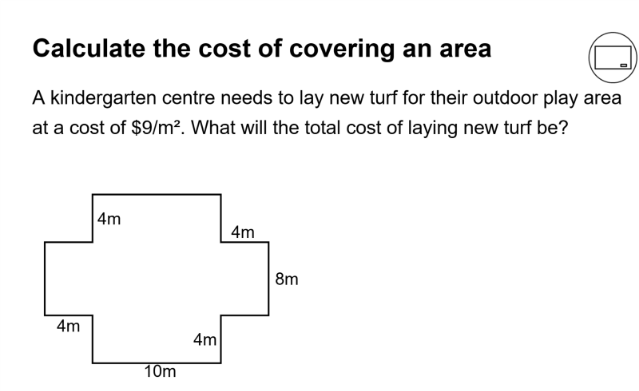
Practicing calculating area.
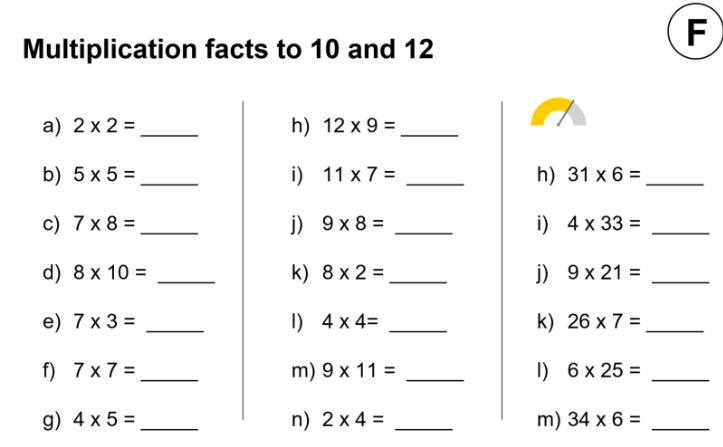
Calculating the area of a space is essential and a highly valuable skill in everyday life. Using the correct units is always an important focus. You can create your own questions by drawing a rectangle and labelling two of the connected sides or complete the following task: