
NAPLAN and Numeracy News
Conchita Thomas
(Mathematics & Assessment Leader)

NAPLAN and Numeracy News
Conchita Thomas
(Mathematics & Assessment Leader)
Dear Year 3 and Year 5 Parents and Carers,
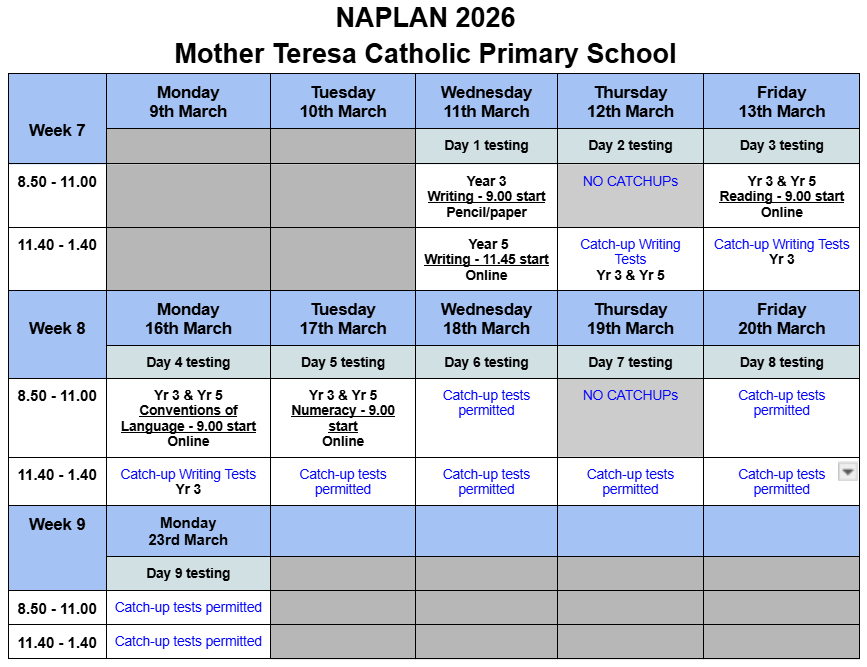
This term, the students in Year 3 and Year 5 will undertake the NATIONAL Assessment Program - Literacy and Numeracy (NAPLAN). It will be held between Wednesday 11 March to Monday 23 March. NAPLAN tests assess student knowledge and skills in Writing, Reading, Language Conventions (spelling, grammar and punctuation) and Numeracy. During the tens days' testing period, test catch up sessions will be made available - where possible - for students who were absent on the testing day.
Please find a link to the NAPLAN 2026 Parent Brochure(معلومات ألولياء األمور ومقدمي الرعاية). For further information about the tests, please visit the VCAA website at VCAA - NAPLAN information for Parentsor the NAP website at www.nap.edu.au.
I have included below, a timetable indicating the days, sessions and starting time for each year level for each test at Mother Teresa:
It was wonderful to see a number of parents from our Prep, Year One and Year Two cohorts attend our first Curriculum Parent Information Session on Monday February 16. In 2025 we began to implement at Mother Teresa, a number of practices, structures and strategies in Mathematics as part of the MACS Vision for Instruction, providing professional learning for our staff. This year, our goal is to provide further clarity for families around those changes, and how you can support your child in light of what is happening at school.
For those who were unable to attend the session earlier this week, here is a short summary of what was outlined in the area of Mathematics:
Myths in Maths
Looking at the latest research in educational psychology and neuroscience we unpacked myths such as:

Anxiety and Maths
We looked at how these myths can contribute towards anxiety for students around Mathematics and why it is important to understand the science around how we learn. These myths can encourage children to think about Maths in a very rigid way. These myths are dangerous because they stop children from putting in effort to improve, and stop putting in the effort to try to learn. Clearing these up can lower the "math anxiety" in the household significantly.
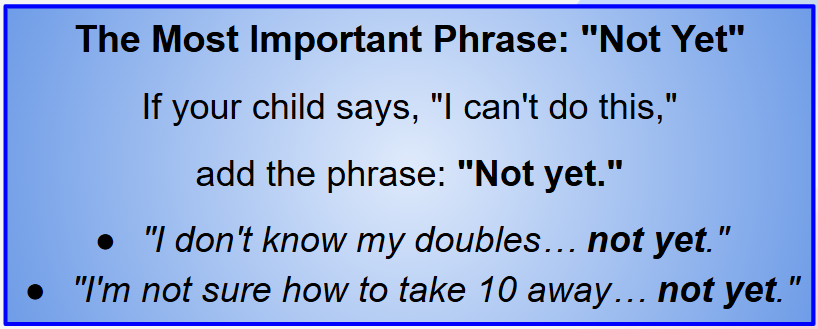
One of the best ways that we can help children and young people is to promote positive attitudes towards Mathematics. We can provide opportunities to calm their emotions or refocus their thinking through mindfulness and breathing; humour; and, imagining a safe place. We can also use the phrase ‘Not Yet’ to reframe the situation:
How we Learn and the Role of Fluency in Maths
Our brains have a limited amount of ‘Working Memory’ (think of it like mental "table space"). If a child spends all their mental energy trying to solve $25 + $14, they have no "space" left to understand the rest of the word problem they are trying to solve.
Fluency means facts and strategies become automatic. This clears the table so they can focus on the big, exciting challenges. Fluency frees up mental space for higher-level thinking. Fluency isn't just "fast counting." It’s the bridge between basic arithmetic and complex problem-solving. It consists of three pillars:
Efficiency: Automaticity in solving $8 + $7
Accuracy: Knowing the right answer
Flexibility: Knowing that $8 + $7 is the same as
$7 + $7 + $1 or $10 + $5
How you can help your child at home
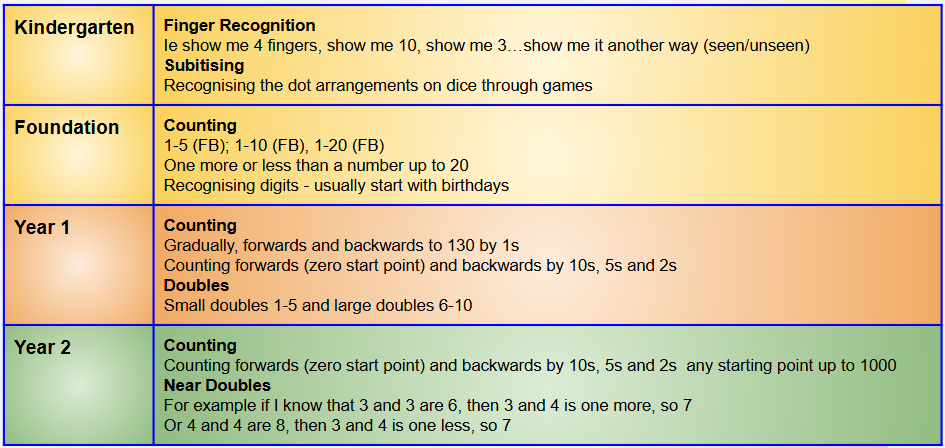
We want children to feel mathematically brave. That happens when they have the tools (fluency) and the mindset (it’s okay to make a mistake) to tackle a challenge. Across the school, we have developed a developmental framework that identifies key skills and strategies for students to develop fluency with. To support that framework, here are some key ones that you can help your child with at home from Kindergarten to Year 2:
Next information session
Please join us for our follow-up Maths and Reading Prep to Year 2 parent information session, where we will look at practical ways that your child can practise at home key mathematical skills, in order to develop fluency, as well as a deeper dive into the world of phonics and how we teach blending and segmenting in the junior classrooms, as earlier outlined in the newsletter by Naomi Glasby.
Where: Open Space (enter through Reception)
We look forward to seeing you there. In the meantime, happy counting!