
Thrive & Flourish

Wellbeing Newsletter
Welcome to Week 6 of Term 2.
For those currently unwell, we hope for a speedy recovery for you.
For those who’ve welcomed a new addition to the family, we extend our warmest congratulations on this happy occasion.
For those families who’ve experienced a recent bereavement, please know you are in the prayers and thoughts of all in our community.
Online Safety:
The eSafety Commissioner (eSafety) is the Australian Government’s independent online safety regulator.
Their purpose is to help safeguard Australians at risk of online harms and to promote safer, more positive online experiences.
eSafety Commissioner: https://www.esafety.gov.au/
As the first agency of its kind in the world, eSafety is at the forefront of preventing online risks, reducing the impacts of harms and building safer digital spaces.
Navigating the digital world, and supporting children to stay safe whilst using technology, is an ever-changing and challenging space for parents. Often, we have many questions, and it can be difficult to get answers or support to help with this.
The eSafety Commissioner Website Australia is an excellent resource for keeping you and
your family safe online. It helps Australians have safer and more positive experiences online.
As of 10 December 2025, many social media platforms are not allowed to let Australians under 16 have an account.

The information on the above page will help you understand why, - and how you can support under-16s to understand the change. (On the eSafety homepage, this appears as a link – click on the ‘learn more’ tab.)
Information available to support parents includes:
*Quick facts.
*Frequently Asked Questions.
*Tools and Updates.
*Talking with under-16’s about age restrictions – videos.
*Explore resources for under-16’s together.
*Health and wellbeing advice.
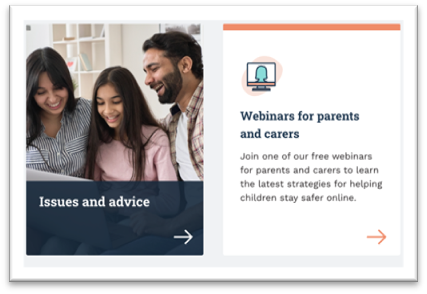
There are free webinars available for parents to help manage childrens’ online interactions.
Online Safety Basics:
Parents can help children safely navigate the online world by taking some basic steps to reduce the risks.
- Get involved with your child’s online activities as a family. Play games together. Talk about favourite apps, games or websites.
- Keep lines of communication open. Ask about their online experiences, who they are talking to and whether they are having any issues.
- Reassure your child they can always come to you, no matter what. Your child may not communicate openly about things that worry them online if they fear being in trouble if they tell you. Let them know you will not cut off internet or device access if they tell you they’re feeling uncomfortable or unsafe online.
- Set rules for devices and online access, with consequences for breaking them. As they grow in online skills and maturity you can review your rules together.
- Get your child’s input – this will help them understand risks.
- Model behaviour that you would like to see. Children will be more likely to follow rules if they see you doing the same.
- Get to know the devices you and your children use and set them up for privacy and online safety.
- Take monitor and control screen time and access to content, based on your child’s age and experience. See our guide to parental controls.
The eSafety website offers support and guidance to give children the knowledge to make sound decisions online and the confidence to ask for help when they need it.
Ref: eSafety Website.
Student Attendance:
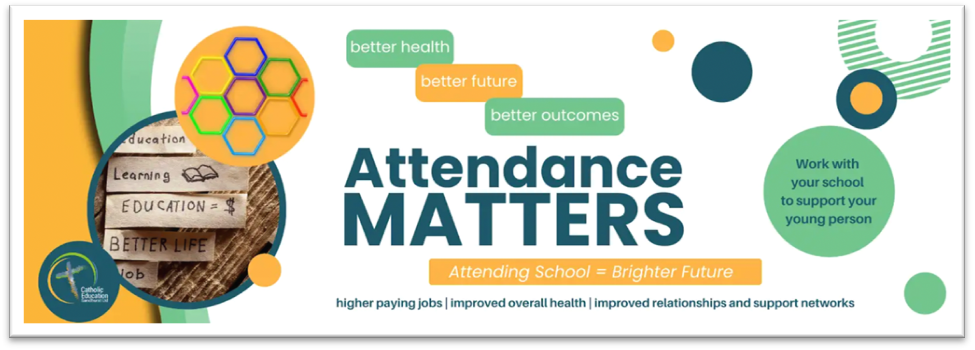
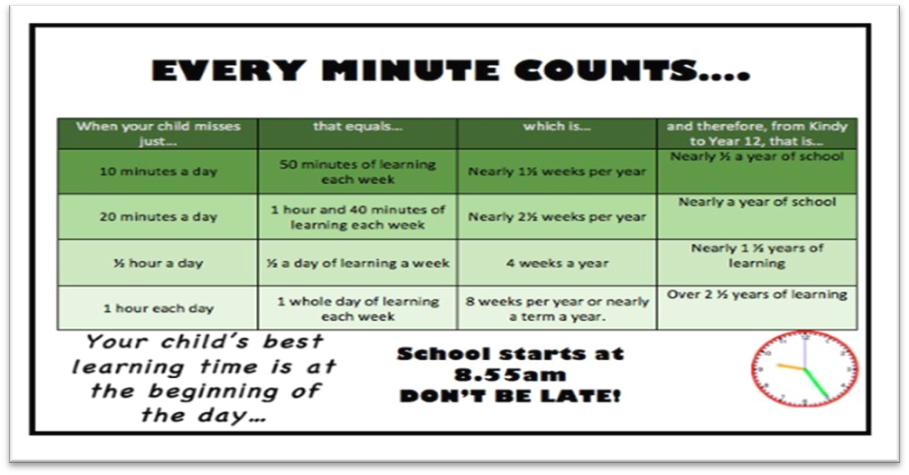
At Sacred Heart, most students come to school regularly and as a result are learning new skills socially, academically and emotionally. This is an expectation and a right that we would like to see enacted for every student.
We know that coming to school on time every day is a necessary condition for learning to occur. Students who attend school every day benefit from all of the support and teacher assistance that is available, and are much more likely to go ahead in their learning.
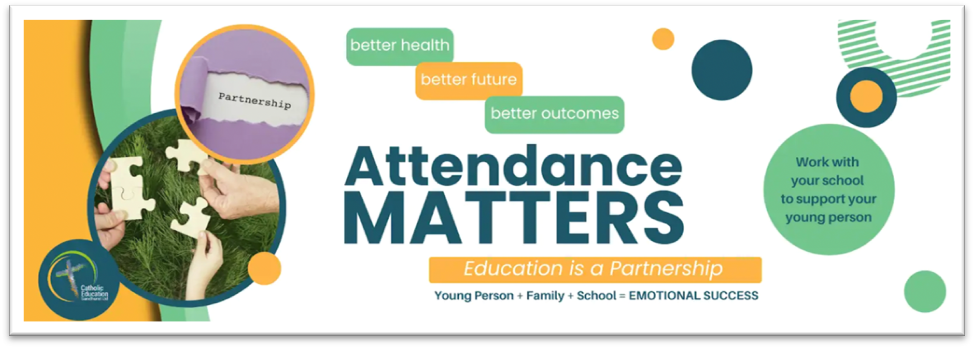
Being ready to begin the day's learning with the rest of the class is also very important and we ask for your support in ensuring that students are in their classes by the beginning of day bell. Being prepared for the day, and starting with peers, encourages a great day of learning and helps with organisational details of the day.
What can I do if my child says they don’t want to go to school?
• Let the child know that being at school is important to you
• Let your child know that you value learning and education. Talk about how being late or regular absences from school can disrupt their learning and limit their choices in the future.
• Keep a regular morning routine. Set the alarm to allow time to get ready.
• Have school uniform, shoes, lunch, hat and everything needed ready the night before school.
• Consider not having the TV or computer games on before school.
• If children appear unhappy, listen to them and help them be honest and objective about what’s happening.
• Show your child you are interested in their school and their schoolwork. Ask them about what they are learning and what they do in class and in the playground.
• Praise effort and their achievements.
• Celebrate their success.
• Show and tell others about what your child does at school.
• Develop a positive relationship with parents and school staff.
• Remain calm! Be firm and quietly say that they are going to school and continue with your usual morning preparations.
• Speak to your child’s teacher, Assistant Principal, Principal or Student Wellbeing Coordinator. This discussion can be confidential (private) and can help the school
to put in place strategies to help.
Please note, Tony will be on leave till the end of term – if you wish to contact the school, please email Jess or Felicity Bryant.
Sacred Heart Response to Bullying and mean behaviour
Our classroom mastery program (which incorporates our behaviour curriculum) together with our PBIS (positive behaviour in schools) framework promotes and teaches expectations so that our students can learn and play in a safe and calm environment. From time-to-time students make errors and engage in behaviour which sits outside our expectations. Behaviour is monitored at school in our classrooms and by staff on duty. When there is unacceptable behaviour, this is addressed using our behaviour frameworks. (More information is available here)
Extreme behaviour can include bullying. It is important that parents are aware of what bullying is and what can be done to report this at our school. Below is an excerpt of our school’s policy on bullying.
Bullying
Bullying is the repeated and intentional behaviour of causing fear, distress or harm towards another person that involves an imbalance of power. It can involve humiliation, domination, intimidation, victimisation and harassment. In any bullying incident there are likely to be three parties involved: the bully, the person being bullied, and bystanders
Bullying can take many forms including:
- Physical bullying which involves physical actions such as hitting, pushing, obstructing or using an object to hurt or intimidate someone. Damaging, stealing or hiding personal belongings is also a form of physical bullying.
- Psychological bullying which is when words or actions are used to cause psychological harm. Examples of psychological bullying include name calling, teasing or making fun of someone because of their actions, appearance, physical characteristics or cultural background.
- Indirect bullying which is when deliberate acts of exclusion or spreading of untrue stories are used to hurt or intimidate someone.
- Cyberbullying which is the ongoing abuse of power to threaten or harm another person using technology. Cyberbullying can occur in chat rooms, on social networking sites, through emails or on mobile phones.
What Is not Bullying
There are many negative situations which, whilst being potentially distressing for students, are not bullying. These include:
- Mutual Conflict Situations which arise where there is disagreement between students but not an imbalance of power. Mutual conflict situations need to be closely monitored as they may evolve into a bullying situation
- One-Off Acts (of aggression or meanness) including single incidents of loss of temper, shouting or swearing do not normally constitute bullying.
Reporting Bullying
Students and their parents/carers are sometimes reluctant to pursue bullying incidents, for fear that it will only make matters worse.
A key part of the School's bullying prevention and intervention strategy is to encourage reporting of bullying incidents as well providing assurance to students who experience bullying (and parents/carers) that:
- bullying is not tolerated within the School
- their concerns will be taken seriously
- the School has a clear strategy for dealing with bullying issues.
Bullying incidents can be advised to the School verbally (or in writing) through any of the following avenues:
- informing a trusted teacher
- informing the school social worker (Jess)
- informing the wellbeing leader (Tony)
- informing the Deputy Principal (Felicity) or the Principal (Carolyn).
Students are informed of the above through posters which are in classrooms and around the school. Teachers also remind students of this and Jess visits classrooms periodically. The whole policy on Bullying prevention is available on our website at this link.
If you are concerned about bullying, please reach out to the people above. Our students’ health and wellbeing is a strong focus at Sacred Heart School Tatura.
We welcome any emails or calls if families wish to seek support and can be contacted via email at any time or a phone call to school.
Email:
Tony McDonald: tmcdonald@shtatura.catholic.edu.au
Jess Daniel: jdaniel@shtatura.catholic.edu.au

If ever you need help sorting out personal or family issues, give CatholicCare Victoria a call. They offer many services to all members of our community – ALL FREE.
Wishing everyone a safe and happy fortnight ahead.
Tony and Jess.