
Health and Wellbeing

The Push Up Challenge:
Part of the Push for Better Foundation
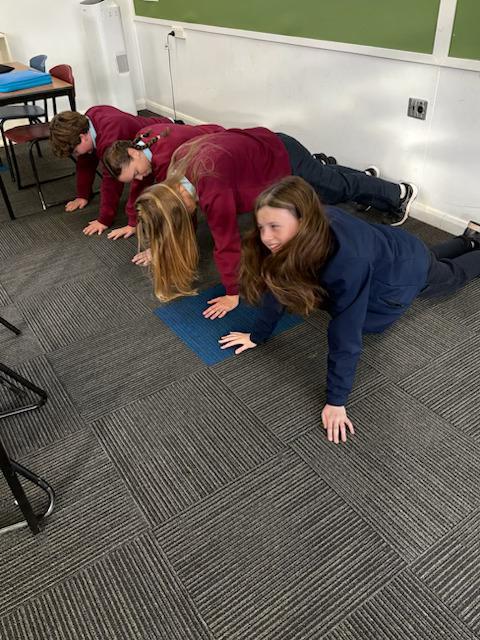
Judd, Kenzie, Indi, Charlee all participating in the PushUp Challenge
Judd, Kenzie, Indi, Charlee all participating in the PushUp Challenge
Over the past two weeks, Year Levels have been participating in the Push Up Challenge.
The Push Up Challenge is a major annual mental health and fitness event where participants complete a targeted number of push-ups to symbolize lives lost to suicide and raise funds for mental health initiatives. So far, the total Push Ups has surpassed 150 million, raising in excess of $9 Million.
This Challenge is to complete 3307 Push Ups for each Year Level by the end of Term - June 26. All Year Levels are on track to achieve the target; many are surpassing the goal.
“Whether you think you can, or you think you can't, you are right.” – Henry Ford (Founder of the Ford Motor Company)
Why are we doing this challenge?
3307 is the number of Australians who committed suicide in the year 2024 - a very sobering thought.
1. Raising awareness for Mental Health
- Every push-up shines a light. You are breaking stigmas and sparking vital conversations with every single rep.
- Pushing for better mental health. Remember that moving your body directly reduces psychological distress and builds your own mental resilience.
- You are not pushing alone. Lean on your mates, check in on your team, and let the community carry you forward.
Behind every rep is a reminder. Keep moving for the people who matter, honouring the cause every time you hit the floor
1. Raising awareness for Mental Health
- Every push-up shines a light. You are breaking stigmas and sparking vital conversations with every single rep.
- Pushing for better mental health. Remember that moving your body directly reduces psychological distress and builds your own mental resilience.
- You are not pushing alone. Lean on your mates, check in on your team, and let the community carry you forward.
Behind every rep is a reminder. Keep moving for the people who matter, honouring the cause every time you hit the floor
2. We are also participating in fundraising.
To support our students in the cause, please go to https://www.thepushupchallenge.com.au/main-donate-page, search for Donald High School, follow the links and make a donation. (All donations greater than $2.00 are tax deductable - receipts are generated and sent to your email address).
Here are the steps to donate:
https://www.thepushupchallenge.com.au/main-donate-page
Chose: Donate
Search: Donald High School
Chose: Donald High School Collective
Receipts are forwarded when an email is provided.
Cash donations:
- you may make a cash donation by placing money into an envelope and giving this to the general office or to Mr Bott.
- you can make a loose change donation to form assembly at any time before the end of term.
All donations will be forwarded to the Push for Better Foundation.
All Year Levels are keeping a tally, with all on track to achieve their goal.
So far, Donald High School has reached $40 in donations.
“If it doesn't challenge you, it won't change you.” – Fred DeVito (founder of the company Core Fusion - Barre teaching - low-impact, strength training)
Thank you for your support.
TEEN Mental Health First Aid
Students in Year 7, 8 and 9 undertook 3 sessions to complete their TEEN Mental First Aid accreditation this term. Victoria from Headspace Swan Hill facilitated the sessions with staff support.
The program equips students with the knowledge, skills and confidence to recognise, understand and respond to a friend or peer experiencing a mental health problem or mental health crisis and how to reach out.
Learning Outcomes
Upon completion of this course students will be able to:
Recognise the signs and symptoms of mental health problems commonly experienced in young people
Know when and how to seek the support of a trusted adult
Use an evidence-based action plan to initiate a mental health first aid conversation
Assess for a range of crisis situations and provide initial support
Understand the prevalence and impact of mental illnesses, risk factors and treatments and supports available
Know the barriers to help seeking and how to overcome these.
This program was fully funded by headspace Swan Hill and the Engage program through NCLLEN.
Protecting against Mosquito-borne Diseases & Free Japanese Encephalitis Vaccine
Some areas in regional northern Victoria are experiencing a longer mosquito season this year due to recent flooding. While the overall risk is currently low, some mosquitoes may be carrying diseases that make people sick.
The best protection against mosquito-borne illness is to avoid mosquito bites. The free Japanese encephalitis vaccine is also available for more Victorians.
Free Japanese encephalitis vaccines:
Japanese encephalitis virus is spread to humans through bites from infected mosquitoes. It can cause a rare but potentially serious infection of the brain.
The free Japanese encephalitis vaccine is available for:
people aged 2 months or older who live or work in eligible high-risk local government areas in Victoria
until Friday 31 July 2026, people who plan to visit high-risk areas in Victoria or interstate for outdoor recreation such as hiking, camping, caravaning or boating.
For more information:
refer to the Department of Health’s Japanese encephalitis webpage for a list of high-risk areas
speak to your GP or immunisation provider to check if your family is eligible for a free vaccine ahead of any planned travel during the coming months.
How to help prevent mosquito bites:
To help protect against mosquito bites, families can:
cover up as much as possible with long, loose-fitting, light-coloured clothing
apply insect repellent that contains picaridin or DEET on exposed skin when outdoors
limit outdoor activity if lots of mosquitoes are active
clean up and remove containers and items around the home that may hold water where mosquitoes may breed.
Families with any health concerns should see their doctor or phone Nurse-on-Call: 1300 606 024 (available 24 hours).
Find out more:
For more information on protecting against mosquito-borne diseases, families can refer to the following Better Health Channel pages:
Protect yourself from mosquito-borne disease, including a handy checklist to help reduce mosquito breeding sites at home and resources translated into other languages