
Wellbeing

Mental Health in Primary Schools (MHiPS)
As previously outlined, our school is part of the final stage of the rollout of the Mental Health in Primary Schools initiative. This government funded strategy aims to support all schools to be able to implement programs and strategies as needed for their individual community needs to promote positive wellbeing, an important aspect of overall good mental health.
Part of the reason for implanting this in primary schools, is to promote early intervention and preventative or protective factors for our young people as they move through primary and into secondary education, as we know that many teenagers and young people 18-24 can experience significant mental health issues. More information about the initiative can be found here https://www.vic.gov.au/mental-health-primary-schools
At the primary school level, the focus of Mental Health in Primary Schools includes things like:
· Building positive relationships with peers and with staff
· Feeling positive about attending school, being engaged as learners
· Developing social skills and strategies to manage conflicts and friendship difficulties
· Increasing understanding of emotions, emotional regulation and overall resilience.
· Building staff capacity to support students in building positive skills and strategies.
· Increasing community awareness of wellbeing difficulties primary school students may experience
· Promoting the importance of consistent attendance and supporting students who may be at risk of school refusal/school can’t.
A particular area that we are looking at this year at BEPS is supporting consistent attendance.
Attending school regularly is important for many reasons, the obvious one being not missing parts of or whole units of learning in the classroom. But there are other reasons too- being connected to your class, your peer group is difficult when attendance is inconsistent. Students can feel left out of groups or “out of the loop” and then this can cause them to feel less positive about coming to school. School refusal or school can’t doesn’t just begin out of nowhere, it is often over long periods of time where bumps in the road and increased days off can build patterns of reduced attendance, which turns into more days off as the student begins to feel less connected to school. Many other factors can be at play as well, such as anxiety, neurodivergence, learning difficulties. It is important to build a solid, supportive team around the learner when a young person is experiencing school reluctance or outright refusal (school can’t).
We are here to support all our students and that’s why we may reach out to you for further information about repeated absence, so we can work together and further explore any other barriers that might be present that are contributing to a student feeling like they don’t want to come to school. We ask that parents continue to explain absences in Compass, to assist us to monitor and be aware of reasons for absence and in the case of extended holidays, to please let us know in advance and also enter in Compass so that we are aware. Ideally, long holidays should be scheduled over the school break to minimise the impacts on attendance.
We understand illness happens and we certainly do not want children attending school when they are unwell, which is why we want to minimise non-illness absences where possible.
Please be mindful that consistently missing 15 days a year adds up to 105 days total over the course of primary school- that’s the equivalent of 2 whole terms! Students who are absent 20 days a year, will go on to miss almost three terms of school across their primary school journey and students who miss 25 days a year, are missing half a term each year and if that continues across primary school essentially means they miss out on a whole year of schooling!
It can be tricky to keep track of how many days your child has missed, especially if it tends to be a day here and a day or two there, if you are using Compass predominantly on your phone you can’t see the infographic (example below- not a real BEPS student) and the overall percentage easily. If you are unsure, please login into Compass on a laptop (or on your phone, but select “open in browser”), navigate to your child’s profile (just under their photo), click the attendance tab and have a look at the Attendance Summary.
If you are concerned that your child is experiencing some reluctance to attend, please reach out to your child’s teacher or myself katie.abbott@education.vic.gov.au and we can make a plan together to support them.
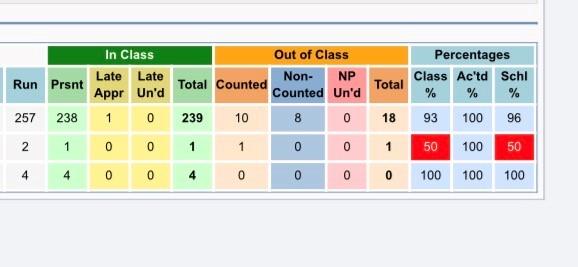
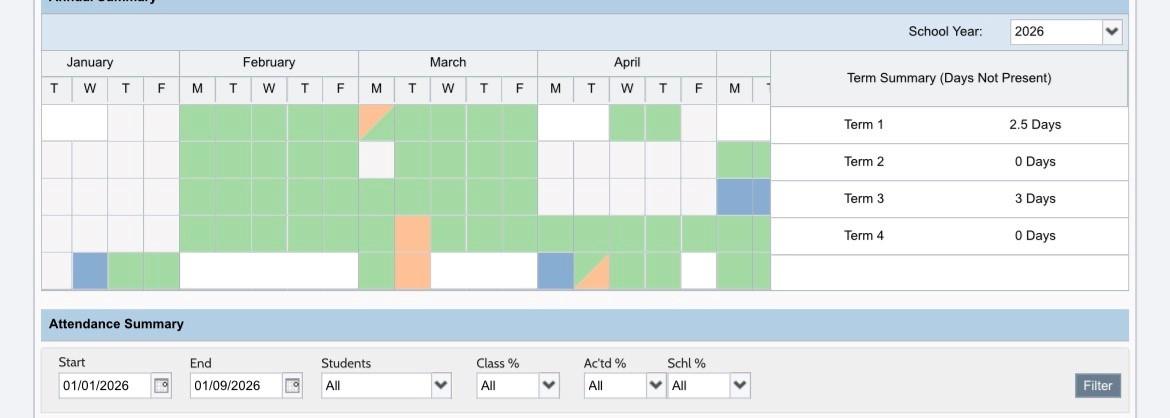
Attendance colour coding- red = unexplained absence, yellow = late arrival/early departure, green = present, blue = school event/activity (e.g. a sports day, excursion, etc.)
The percentages are broken down into attendance in class, accounted for attendance (includes explained absences) and total school attendance (including events if relevant). In the example below, the student has 50% attendance for events (two events total for that year level, the student was absent for one of them). For reference, an attendance percentage of 95%, equates to about 10 days absent over the school year, 90% equates to about 20 days absent and 85% attendance equates to about 30 days (more than half a term!).
Katie Abbott
Leading Teacher (Wellbeing and Disability Inclusion)