
Principal's Message
At Kellyville High School, our core mission is to cultivate a learning culture of excellence that nurtures the whole child, empowering them to become respectful, resilient and aspirational citizens. Central to this vision is a commitment to maintaining high expectations for every student while providing them with the tools they need to succeed. We believe that setting ambitious goals - with a clear roadmap of what students need to do to achieve their goals – is vital to unlocking their potential.
To remove the guesswork from academic achievement, Kellyville High School is moving towards a standards-referenced framework in assessment. Rather than ranking students against one another – usually based on their performance in tests and exams - standards-referencing focuses on what students know and can do in relation to pre-established benchmarks, or standards, which are clearly defined by NESA.
For example, if a student shows evidence of learning that aligns with the benchmark descriptor for an A grade, then that student will receive an A. This means that teachers can collect evidence at different points during the school year and base their on-balance judgement about a student’s performance based on how this evidence of student work aligns with the pre-established benchmark.
The benefits to students of a standards-referenced approach to assessment are significant. This means that teachers can engage students in a much broader range of learning activities that cater for a broader range of learning styles and abilities, while at the same time reducing the number of summative tasks such as tests and exams. While tests and exams still have a place, we know that students often do not perform to the best of their ability in the high-stress environment of tests and exams. If they are given an opportunity to demonstrate what they have learned, across a greater range of activities and over a period of time, students are likely to more accurately show their knowledge and understanding, with ample time for teachers to provide on-going feedback and make necessary adjustments in response to the evidence of learning collected.
To give our students a clearer understanding of these benchmarks and provide them with a learning roadmap, we are introducing two key school-wide scaffolds that unpack exactly how to move from basic content retention to sophisticated, deep understanding.
The Kellyville Learning Journey
The first scaffold – The Kellyville Learning Journey - explicitly identifies key verbs associated with different levels of achievement. As verbs are doing words, this scaffold shows students what they must do with the content they are learning. The three levels of doing words – know, think, connect – align with achievement standards for each grade A-E.
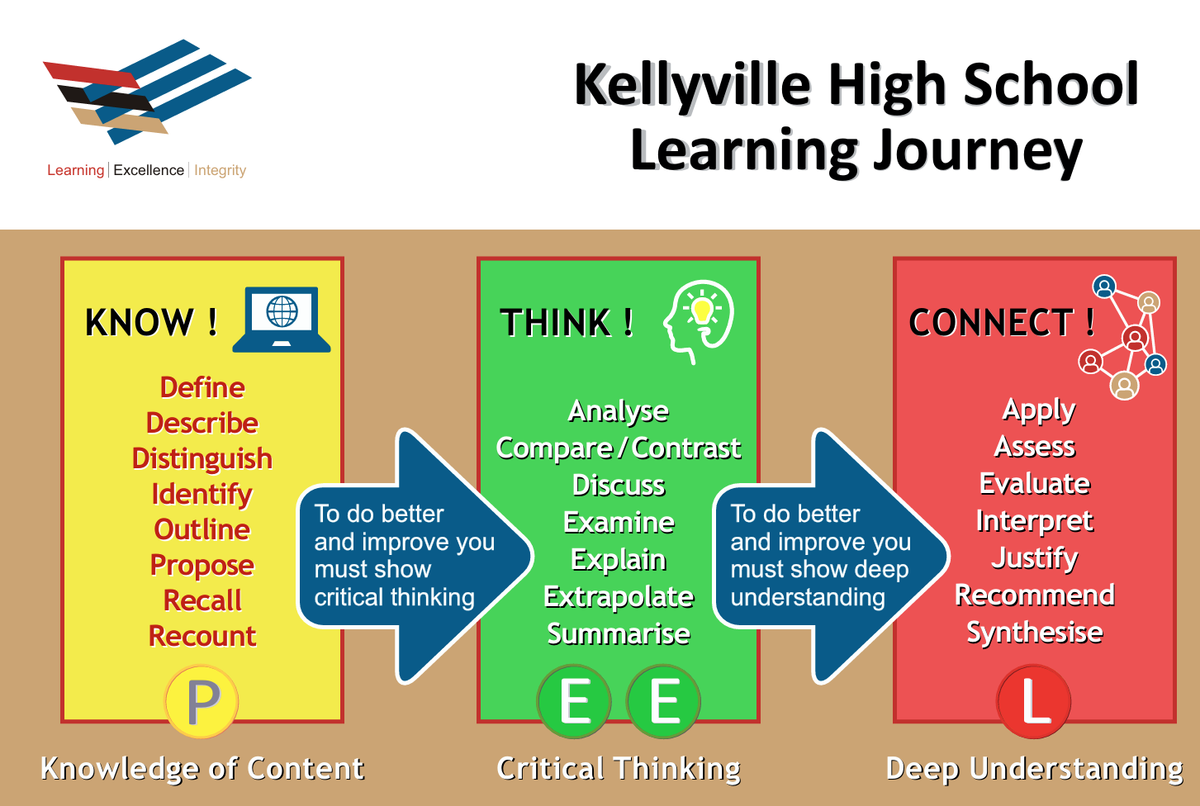
For example, knowledge of content involves foundational skills such as defining, describing, identifying, recalling and outlining. While these are important skills, students must go beyond knowledge if they are to improve. The second level – roughly aligned with grades C and B – asks students to engage in critical thinking and demonstrate deeper analysis. This level shifts to verbs like analysing, comparing/contrasting, discussing, examining and explaining. Finally, the third level – aligned with a high grade B and grade A, asks students to show deep understanding by applying, assessing, evaluating, interpreting, justifying, recommending and synthesising their knowledge across complex contexts.
By understanding this hierarchy, students know exactly what an A or B (Bands 5 and 6 in the HSC) looks like compared to a C (Bands 3 and 4).
The PEEL Writing Scaffold
The PEEL writing scaffold has been used at Kellyville High School for a number of years – mainly in English classes. This scaffold is a useful guide to help students structure paragraphs, particularly if they are not confident writers. However, this exposure by most students to the PEEL scaffold (it is also used in our partner primary schools), is an opportunity to focus on the higher order verbs and the deep understanding that students must show if they are to achieve in the higher bands.
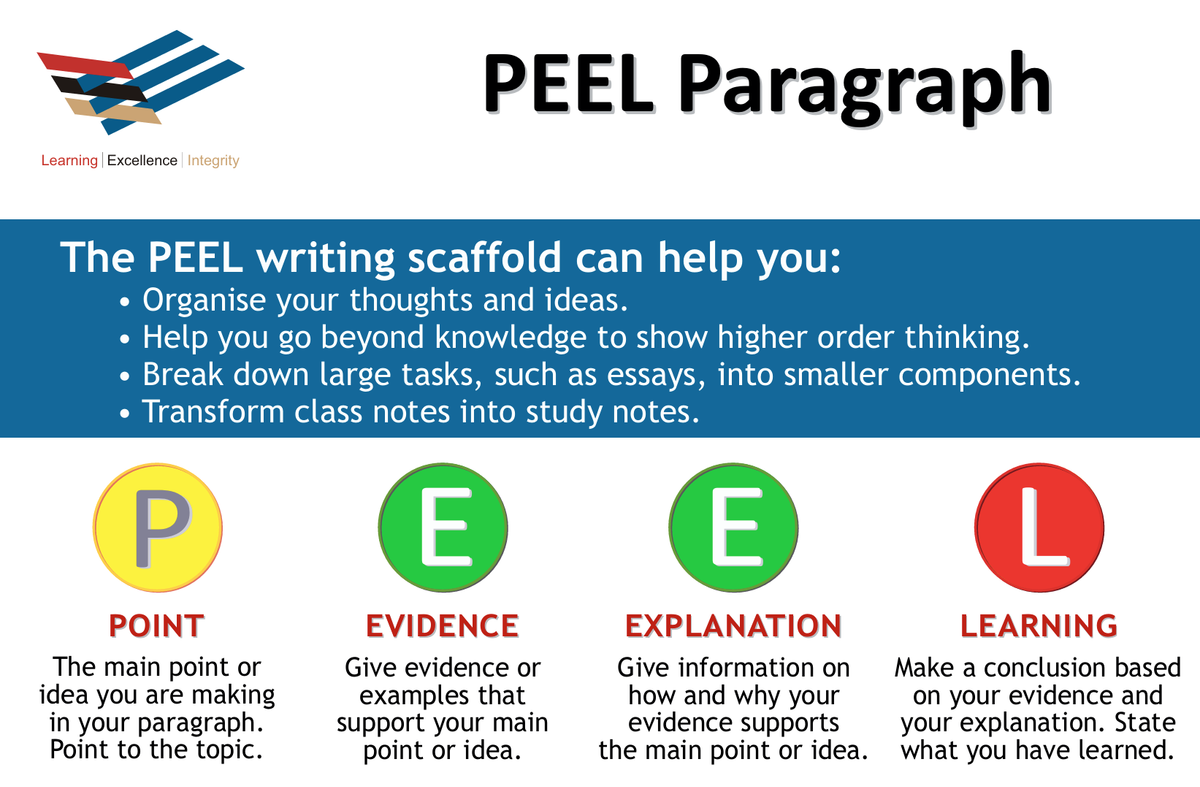
This focus on higher order skills comes by changing the L in PEEL from Link to Learning. This small change will have an enormous impact on student performance as the L for Learning encourages students to engage with the complex verbs associated with deep understanding identified in The Kellyville Learning Journey. By ensuring that their paragraphs have the full range of verbs – from knowledge to critical thinking to deep understanding – students can link multiple PEEL paragraphs to form sophisticated essays that meet criteria for achievement in the higher grades or bands.
By integrating the Kellyville Learning Journey Key Verbs Scaffold and PEEL writing techniques into our daily classroom routines, teaching programs, and assessment feedback, we ensure that every student has a shared professional vocabulary. They are never left wondering what "excellent" work looks like; the criteria are clear, visible, and achievable.
Both the Kellyville Learning Journey and PEEL scaffolds will be prominently displayed in every learning space in the school, alongside our Core Values and Expectations posters. These scaffolds will be used by teachers and students to engage in a shared vocabulary and understanding of what achievement at different levels looks like.
National Sorry Day, Tuesday 26 May
On Tuesday, 26 May, we will come together as a school community to acknowledge National Sorry Day. This is an important day for all Individuals to reflect on the history and ongoing impacts of the Stolen Generation where Aboriginal and Torres Strait Islander children were forcibly removed from their families, communities, cultures, and Country under past government policies.
In 1997, the Bringing Them Home Report shared the stories and experiences of many survivors of the Stolen Generations. The report revealed the deep trauma caused by these removals, including the loss of family connection, culture, language, identity, and belonging. Many children experienced neglect, racism, and isolation after being removed from their homes. The effects of this trauma continue to impact individuals, families, and communities today across generations.
For our school community, this history holds particular significance because our school grounds are connected to the history of the Marella Mission. Marella Mission was established as a home for Aboriginal children who had been separated from their families and communities. For many children, places like Marella became symbols of both hardship and resilience, experiencing disconnection from culture, identity, and family.
Standing on these grounds today reminds us that history is not something distant from us, it is connected to the place where we learn each day. Acknowledging this history is part of truth-telling, and truth-telling is an important part of reconciliation.
Sorry means more than simply saying a word. Sorry means acknowledging the truth, learning from the past, and committing ourselves to ensuring these injustices are never repeated. Reconciliation is not achieved through one assembly or one lesson, it is built through ongoing actions, relationships, respect, and willingness to learn from one another.
On Tuesday, we will acknowledge and remember the survivors of the Stolen Generations, their families, Elders and communities. We honour their strength and resilience, and we reflect on how each of us can contribute to a more inclusive, respectful, and truthful future.