
Assistant Principal's Report
Katrina Spicer - Wellbeing and Inclusion

Assistant Principal's Report
Katrina Spicer - Wellbeing and Inclusion
Welcome back to our existing families, and a big welcome to the new families who are starting at WHPS this year. We have had a lovely smooth start to the school year, with students and teachers all settling in quickly to their new classrooms.
Katrina Spicer - Assistant Principal for Wellbeing and Inclusion

My role is to oversee the Wellbeing and Inclusion programs at WHPS. I am also responsible for daily organisation at the school.
I am the first port of call regarding any Wellbeing or Inclusion issues and I manage the Wellbeing Team and Education Support staff who support students with disabilities.
From this year, I am also the school's designated Mental Health and Wellbeing Leader.
Desi Kyriacou Bablis - Social Worker

Mrs Desi Kyriacou-Bablis, our school Social Worker, is here to support students who may be dealing with grief and loss, needing help with social and emotional skills, experiencing anxiety or facing significant life challenges.
Desi is available on Tuesdays, Wednesdays, and Thursdays. If you feel your child could benefit from her support, or if you have any questions, please don’t hesitate to contact me, Katrina Spicer, through the school phone number or by email.

Victoria Gilbert - Disability Inclusion Coordinator
This year we welcome Ms Victoria Gilbert as the school's new Disability Inclusion Coordinator. Victoria (Ms G) will be managing applications for Disability Inclusion Profiles for students who meet criteria. She will also be working closely with me and the teachers of students who receive disability funding (Program for Students with Disability/Disability Inclusion) to ensure our inclusion students are well supported to do their best and thrive at WHPS. Ms G works on Mondays, Thursdays and Fridays.
Many students at WHPS receive NDIS funding, which families use to access ongoing therapies such as Speech Therapy, Occupational Therapy and Physiotherapy. Some families prefer to have these therapies take place during school hours, on school premises.
Whilst we recognise the importance of these therapies for students, the school has limited spaces available that meet the Department of Education’s supervision requirements and mandatory Child Safety Standards. We are also mindful that students receiving therapy during school hours miss out on valuable classroom instruction, as well as important socialisation during recess and lunch breaks.
As such, we strongly recommend that families arrange for ongoing NDIS therapies to take place outside of school hours, and NOT at school.
If families are unable to schedule these therapies outside of school hours and would like to request permission for therapies to take place on school premises, please follow the process outlined in the post in your Compass News Feed. Note that students who receive funding under either the Program for Students with Disabilities or Disability Inclusion will be prioritised in 2026.
THIS APPLIES TO FAMILIES WHOSE CHILDREN RECEIVED THERAPIES AT SCHOOL IN 2025, AND FAMILIES WHO WOULD LIKE TO REQUEST ONSITE THERAPIES FOR THE FIRST TIME.

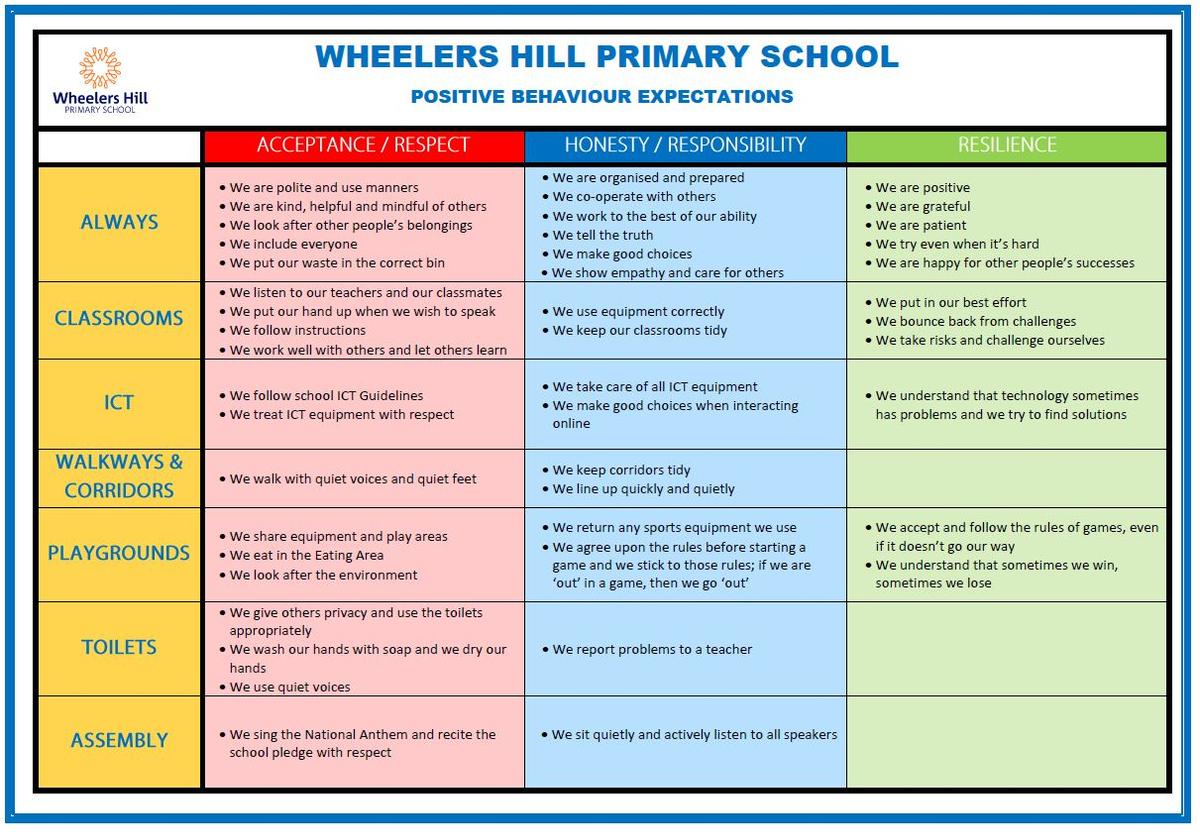
School-Wide Positive Behaviour Support (SWPBS) is the framework our school uses to manage student behaviour. Under this framework our teachers explicitly teach the behaviours expected of children at school and acknowledge students with a coloured token when they demonstrate these behaviours.
POSITIVE BEHAVIOUR EXPECTATIONS MATRIX
All families should have received a paper copy of the Positive Behaviour Matrix with your child's Code of Conduct. The matrix is also available on the school website.
Each week, students are explicitly taught one (or more) of the behaviours on the matrix. This ensures that all students in the school understand the behaviours expected of them here at school. The matrix is on display in all classrooms and offices. Teachers and students refer to the matrix regularly.
MAJOR AND MINOR BEHAVIOURS
The list of major and minor behaviours, which is also on display in every classroom, explains which behaviours are managed by teachers and which behaviours are managed by a member of school leadership.
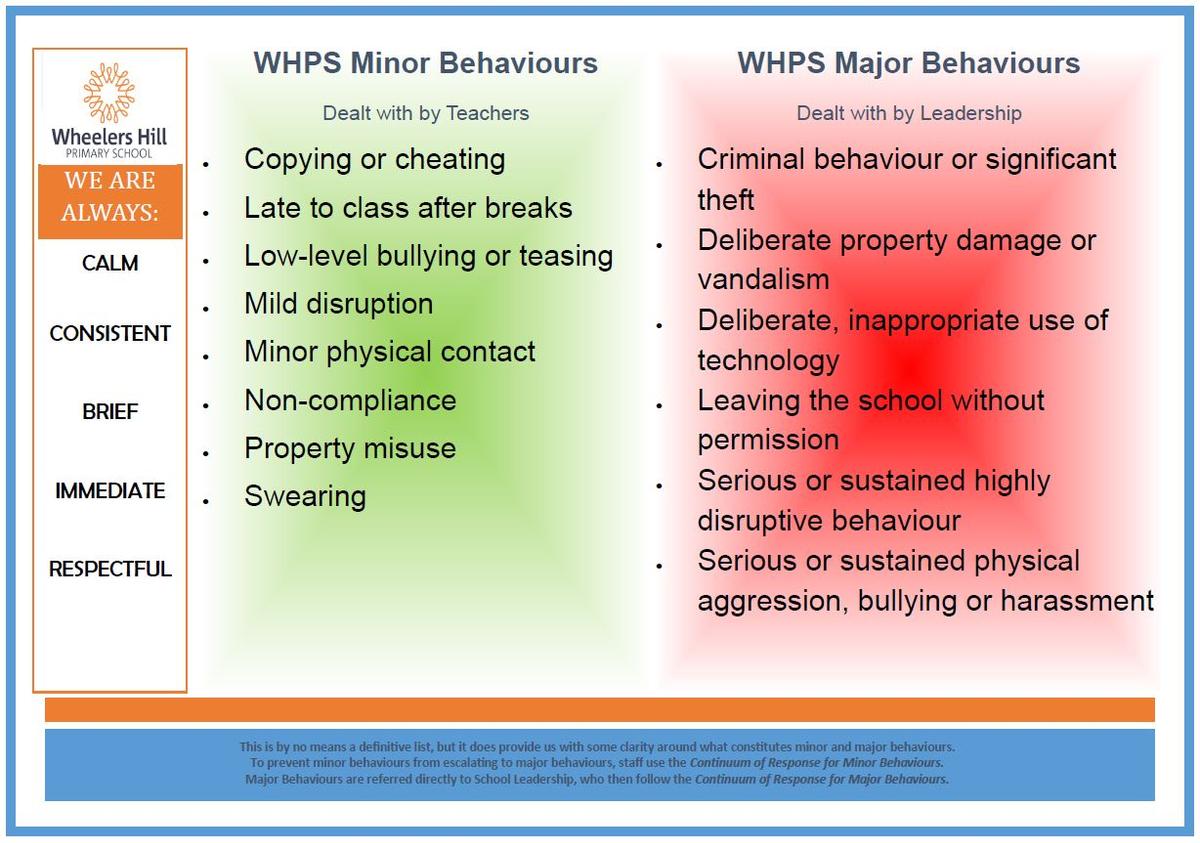
Countless studies have shown that a consistent approach between home and school is highly beneficial for effective behaviour management. You may consider developing similar strategies such as these to use at home.
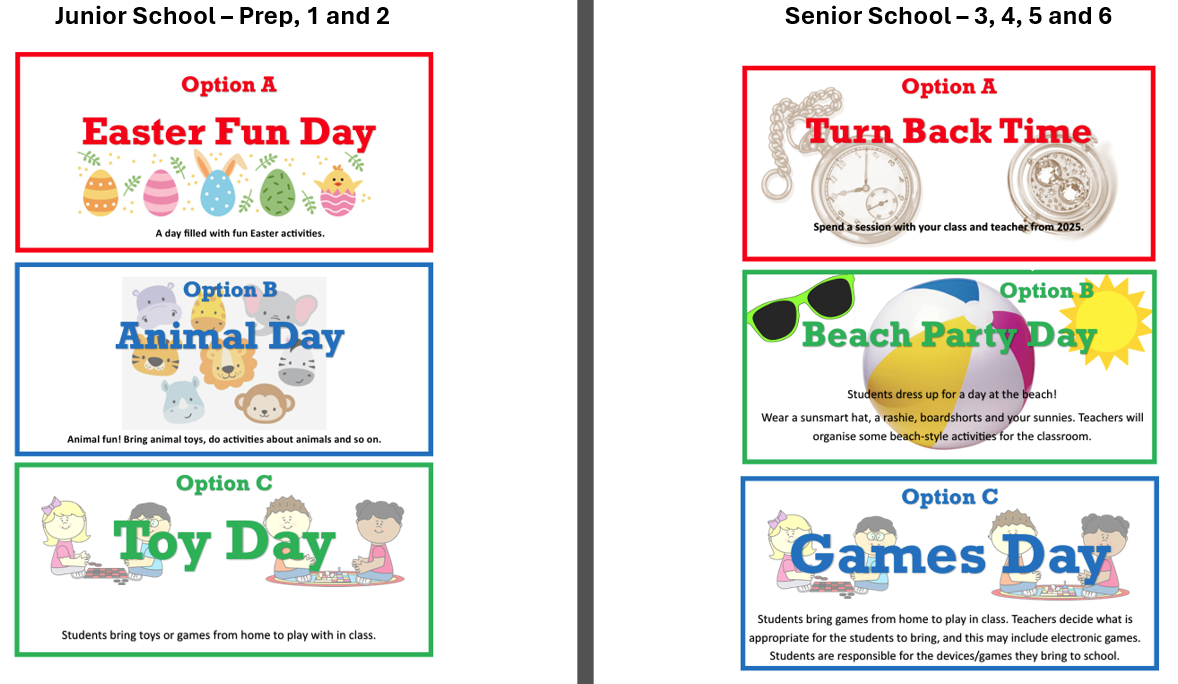
REWARD OPTIONS FOR TERM 1
Every Friday,students use their tokens to vote for an end-of-term reward. The reward options for Term 1 are:
Katrina Spicer
Assistant Principal for Wellbeing and Inclusion
katrina.spicer@education.vic.gov.au

(And Why It Matters More Than You Think)
By Dr Justin Coulson
The start of a new school year is full of emotion.
There's excitement. Nervous energy. Hope that this year will be better than the last one.
And underneath it all, a quiet question:
Will my child be okay at school this year?
One of the biggest influences on how a school year unfolds isn't the classroom, the curriculum, or the teacher. It's the relationship between parents and teachers.
WHY THE PARENT-TEACHER RELATIONSHIP MATTERS SO MUCH
Teachers don't just teach content. They manage classrooms, behaviours, emotions, learning needs, and expectations - often for 25-30 children at a time.
One of the biggest sources of stress for teachers isn't student behaviour alone, but parent interactions. Many teachers report being yelled at, sworn at, or verbally abused by parents. A significant number consider leaving the profession because of it.
That's confronting - especially when most parents are simply trying to advocate for their child.
But when we stop being adversaries and parents and teachers work with each other, children benefit: academically, socially and emotionally.
HERE'S HOW TO BUILD A STRONG, RESPECTFUL RELATIONSHIP BETWEEN SCHOOL AND HOME
1.Look for Ways to Contribute
If there's a way to volunteer - reading groups, excursions, classroom help, library work - even occasionally, it makes a difference. When you can, showing up as someone who contributes (not just someone who needs something) changes the dynamic.
Teachers are more likely to connect with parents they've seen helping, supporting and engaging with the school community.
2. Lead with Gratitude (Without Expecting Anything Back)
Everyone likes to feel appreciated - and teachers are no exception.
A simple note at the start of the year, a small coffee voucher, or even a message saying "We're really grateful you're teaching our child this year", can mean a lot.
Better still, when your child comes home sharing something positive that happened at school, pass that feedback on to the teacher. Let them know what they're doing well and how it's landing at home.
Gratitude isn't bribery. It's recognition. And recognition builds goodwill that carries you through harder conversations later.
3. Don't Believe Everything you Hear
Children tell their stories from their perspective - which is valid, but incomplete.
When your child says, "My teacher is the worst," slow down. Get curious. Consider the teacher's point of view. The same goes for playground gossip or other parents' opinions. A teacher with a tough reputation might turn out to be exactly the right fit for your child.
Be slow to judge. Quick to understand. And open to nuance.
4. Assume Positive Intent
Most teachers want your child to win. They want their students to feel safe, supported, and capable.
And teachers are also human. They have full classrooms, tight schedules, and limited time. Mistakes occur. Miscommunication happens.
When issues arise, approaching the conversation with calm, respect, and the assumption of positive intent makes a huge difference - for you, the teacher, and most importantly, your child.
WHAT PARENTS CAN DO THIS YEAR
If you want a practical starting point, try this:
You don't need to do all of this perfectly.
But when parents and teachers stand on the same side, children feel it - and school becomes a safer, more supportive place to grow.
