
Secondary School
NAPLAN 2026: Tracking Growth, Guiding Pathways
During Week 7, Secondary students completed the 2026 NAPLAN assessments across Monday 11 March - Wednesday 13 March. Despite a major outage when the VCAA’s servers failed, locking out several schools across Victoria, our students were able to complete all five scheduled tests with little concern or interruption.
The Australian Curriculum Assessment and Reporting Authority (ACARA) has reported that parents across Australia are still adjusting to NAPLAN’s new “proficiency” standards, which have replaced the former 10-band structure. Instead of focusing on rankings or comparisons between students, the updated system is designed to identify whether a student is working above, at, or below the expected proficiency level for their year group. This shift has proven significant for many families. It is hoped by ACARA that the new reporting format will provide parents with more targeted information about their child’s learning.
Our approach to NAPLAN at Oxley remains closely aligned with other “like schools” across Victoria and beyond in how we engage with the data. Rather than treating NAPLAN as a one-off measure or a tool for ranking students, Oxley uses the results as part of a broader growth‑tracking framework for all our students. We carefully examine how each student is progressing year to year throughout their Middle School years and use the data to determine how their learning trajectory compares to their individual starting point at the start of Year 7. This approach provides teachers and leaders with valuable insights that go far beyond a single NAPLAN score for each section, and even beyond Oxley’s own Interim and Semester reports.
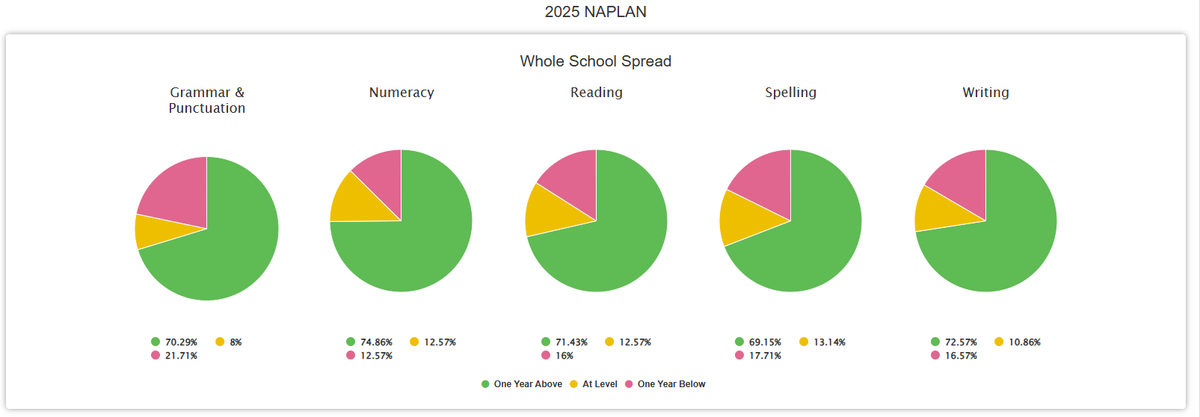
We are proud to note that Oxley consistently performs strongly on NAPLAN. Across the assessed domains, Numeracy, Writing, Reading, and Conventions of Language, our students regularly demonstrate growth that exceeds national expectations and high performing “like schools”. This exceptional progress is not accidental and reflects the efforts of our students, the dedication of our teachers, and the strength of our teaching and learning programs.
A Comprehensive Assessment Picture: PAT and Edutest
NAPLAN data is only one part of the Secondary School’s broader assessment strategy. At the beginning of Year 7, all students undertake Progressive Achievement Tests (PAT) in literacy and numeracy. These assessments allow us to determine each student’s starting point upon entering Secondary School. They help establish early indicators of where support or extension may be needed and enable teachers to plan for differentiated learning.
Mid‑year, Years 7-9 students also participate in Edutest, a diagnostic tool that provides detailed information in areas such as:
Verbal Reasoning
Numerical Reasoning
Reading Comprehension
Mathematics
These assessments inform our understanding of each learner across the year levels. For the first time, in 2026, Oxley will extend this testing to our Year 9 cohort, providing a consistent and comprehensive data set spanning from entry into Secondary School. This will allow us to trace each student’s developmental pathway more accurately over time.
When considered alongside NAPLAN and Oxley’s own internal assessment and reporting, these assessment tools help better understand a student’s zone of proximal development (ZPD), which outlines the gap between what a learner can achieve independently and what they can achieve with targeted instruction or support. By identifying a student’s ZPD, teachers can provide appropriately challenging learning experiences, ensuring that each student is appropriately challenged without becoming overwhelmed. It is this balance that fuels genuine academic growth.
Teachers use the combined data from NAPLAN, PAT, Edutest, classroom assessments, and observations to inform:
instructional planning
the selection of resources
adjustments for support and extension
long‑term academic pathways, including subject selection
This ensures that each student’s learning journey is personalised, purposeful, and well supported.
VCE Pathways and Subject Selection Evening
As we look toward the remainder of the year, an important date for families is approaching. On Tuesday 18 June, Oxley will host the VCE Pathways and Senior School Subject Selection Evening. This event is essential for all Year 10 and Year 11 students and their parents, as it provides critical information about the VCE, subject offerings, and the requirements for successful transition into Senior School.
During the evening, students and families will hear from Teaching and Learning Leaders, Heads of Faculty, and senior staff who will outline:
subject structures and requirements
pathways into VCE, VET, and potential university destinations
how subject choices align with career aspirations
recommendations based on student interests, strengths, and past performance
This guidance is especially valuable as students begin making decisions that will shape their final years of schooling and their post‑secondary opportunities.
While the evening is primarily designed for Senior School students (Years 10–12), we warmly welcome Middle Years families who may wish to gain an early understanding of upcoming pathways.
Additionally, Years 7–9 students will receive age‑appropriate subject information sessions during school hours in Term 3, ensuring that every student is well supported during their selection process.
“For the Lord gives wisdom; From His mouth come knowledge and understanding.” Proverbs 2:6 (KJV)
Mr James Avram
Head of Secondary School
Changes to Years 7-10 Reports
As part of the implementation of the Australian Curriculum Version 9 across Years 7–10, a reporting group has undertaken a review of both the Interim and Semester Report templates. These updates are designed to ensure our reporting processes align with the revised curriculum and continue to provide meaningful information about student learning and progress. It has been designed to give parents clearer, more meaningful insights into both achievement and learning behaviours.
The Semester Reports will take this further by reporting directly against the Australian Curriculum Version 9 (AC9). Parents will be able to see how their child is progressing against the national progression standards, providing a more accurate and transparent view of achievement in each subject. This alignment with AC9 also ensures consistency across year levels and subjects, supporting a more coherent understanding of student growth over time.
In the Interim Reports, families will notice refined wording within the Work Habits section. These adjustments aim to more accurately reflect the learning behaviours and classroom expectations we value at Oxley. These habits describe how a student applies themselves to their studies, such as their organisation, engagement in class, persistence, preparedness, and willingness to seek feedback. By explicitly articulating these behaviours, we aim to provide a clearer picture of the dispositions that underpin learning success. These indicators also help students reflect on their personal learning habits and set tangible goals for improvement.
The scale used to assess each Work Habit has also been updated. Students will now be reported against a five‑point scale, as outlined below:
- Exceptional
- Consistently
- Usually
- Sometimes
Rarely
This revised scale provides greater clarity regarding each student’s demonstration of key learning behaviours. Please note that a rating of 1 (Exceptional) will be used sparingly and reserved for instances where a student demonstrates a particular work habit significantly above the expected level. For most students, ratings between 2 and 4 will be typical and appropriate.
Information regarding the changes to Semester Reports will be communicated mid-Term 2.
Mr Andrew Piper
Head of Curriculum and Assessment