
Careers Update

Five tips for creating a study schedule you’ll actually stick to;

You’ve probably created the perfect study schedule at least once in your academic life – colour-coded, beautifully organised, with every hour accounted for and ambitious goals mapped out week by week. And if you’re like most students, that perfect schedule lasted about a week before real life got in the way and it became another piece of paper gathering dust in your drawer.
The problem isn’t usually with your good intentions or even your planning skills. It’s that most study schedules are created as if you’re a study robot who never gets tired, never has competing priorities, and never needs a break. They’re designed for an ideal world rather than the messy, unpredictable reality of actually being a human trying to balance multiple responsibilities.
Creating a study schedule you’ll actually stick to requires a different approach – one that acknowledges your real life, builds in flexibility, and treats your academic year like the endurance event it actually is. Just like training for a marathon, successful long-term study requires periods of intensity, recovery, and strategic pacing rather than trying to sprint for months on end.
Think like an endurance athlete
The most successful students approach their academic year like athletes preparing for a major competition. They understand that peak performance requires strategic planning, periods of intense training, deliberate recovery, and sustainable pacing that can be maintained over the long term.
Ramp up periods are when you gradually increase your study intensity leading up to major assessments or exam periods. Rather than suddenly jumping from minimal study to intensive cramming, you slowly build your daily study time and focus over several weeks. This might mean starting with an extra 30 minutes per day six weeks before exams, then adding another 30 minutes each week until you reach your peak intensity.
Taper periods happen in the few days immediately before major exams or assessments. Just like athletes reduce their training intensity before competition day, you should scale back the volume of new learning and focus on light review, confidence-building activities, and ensuring you’re mentally and physically ready to perform.
Recovery periods are essential after intense assessment periods. This might mean taking a complete break from study during school holidays, or simply returning to a lighter maintenance schedule once major exams are finished. Recovery isn’t laziness – it’s a necessary part of sustainable performance.
Maintenance periods make up the majority of your academic year. These are your baseline study habits that keep you on track with coursework, homework, and gradual skill building without pushing you to exhaustion. A good maintenance routine should feel challenging but sustainable over many months.
1. Be realistic and accurate about your time
The foundation of any sustainable study schedule is brutal honesty about how you actually spend your time and what you can realistically achieve. Most students overestimate their available time and underestimate how long tasks actually take, which sets them up for failure before they even start.
Track your current patterns for at least two weeks before creating any new schedule. Note when you naturally feel most alert, how long different types of study actually take you, and what other commitments are genuinely non-negotiable in your life. This data becomes the foundation for realistic planning.
Use a proper scheduling tool – whether that’s a physical planner, phone app, or online calendar – and block out all your existing commitments first. This includes:
- School hours and travel time
- Work shifts and travel time
- Regular activities and sports
- Family commitments and household responsibilities
- Essential personal care time (meals, sleep, exercise)
- Social time that’s important for your wellbeing
Only after you’ve mapped out these commitments can you see your genuinely available study time. This might be less than you hoped, but working with accurate information is always better than creating fantasy schedules based on wishful thinking.
Build in buffer time for the unexpected. If you think a task will take two hours, schedule two and a half. If you have four hours available on Saturday afternoon, only plan three hours of study. This extra time absorbs the small disruptions and delays that are part of normal life.
2. Reward yourself for success
One of the biggest mistakes students make is treating study success as its own reward, then wondering why they lose motivation after a few weeks. Your brain needs positive reinforcement to maintain challenging behaviours, and academic success is often too distant and abstract to provide sufficient motivation in the moment.
Identify what actually motivates you rather than what you think should motivate you. Some students are energised by social rewards – time with friends, family activities, or social events. Others prefer personal rewards like new purchases, special meals, entertainment, or time spent on hobbies. Still others are motivated by achievement-based rewards like ticking things off lists, earning recognition, or reaching specific milestones.
Match rewards to effort levels with different types of recognition for different achievements:
- Daily study goals might earn small rewards like favourite snacks, extra screen time, or a relaxing bath
- Weekly targets could unlock bigger rewards like social outings, new purchases, or special activities
Major milestones like completing exam periods deserve significant celebrations that acknowledge the sustained effort involved
Don’t push through indefinitely without breaks or rewards. Even the most motivated students need regular positive reinforcement to maintain challenging routines. If you’re constantly telling yourself “just one more week” or “after this assignment” without following through on promised breaks, you’re training your brain not to trust your planning.
Plan recovery time as carefully as you plan study time. This might mean scheduling complete days off, planning social activities you’re genuinely excited about, or dedicating time to hobbies and interests that energise you rather than drain you.
3. Be organised with your materials and environment
Chaos kills motivation faster than almost anything else. When you can’t find your notes, don’t have the right materials, or waste time looking for information, study sessions become frustrating rather than productive. Good organisation removes friction and makes it easier to start and maintain study habits.
Create systems for your materials that work with your natural habits rather than against them. This might include:
- Physical folders or binders for each subject with clear labelling
- Digital folders with consistent naming conventions
- An index system so you can quickly find specific topics or notes
Regular clean-up sessions to prevent accumulation of clutter
Set up dedicated study spaces that have everything you need within arm’s reach. This doesn’t require a perfect desk setup – it just means having pens that work, paper or devices ready to go, textbooks accessible, and basic supplies like calculators or rulers where you can find them quickly.
Establish routines that reduce the mental energy required to start studying. This might mean always studying in the same location, keeping a standard set of materials in your study space, or following the same sequence of setup activities that signal to your brain it’s time to focus.
Prepare for study sessions in advance rather than trying to organise materials when you’re supposed to be learning. Spend a few minutes at the end of each study session setting up for the next one, or use travel time or breaks to gather what you’ll need later.
4. Join a study group or find accountability partners
Studying alone requires enormous self-discipline and motivation that can be difficult to maintain over long periods. Having other people involved in your study routine provides external accountability, social connection, and shared motivation that makes challenging routines more sustainable.
Find people with similar goals and timelines who are working towards comparable objectives. This might be classmates taking the same subjects, friends with similar academic ambitions, or even family members who can provide support and accountability even if they’re not studying the same material.
Establish regular check-ins where you share progress, discuss challenges, and celebrate successes together. This could be weekly study group sessions, daily text updates about completed tasks, or regular phone calls to discuss what’s working and what isn’t.
Share the load by studying together when possible. Group study sessions can be more engaging than solo work, allow you to learn from different perspectives, and provide natural breaks through discussion and explanation. They also create social pressure to actually show up and be prepared.
Support each other through difficult periods by recognising that everyone has ups and downs in motivation and performance. Good study partners help each other through challenging times rather than creating additional pressure or competition.
5. Use tools and technology strategically
The right tools can dramatically reduce the effort required to maintain good study habits and make your learning more efficient and effective. However, the key is choosing tools that genuinely solve problems in your routine rather than adding unnecessary complexity.
Leverage AI and online resources to supplement your learning:
- Use AI tools to create practice questions, explain difficult concepts, or provide feedback on your understanding
- Watch tutorial videos online to get different explanations of challenging topics
- Use language learning apps or subject-specific platforms that gamify practice and review
Consider getting additional support when you’re struggling with particular subjects or topics:
- Tutors can provide personalised instruction and accountability
- Study groups or peer tutoring can offer collaborative learning opportunities
- Teachers and school counsellors often have additional resources or strategies to suggest
Apply proven study techniques that research shows are effective:
- The Pomodoro Technique for maintaining focus during longer study sessions
- Spaced repetition for memorising information over time
- Active recall methods that test your knowledge rather than just reviewing notes
- The Feynman Technique for ensuring deep understanding of complex concepts
Use productivity and organisation apps that match your natural working style:
- Calendar apps that sync across devices and send reminders
- Task management tools that help you break large projects into manageable steps
- Note-taking apps that allow you to search and organise information easily
- Focus apps that block distracting websites during study time
The most important thing to remember about tools is that they should make your life easier, not more complicated. Start with one or two tools that address specific problems you’re facing, get comfortable with them, and only then consider adding additional resources to your toolkit.
Remember that creating a sustainable study schedule is a process of continuous adjustment rather than a one-time planning session. What works at the beginning of the term might need tweaking as your workload changes, and what serves you well in one subject might not work for another. The key is building flexibility and self-awareness into your approach so you can adapt your methods while maintaining your overall commitment to your academic goals.
Goal setting: Why it’s important and how to do it

Goal setting can be tricky, but it's important. Learn about why you should set goals and how to make it easy in this blog.
Goal setting; some of us love it, some of us would rather pull our own teeth out. But no matter which camp you fall in, goals are important. Nearly every successful person has goals (and it’s how they became successful). They give us a path to follow and something to aim for. As humans, we always work better when we have a plan and a direction, and good goals can give us both of those, but the process of coming up with them can be frustrating.
Why? Because when you set yourself some goals you have to ask yourself some of the tough questions. Like, “who am I?” and “what do I want to do with my life?”. But there’s a way to make goal setting easy – read and learn…
Don’t just ‘wing it’
Making up goals on the fly (often when someone asks you what your goals are) is often a recipe for not succeeding. Setting good goals takes time and involves a few steps – something that’s difficult to replicate in about 3 seconds under pressure. The best (and most powerful) goals are the ones that are well thought-out, broken down into stages, then backed up with a solid plan to cover each stage of your journey.
Compare it to driving into town. Say you know you want to go to town, but you’re not sure what you need to do there today. You may get in the car or on the bus, but where are you actually going? How long will it take you to get there? When you do get to town, what are you going to do? Is it likely that you’ll achieve much, or is the plan to just wander around for a bit until you find something interesting to do? People don’t do this – because it’s a waste of time. When you go to town it’s for a reason – to meet a friend, do some shopping, check out the library, watch a movie, or even just chill. You have a goal (the thing you want to do), then you enact a plan to get there (ask mum for the car, walk to the bus stop, or hop on the train). You’ll make sure you’re wearing the right clothes and have anything you need with you (like money for the movie). Successful trip? Yes.It’s a basic explanation, but it’s no different to setting life, health, or career goals – without a destination in mind and a plan to get there, there’s a good chance you’ll spend plenty of time wandering aimlessly from job to job or feeling bored and unfulfilled.
Good vs not-so-good
People often say that ‘good’ goals are SMART – Specific, Measurable, Attainable, Relevant, and Time Bound. But that’s more for checking your goals are ‘good’ once you’ve finished setting them. Good goals need to do more than just be within reach:
- Goals must be meaningful to you – not things your friends are doing or your parents, teachers or peers think you should do.
- Setting unrealistic goals might mean that you give up before you achieve them, or you spend way too much time chasing the impossible.
- You need to know the time frames for your goals – it’ll help you measure your progress and keep you accountable.
- Avoid negative goals. For example, if you want to lose weight, you’re basically focusing on the fact that you’re unhappy about your weight now. Rephrasing it to “be healthier” is much more positive and appealing goal and you’re more likely to stick with it for longer.
Setting too many goals will be overwhelming and not achievable. Remember, you only have limited time and energy, and goal setting comes in between other elements in your life, like school, study, family time, hobbies, sports, etc… It’s better to achieve a handful of good goals than fail by doing 20 at once.
Steps to setting meaningful goals
Now you know why goal setting is important, here are the steps you can take to actually start.
Step 1: Brainstorm
Find a quiet place, take a pen and paper, and brainstorm. List what’s important to you, what makes you happy, and what lifetime ambitions you have – don’t be afraid to put down things you think are impossible.
Step 2: Start a list
From the ideas you came up with in Step 1, come up with a list of between 1 and 3 main themes to turn into goals. Write them down and try to be specific – not just “I want to work with animals”, make them more like “I want to work with dolphins and protect marine biodiversity”.
Step 3: Cull
Now we cull. Decide which of the goals appeal to you the most and genuinely reflect your interests and passions. Which ones are you happy to put aside for now, and which ones do you want to focus on? Don’t discount goals because you think they’re impossible – keep those ones, as you might just start on them next year or when you’re older.
Step 4: Create a timeline
Allocate a time-scale to each goal, i.e. short term (in the next few weeks, months), medium (1-5 years), or long term (5-10 years or more). When do you want to achieve them by? Some goals are better suited to the short term – completing a marathon probably doesn’t need to be a 5 year goal, while others are going to take 10 years or longer to bring to life.
Step 5: Start mapping
Lastly, you need to make a plan so you have a map to follow on your journey. This step can be a bit tricky, and is where lots of people come unstuck, so we’ve gone over it in detail for you below.
The gathering stage
First, you need to get all the information in the one place. Some things you’ll already know, but other pieces of the puzzle need to be brought together, so search the web for info and ask people who are already on a similar path to where you want to be.
Write everything down:
- What are the things you have to do first? Do you need to go to uni or TAFE? Do you have to be over 18, or have your driver’s license?
- How much will it cost? And are there other ways of paying for it? If you think a goal is too expensive then look for financial support programs, as there are lots of scholarships available to apply for.
- How long will it take? If you need a 3 year degree plus work experience and you’re in Year 9, then we’re talking about a long term goal (and that’s great!).
How much time will it take each week? Can you do a little bit each day, or do you need to set aside chunks of time?
The planning stage
Take all the information and start planning what you need to do and when. A great way to do this is with a big sheet of paper – put your goal at the bottom of the paper, then work backwards to now.
Unless you’re working with a short-term goal, break down your big goal into a series of short- and medium-term goals that will get you where you want to go. For example, if you want to become a marine biologist, the first thing you need to do is get into university, so make that your mid-term goal.
Balance
Life is all about getting the balance right, and goal setting is no different. If you love chocolate but eat it all day every day, you’ll end up sick of chocolate. So even though your goals are something you’re interested in, remember not to make plans that will swamp the rest of your life. Or you might end up getting sick of your goal and end up giving up.
Accountability
Share your plans with someone who will motivate and encourage you, keep you focused, and celebrate your successes with you. There are also plenty of apps and programs that can help you build habits and track of your progression. We’ve listed a few of them here:
Stay on track
Cross off items on your planner, keep a note of all your achievements, and celebrate your successes. (Don’t forget to add them to your resume).
Before you know it, 5 or 10 years will have passed, and you’ll be reflecting on all you’ve achieved in that time. You might be in the place you imagined at the beginning of your goal setting process, or you might be somewhere else entirely – either way, you’ll have achieved lots along the way.
Don’t stress
Remember, it’s okay to ditch a goal if it’s not working out. Life is short, so just pick something new that’s aligned with where you want to be in life. Only do as much as you have the time and enthusiasm for, so you always have a good chance of succeeding.
Goals aren’t about adding extra pressure to your life. The reason for setting goals is to help you achieve more, not less, and ensure you’re happier with your life along the way.
Whatever you choose to do, stay focused and good luck!
9 Jobs that didn’t exist 10 years ago (and what they pay)

The job market is changing faster than ever before, and some of the roles that are hiring right now simply didn’t exist a decade ago. Technology advances, social changes, and new industries have created career paths that weren’t even on the radar when today’s university students were in primary school.
If you’re thinking about your future career, it’s worth knowing that you’re not limited to traditional paths. Many of the most interesting opportunities are emerging right now and understanding what these roles involve and what they pay can help you spot possibilities you might not have considered.
Here are nine jobs that have emerged in Australia over the past decade, along with what you can expect to earn and where to learn more about each field.
Music Therapist
Music therapy sits inside the health, care and medical emerging space, using music as a therapeutic tool to help people with physical, emotional, cognitive, or social needs. Most therapists earn between $800 and $2,000 a week (roughly $41,600 to $104,000 a year), with a smaller group earning above that range.
Recent job advertisements show full-time roles in the $90,000 to $95,000 range, and Jobs and Skills Australia has identified it as an emerging role. If you’re interested in both music and helping people, this relatively new profession combines both in meaningful ways.
Where to learn more: Australian Music Therapy Association
NDIS Support Coordinator
This role barely existed before the National Disability Insurance Scheme rolled out across Australia, which is why it appears as an emerging occupation. NDIS Support Coordinators help people with disabilities navigate the scheme, connect with services, and make the most of their funding.
Census data shows that 89% of workers in this role earn at or above the national average of $805 a week (about $41,860 a year), with 5% earning $2,000 or more per week ($104,000+ a year). Current Australian job advertisements and industry guides put most Support Coordinators in the $75,000 to $90,000 range, with specialist coordinators able to charge higher hourly NDIS rates.
Where to learn more: National Disability Insurance Scheme
Climate Change Analyst
As organisations and governments work to understand and respond to climate change, the need for people who can analyse data, model scenarios, and develop strategies has exploded. This is one of the clearest examples of the sustainability and net-zero career stream that’s emerged recently.
Australian roles advertised for climate or decarbonisation analysts in government and large organisations commonly sit around $145,000 to $155,000 plus superannuation. For example, NSW EPA’s Principal Climate Change Analyst role starts at $148,230 plus super. Wider salary datasets put the typical range from about $102,000 to $181,000, making this one of the better-paid emerging fields.
Where to learn more: Department of Climate Change, Energy, the Environment and Water
Electric Vehicle Technician
As Australia’s electric vehicle fleet grows, there’s increasing demand for technicians who understand batteries, electric motors, and high-voltage systems. This role builds on traditional automotive skills but requires completely different technical knowledge.
Australian job advertisements for EV technicians and mechanics tend to run from about $55,000 a year at entry level up to $90,000 or more for council, utility, or fleet work. Field service roles can pay even higher. Job boards list hourly rates of $37.75 to $48.05 for local government workshop positions.
Where to learn more: Electric Vehicle Council
Battery Design Engineer
This is one of the most future-facing roles to emerge recently. As renewable energy storage becomes crucial for Australia’s energy transition, engineers who can design and optimise battery systems are in high demand. Census analysis shows that 41% of workers in this field were already earning $2,000 or more per week (at least $104,000 a year) back in 2021.
Current Australian battery and energy-storage engineering roles sit roughly in the $105,000 to $155,000 range, with senior positions paying considerably more. This field combines electrical engineering, chemistry, and sustainability in ways that simply weren’t needed a decade ago.
Where to learn more: Future Battery Industries CRC
Quantum Computing Scientist
Quantum computing represents a completely different approach to processing information, and Australia is investing heavily in this emerging technology. The 2021 Census found that 69% of people in quantum computing roles were earning $2,000 or more per week, meaning most were already over $104,000 annually.
Current Australian figures show salaries ranging from about $100,000 to the mid-$160,000s, depending on whether you’re working in a university, with organisations like CSIRO or in defence, or in commercial development. This is highly specialised work that requires advanced physics and mathematics knowledge.
Where to learn more: UNSW Centre for Quantum Computation and Communication Technology
Machine Learning Engineer
Machine learning engineering was rare a decade ago but is now firmly established as an emerging field. These engineers build and deploy systems that learn from data, powering everything from recommendation algorithms to medical diagnostics. The Census shows that 67% were already earning $2,000 or more per week, so over $104,000 annually.
Australian job market data currently has machine learning engineers earning about $135,000 to $150,000, with senior roles pushing towards $180,000 or more. As artificial intelligence continues to develop, this field is only likely to grow.
Where to learn more: CSIRO’s Data61
Robotics Engineer
Robotics engineering sits within advanced manufacturing and automation, designing systems that can sense, think, and act in physical environments. Census data from 2021 showed that 35% of robotics engineers were already earning $2,000 or more per week ($104,000+ annually).
Current Australian job listings show typical robotics engineer salaries in the $120,000 to $130,000 range, with specialist or senior positions reaching about $170,000. This field combines mechanical, electrical, and software engineering in ways that are becoming increasingly important across industries.
Where to learn more: Australia’s Robotics Strategy
Bioinformatician
As health, medical research, and genomics push further into data analysis, bioinformaticians have emerged to bridge biology and computing. These professionals analyse genetic and biological data to help understand diseases, develop treatments, and advance medical knowledge. Census data shows that 43% of bioinformaticians were already earning $2,000 or more per week ($104,000+ annually).
Current Australian salary sources put bioinformaticians mostly between $95,000 and $120,000, with senior research or clinical bioinformatics roles in WA and VIC health services at around $105,000 to $110,000 plus superannuation.
Where to learn more: Australian Bioinformatics and Computational Biology Society
What this means for your future
If there’s one clear message from these emerging roles, it’s that the job market is constantly evolving. Many of the careers that will be common in ten years’ time don’t exist yet, and the skills that matter most might be ones you’re still developing.
The fields represented here span health, technology, sustainability, and social services – areas where Australia is investing heavily and where problems need solving. If any of these roles spark your interest, it’s worth exploring the organisations linked above to understand what pathways exist and what qualifications you might need.
From Blood Test to Diagnosis: Pathology Behind the Scenes

Most of us have, at one point or another, had a blood test (or at least know someone who has). However, not many of us are actually sure about what happens to the sample post-doctors visit.
Where does the blood go, how is it tested and how do doctors use it to understand important findings about your health? The process raises tonnes of intriguing questions and, to find the answers, we’ve enlisted the help of our friends at Healius (A.K.A leaders in the pathology industry and one of the largest healthcare organisations in Australia, providing 1 in every 3 pathology tests nationwide). With their insider insights, you’ll be an expert on all things pathology-related in no time. And who knows, you might even feel inspired to pursue pathology jobs!
First Things First: Pathology Definition
According to the experts at Healius, pathology is the foundation of modern medicine and playing a crucial yet often unseen role in diagnosing, monitoring, and treating disease. Every blood test & biopsy gives doctors the insights they need to deliver care and without pathology, early detection of conditions like cancer, diabetes, and infections would be near impossible!
Whether they’re confirming a routine diagnosis or uncovering a critical illness, everyone in Healius’ dedicated workforce plays a vital part in working together to shape patient diagnosis, from the pathology collectors who take your specimen test, to the couriers that then transport it to the lab, to the laboratory scientists and pathologists who process and analyse specimens! These unsung heroes are behind the result that lands on the doctor’s desk!

Discover Exciting Pathology Jobs
When you start planning a career in the pathology industry, it’s easy to ignore the variety of exciting pathology jobs on offer and zero in on the lab scientist pathway. And while that’s a fantastic choice, it’s important to realise that it’s not your only option.
To demystify the other fantastic pathology jobs out there, we teamed up with Healius, who gave us a full rundown of each role!
Courier
As a Courier, you will be travelling to different clinics to pick up and transport specimen tests to the laboratories. This involves being reliable and being able to drive. A Courier usually enjoys variety in their day and liaises with a range of different people.
Laboratory Assistants
Once the specimens have been dropped off to the laboratories by the Courier, the Lab Assistants handle & process the samples at pre-analytic stage, this includes the operation of the laboratory machinery, assisting scientists and data entry responsibilities. Lab Assistants often are methodical and have an interest in science & laboratory work.
Laboratory Technicians
Laboratory Technicians are responsible for the maintenance of laboratory machinery and stock control, ensuring the laboratory is working properly & efficiently. This could mean performing manual machinery tests, maintaining records and following policies & procedures. A lab technician will be analytical and methodological.
Scientists
Once the specimens have been processed, it is where the analysis starts! As a scientist you will be performing analysis under the microscope & providing interpretation of test results. There are various departments that you could be a part of that focus on specific scientific disciplines, for example Biochemistry, Toxicology or Genomic Diagnostics. Scientists are highly analytical and investigative and are happy working in a laboratory setting where they will be focusing for long time periods.
Pathologists
Pathologists are clinically trained medical specialists who are responsible for identifying and diagnosing abnormalities, diseases and infections. A key partner to doctors and patients, this can also involve providing reports & collaborating with doctors to help determine the best course of treatment. Pathologists rely on technical & medical expertise as well as being highly analytical, collaborative, and able to make strong decisions.
If you’d like to learn more about life in each role, hear directly from employees with Healius’ employee spotlights.
Launch a Career in Pathology Today
After reading through all the different pathology jobs and gaining a better understanding of the industry, we’re willing to bet you’re ready to take the next step and launch a life-saving career!
How to become a Speech Pathologist

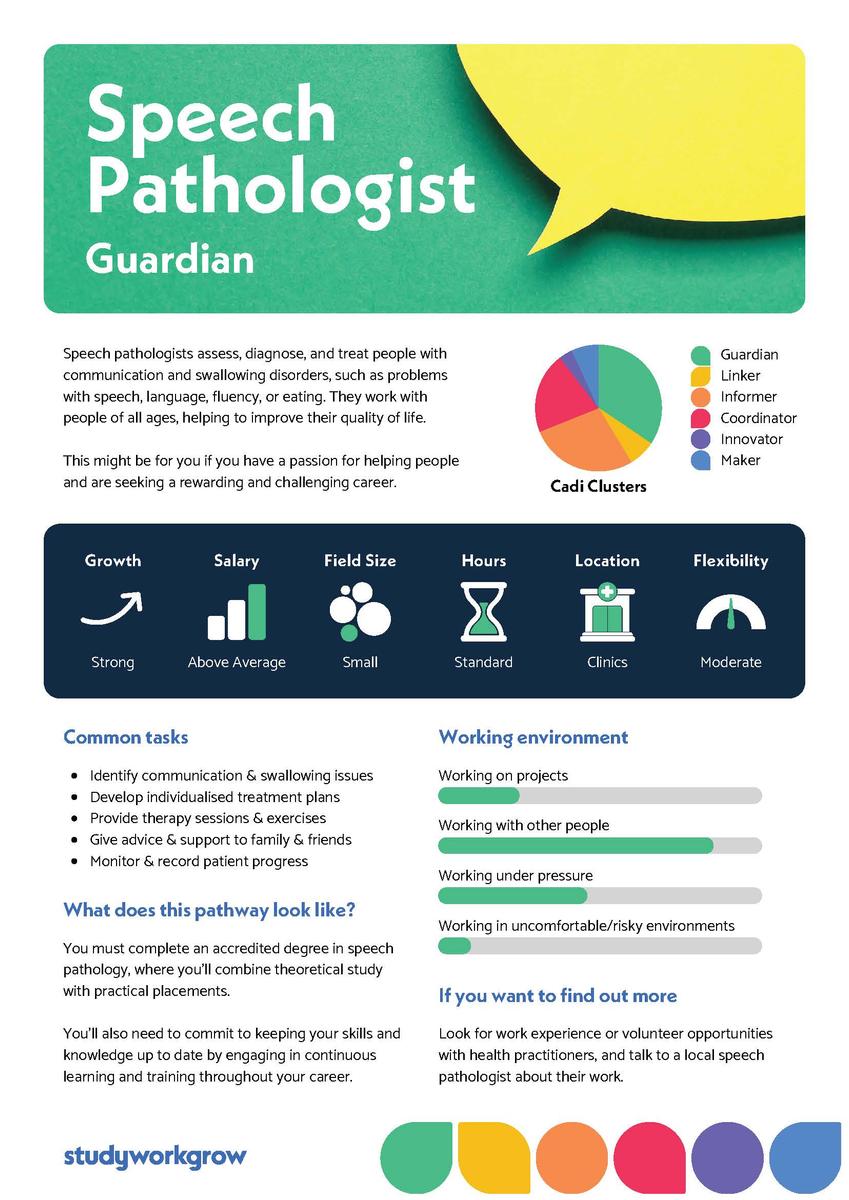
A career as a speech pathologist offers the opportunity to make a real difference in people's lives - find out more in this Job Spotlight. Speech pathologists assess, diagnose, and treat people with communication and swallowing disorders, such as problems with speech, language, fluency, or eating. They work with people of all ages, from young children with developmental delays to adults recovering from strokes or managing neurological conditions, helping to improve their quality of life. If you have a passion for helping people and are seeking a rewarding and challenging career, speech pathology could be ideal for you.
What skills do I need as a speech pathologist?
- Caring and empathetic
- Excellent communicator
- Adaptable and creative thinker
- Emotionally resilient
- Great problem-solver
- Committed to lifelong learning
- Works well in a team and independently
- Strong attention to detail
What does the job involve?
- Identifying the cause and extent of communication and swallowing issues
- Developing individualised treatment plans based on patient needs
- Providing therapy sessions to improve speech or swallowing function
- Helping patients overcome stutters and other fluency issues
- Teaching strategies and exercises to patients
- Giving advice and support to family, friends, and carers of patients
- Relaying relevant information to other medical and health professionals
- Keeping detailed clinical records and monitoring patient progress
What industries do speech pathologists typically work in?
- Health Care and Social Assistance
- Education and Training
What kind of lifestyle can I expect?
Speech pathologists typically work full-time, though part-time positions are common and the field offers good flexibility for work-life balance. A majority of the work is done indoors, but often requires you to be face-to-face with patients, so there is little opportunity to work remotely or from home. Speech pathologists tend to earn above average salaries throughout their career, particularly experienced practitioners.
You can expect to find work in hospitals, rehabilitation centres, schools, private practices, aged care facilities, or community health centres. Some speech pathologists even run their own private practices or work as independent contractors. Regional areas often have strong demand for speech pathologists and may offer additional benefits or incentives.
How to become a speech pathologist
To become a speech pathologist, you must complete an accredited university degree in speech pathology, where you’ll combine theoretical study with practical clinical placements. Your studies typically take anywhere between 4-6 years to complete.
After completing your studies, you’ll need to register with your state or country’s relevant association or board (such as Speech Pathology Australia) to practise professionally. Some positions, particularly ones involving work with children, may also require additional clearances or certifications. You’ll also need to commit to keeping your skills and knowledge up to date by engaging in continuous learning and training throughout your career.
What can I do right now to work towards this career?
If you’re in high school and you’d like to find out if a career as a speech pathologist is right for you, here are a few things you could do:
- Seek work experience or volunteer opportunities with health practitioners in hospitals, schools, or private practices
- Research university courses in speech pathology to understand entry requirements and pathways
- Talk to a local speech pathologist about their work, or watch online interviews and videos about the profession
Similar careers to speech pathologist
- Occupational Therapist
- Sonographer
- Audiologist
- Registered Nurse
- Aged Care Worker
- Music Therapist
- General Practitioner
- Social Worker