Term 3, 2025
Curriculum News - Prep
Term 3, 2025
Curriculum News - Prep
Welcome to Term 3, we can’t believe we are already half-way through Prep! The children have achieved so much and also have so much to look forward to for the remainder of the year.
Term 3 focuses on extending students’ knowledge, with our wonderful programs designed for targeted development. We continue with our morning exercises to get our bodies ready for learning and brains switched on for the day.
Our ‘How the world works’ unit of inquiry has a Maths and Design/Technology focus and the students will be involved in a variety of fun, hands on explorations such as ‘Cubby Day’, designing a treehouse and a tallest tower challenge.
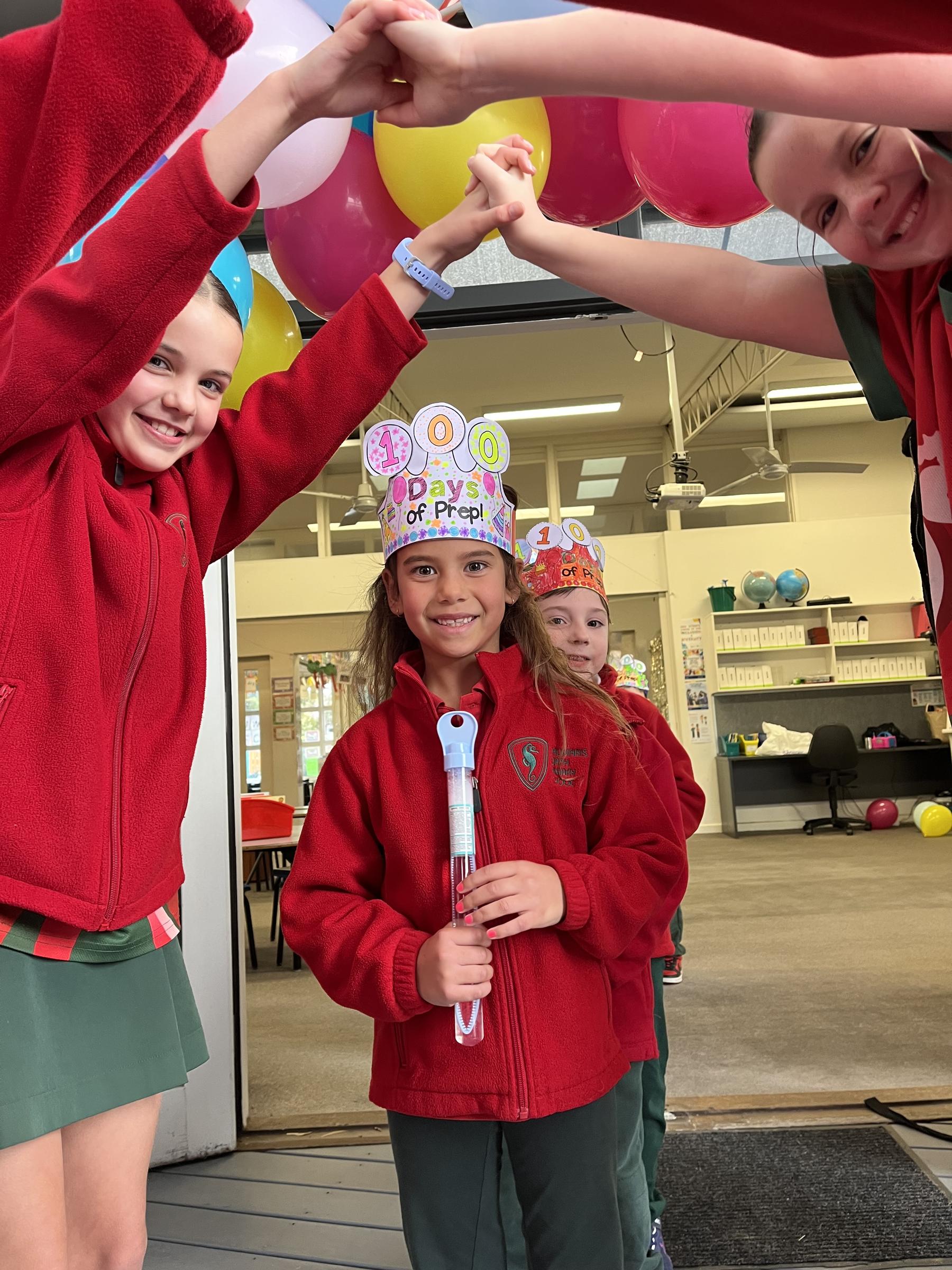
This term we also celebrate the Preps 100 Days of school and Fathers and Special Friends Day morning. We have another interesting and exciting term ahead!
Transdisciplinary Theme
Where we are in place and time
Central Idea
Family histories provide an insight into culture
Lines of inquiry
Transdisciplinary Theme
How the world works
Central Idea
Climate and the type of materials available determines the structures that can be built
Lines of inquiry:
The different materials used to build structures
The way these materials influence the design of the buildings and structures
The effects climate has on the design of houses
English – Literacy Skills Development
In Term 3, students will build upon the foundational literacy skills developed in the first half of the year. Through consistent and engaging activities, students will extend their knowledge and begin applying their skills with greater independence and confidence.
Reading & Viewing
• Consolidating Letter-Sound Knowledge Students will deepen their understanding of phoneme-grapheme correspondences by blending sounds to read consonant-vowel-consonant (CVC) words (e.g., cat, dog, pin). They will continue to engage in multisensory phonics activities using a systematic synthetic phonics approach.
• Developing Decoding Skills
With increased confidence in recognising letters and their sounds, students will begin decoding simple texts. They will practise applying their phonics knowledge to unfamiliar words during guided reading sessions.
• Expanding Sight Word Vocabulary
Students will learn and use an increasing bank of high-frequency words to support fluency and automaticity in reading.
• Comprehension Strategies: We will further explore story elements such as problem and solution, and sequence key events in texts. Students will continue to make predictions, ask questions, and retell familiar stories using beginning, middle, and end structures.
• Use of Print Concepts
Children will develop an understanding of how print works, including directionality (left to right, top to bottom), spaces between words, and punctuation.
Writing
• Writing CVC Words and Simple Sentences Students will practise stretching out sounds in words and writing them using phonetic and some conventional spelling. They will be encouraged to apply their growing knowledge of sounds and sight words to write short, meaningful sentences.
• Writing for Different Purposes
We will introduce different text types such as recounts and simple narratives. Students will participate in shared and independent writing tasks to express their ideas clearly.
• Writing Conventions
Continued focus will be placed on using capital letters at the beginning of a sentence, spaces between words, and full stops. Students will also explore the use of question marks and exclamation marks where appropriate.
• Handwriting Development
Fine motor and handwriting skills will continue to be developed through structured handwriting lessons, focusing on consistent letter size and formation.
Speaking & Listening
• Building Oral Language
Students will take part in purposeful discussions to describe personal experiences, retell events, and share information related to classroom learning.
• Structured Speaking Tasks
Through activities such as storytelling, ‘show and tell’, and group sharing, students will practise speaking in full sentences, staying on topic, and using appropriate voice and vocabulary.
• Active Listening Skills
Emphasis will be placed on listening attentively to peers and teachers, following multi-step instructions, and responding appropriately during class discussions.
• Questioning and Clarifying
Students will be supported to ask and answer questions to clarify understanding and contribute to conversations.
As we enter Term 3, our Prep students will continue to develop their mathematical understanding through hands-on activities and engaging tasks.
This term, our focus will be on further developing foundational skills in Number and Measurement, with an emphasis on practical problem-solving and real-world applications.
Number:
• Addition and Subtraction
Students will explore simple addition and subtraction through real-life scenarios and engaging activities. They will learn to combine and take away objects using concrete materials such as counters, blocks, and number lines. Through play-based learning, students will build their confidence in solving number stories and using everyday language to describe their thinking (e.g., “plus,” “take away,” “how many left?”).
• Sharing and Grouping
In this unit, students will be introduced to the early concepts of division and multiplication through sharing and grouping. They will investigate how to share objects equally among a group and how to make equal groups of items. These experiences will support their understanding of fairness, equality, and foundational mathematical thinking for later multiplicative concepts.
Measurement
• Length, Mass, and Capacity: Students will explore different ways to measure and compare objects based on length, weight (mass), and how much they can hold (capacity). Using informal units such as blocks, hands, or containers, they will investigate terms like longer/shorter, heavier/lighter, and full/empty. Through sorting, comparing, and hands-on measuring activities, students will begin to understand measurement in meaningful and relatable ways.
Respectful Relationships
This term in our Respectful Relationships program, Prep students will continue developing important social and emotional learning skills that support their wellbeing, relationships, and resilience. In Term 3, we will focus on two key topics: Problem-Solving and Stress Management.
Topic 4 – Problem-Solving
In this unit, students will learn simple strategies to solve everyday social problems in respectful and fair ways. They will explore common challenges that might arise during play or classroom activities, such as turn-taking, sharing, and dealing with misunderstandings.
Through role-plays, stories, and discussions, children will practise identifying a problem, considering how others feel, and working together to find a positive solution. Students will be encouraged to use words like 'Can I have a turn?' or 'Let’s take turns' to express their needs and resolve conflicts calmly.
Topic 5 – Stress Management
In this topic, students will begin to understand what stress is and how it feels in their bodies. They will learn that it’s okay to feel worried, nervous, or upset sometimes, and that there are ways we can help ourselves feel better.
Children will explore simple and age-appropriate strategies for managing stress, such as taking deep breaths, talking to a trusted adult, using calming visuals, and engaging in quiet activities. Through stories, mindfulness, and guided relaxation techniques, students will develop a toolkit of helpful strategies they can use when feeling overwhelmed.
The Zones of Regulation, developed by Leah Kuypers, is a systematic framework that helps individuals, especially children, understand and manage their emotions. It categorises emotions and states of alertness into four color-coded zones:
Blue Zone (low alertness)
Green Zone (optimal alertness)
Yellow Zone (heightened alertness)
Red Zone (extremely high alertness)
By fostering emotional awareness, teaching self-regulation strategies, creating a Zones-friendly environment, and using visual supports, we empower children with essential skills for emotional well-being and self-control.
July- Thinkers
We use critical and creative thinking skills to analyse and take responsible action on complex problems. We exercise initiative in making reasoned, ethical decisions.
August- Balanced
We understand the importance of balancing different aspects of our lives - intellectual, physical, and emotional to achieve well-being for ourselves and others. We practice mindfulness to create a calm and relaxed environment
September- Open-minded
We show appreciation for our own cultures and personal histories. We respect the values and traditions of others. We seek and evaluate a range of points of view.
100 Days at School Celebration – Wednesday 23 July
Curriculum Day - 5 August
Life Ed - 19 August
Science Incursion - 20 August
Student Led Conferences - 20 August
Father’s and Special Friend’s Morning – Wednesday 3 September
Father's Day Stall - 5 September
Cubby Day – Wednesday 10 September
Last Day of Term 3 – Friday 19th September (early dismissal at 2.30pm)