STEM News

Dear fellow scientists,
The STEM team would like to welcome everyone back after a joyful break to a fun filled exciting year ahead of learning and hands on experiments.
Prep students are learning to identify the features of animals, such as scales, fins, feathers, wings, and fur. They are practicing by matching pictures of animals to the correct mat. Watch this fun video on animal body parts to see more: https://www.youtube.com/watch?v=5QDEhGDWrCk
Grade 1 students are learning how to use digital technology to help their learning in STEM. Students are following instructions to use an iPad correctly to complete the STEM task and draw their favourite animal on their front page in their STEM workbook by using a kid-friendly search engine named Kiddle.
For this term, Grade 2 students are focusing on the Physical Science unit of sounds. They are learning to follow instructions to scan a QR code and listen to a variety of sounds, including loud and quiet, low and high, as well as sounds from birds, dogs, whistles, and drums. Watch this video on what’s that sound? https://www.clickview.net/primary/videos/80353611/what-s-that-sound
Grade 3 students are learning to identify things in our environment that generate heat. Through discussions with their table partners, students explored everyday objects that produce heat and explained how they know. In their workbooks, they worked together to draw and label objects that produce heat, demonstrating their understanding through both conversation and creative work. Watch this video on how heat is generated | science lesson: https://www.youtube.com/watch?v=N_wsDI5iumM
Students in Grade 4 are working in partners to create a ScratchJr maze game that meets the following requirements: a clear start and end point, player movement using direction buttons, walls to navigate around, and a success message when the player reaches the end. Watch this video on how to create a maze on Scratch Jr: https://www.youtube.com/watch?v=N254_ZF9L4w
Grade 5 students are learning to match different types of space technology with their uses. They watched a video and recorded two interesting facts about both old and new space technology in their workbooks. Watch this video of discovery: history of Astronomy: https://www.clickview.net/primary/videos/50254/discovery-history-of-astronomy
Grade 6 students are learning to model the behaviour of particles in a solid, liquid and gas. Students identified that solids have a fixed or definite shape, liquids don’t have a fixed shape - they flow to take the shape of the bottom of the container, and gases don’t have a fixed shape - they flow to take the shape of the entire container. Look at this https://www.pbslearningmedia.org/resource/arct15-sci-meltingboiling/melting-and-boiling-simulation/ to see how the atoms in different states of matter behave.
Meet the Team
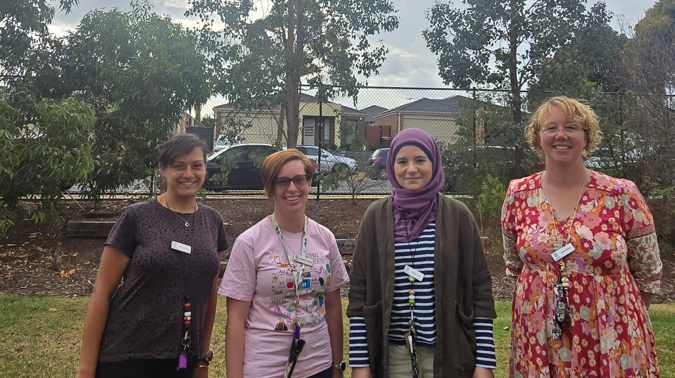
Starting from the left: Ms Gunsan (Melike), Ms Taylor (Charlotte), Ms Gould (Haslinda) & Ms Barnes (Carmen).
STEM team