Welcome to Term Two
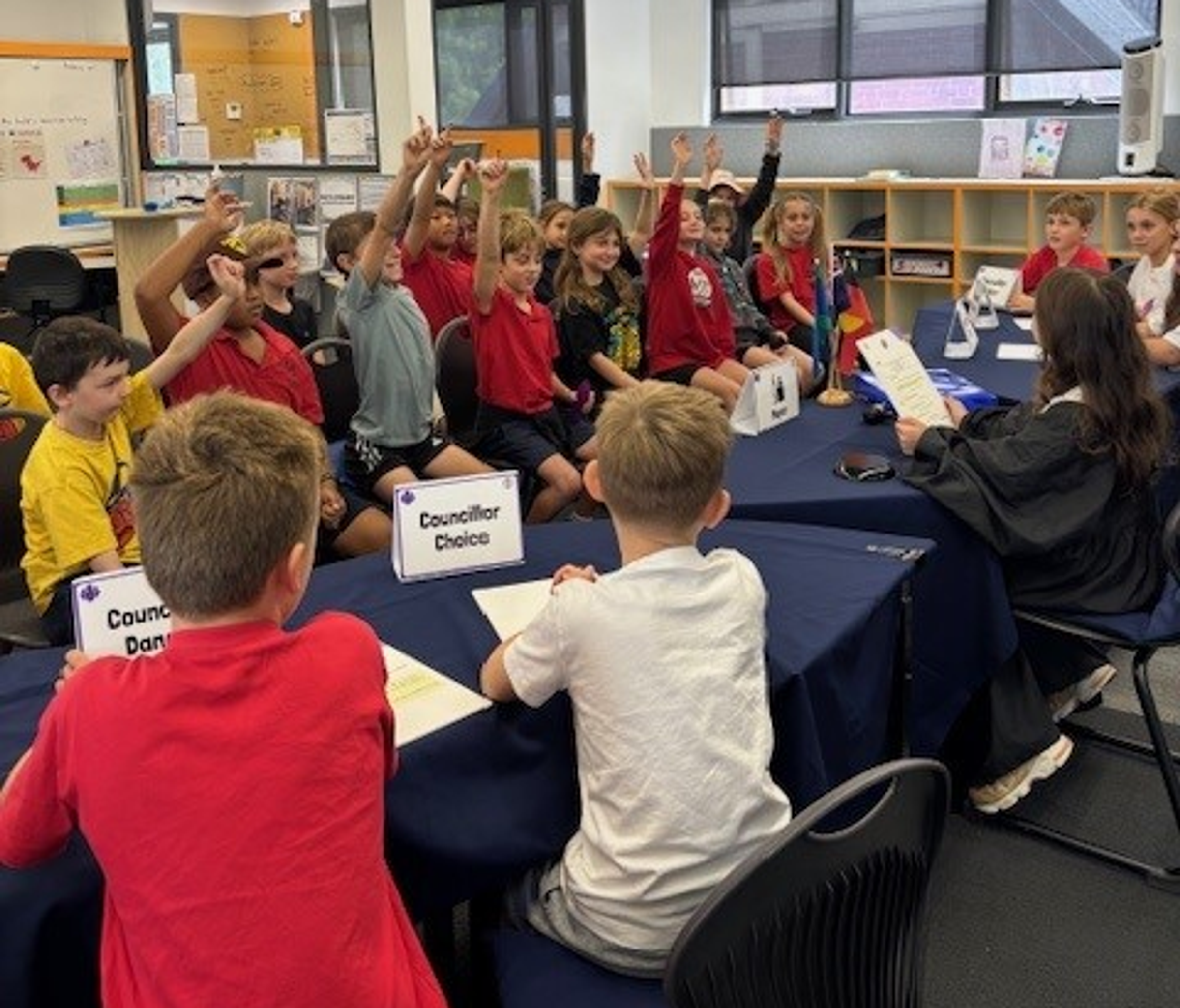
Looking Forward to Camp!
We are looking forward to an exciting term ahead, with one of the highlights being our upcoming camp on the 2nd and 3rd of June. Further details will be shared at our information night (Tuesday 28 April, from 4 - 4:30pm).
Alongside camp, we are excited for another term filled with rich learning experiences and opportunities for exploration in Grade 4.
Literacy
Our Literacy work this term will focus on:
- Information report writing.
- Expanding sentences and paragraphing.
- Growing our vocabulary to include high modality words.
- Adding suffixes and prefixes to words, homophones and spelling.
- Strengthening comprehension while reading our new class novel Storm Boy.
Students will plan, draft, revise and edit an information report on a topic linked to our class novel as an expression of their learning from the term.
Core literacy skills will continue to be supported by weekly explicit phonics, vocabulary, handwriting, grammar and punctuation lessons. Our grammar, punctuation and spelling focus will be determined through assessment and analysis of student writing samples at the beginning of the term.
To support this learning at home you can continue to:
- Encourage your child to read outside of school times daily. If they are a reluctant reader, you could take it in turns to read a page each. Ask questions from time to time to monitor comprehension. Some examples are: Who are the characters? What is the plot? What do you think might happen next?
- Visit the local library to explore different genres.
- Encourage your child to write at home. E.g., keep a journal, write shopping lists or a convincing letter for that new game they’d like.
- Encourage them to use interesting adjectives and verbs (action) when writing.
- Encourage the correct use of full stops, commas and apostrophes.
- Encourage your child to edit their work for mistakes before they show you. They should also make sure the writing makes sense. Getting your child to read their writing aloud is a good technique to find mistakes in writing.
- Using a dictionary helps with spelling mistakes.
- Using a thesaurus helps to expand your child’s vocabulary.
- Encourage your child to practise handwriting at home, to improve neatness.
Provide your child with pens, pencils, paper and a spot to write at home.
Mathematics
In Mathematics we will be learning to develop efficient strategies for addition and subtraction, building confidence with both mental and written methods. Students will work with two, three and four digit numbers, applying place value knowledge to solve problems accurately and flexibly.
A key focus will be on using a range of strategies to support problem solving. These include:
- Jump strategy (breaking numbers into parts and counting on or back).
- Split strategy (separating numbers into hundreds, tens and ones).
- Compensation strategy (adjusting numbers to make calculations easier).
- Students will also practise using the standard written algorithm where appropriate.
We will encourage students to choose strategies that suit the problem, explain their thinking clearly, and check the reasonableness of their answers. Real world word problems will be used to help students apply their skills in meaningful contexts, strengthening both their mathematical understanding and problem-solving confidence.
Students will also explore data by learning to collect, represent and interpret data using tables, picture graphs and column graphs. Students will ask questions, gather data from their peers or environment, and display it clearly using appropriate scales and labels. We will support problem solving by encouraging students to analyse patterns, compare results and explain what the data shows in real-world contexts.
Students will also describe and interpret location using maps, grids and directional language. Students will practise using grid references, coordinates and compass directions to navigate and describe positions. We will support problem solving by encouraging students to visualise movement, follow and give directions, and apply mapping skills to real world contexts.
To support this area of learning at home you can:
- Support general maths fluency by practising skip counting or times tables together.
- Ask your child to teach you the place value games they have learnt at school including: Just Gridding, Mastermind, Four Move Wipe-Out.
- Ask your child to model some of the addition/subtraction strategies they have learnt in the classroom (e.g., “Show me how you can use the jump strategy to solve 45 + 24”).
- Explore place value to at least the tens of thousands together.
- Explore and analyse maps and their different features, such as a map of Australia or your local area. If you are visiting somewhere, look at the map together and explain the directions you are taking.
Further ideas to support students at home can be found here: Literacy & Numeracy Tips to Help Your Child.
Civics and Citizenship
In Geography we will be learning about the significance of places and how people are connected to them. Students will explore the characteristics of Australia and its neighbouring countries, including their locations, environments and cultural features. We will develop students’ understanding of how and why places are important, while building skills in comparing places, interpreting maps and describing connections between Australia and the wider region.
Respectful Relationships (RRRR)
RRRR learning supports social and emotional skill building. This term, we will be focusing on personal and cultural strengths. Activities within this topic area will assist students to:
- Describe personal and cultural strengths.
- Identify some personal and cultural strengths they can use to respond to challenges and opportunities
- Describe factors that contribute to positive relationships with people at school, at home and in the community
- Identify communication skills that enhance relationships
- Describe characteristics of cooperative and respectful behaviour and identify evidence of these in group activities
- Identify ways they can encourage peers to treat others with respect, regardless of their differences in gender identity, ethnicity, abilities, sexuality or family background.
Information on this department mandated program can be found at the following link.
Specialist subjects
Performing Arts
To complement the circus skills students will be learning in preparation for the Year 3 & 4 concert, students will explore drama and expressive movements. They will contribute to choreographing opening and closing songs for the performance, as well as review the skills they will be learning in their circus sessions.
Physical Education
Students will revisit movement skills that are used in track and field. They will practise how to safely and correctly throw a shot put and a discus, run over a hurdle as well as safely practise the scissor and Fosbury Flop technique used in high jump.
Science
Students are continuing with their work on matter, looking at materials and their suitability for a specific purpose.
Visual Arts
Students will continue to explore the combination of complementary colours, adding print and pattern-making to develop their work. They will be channelling Albert Namatjira’s obsession with Australian gum trees, as they head outside to sketch their own.
They will continue to study, examine and reflect on their prior knowledge, with complementary colours as their focal point.
We look forward to continuing to develop positive relationships and successful outcomes for your child.
Prue, Binh, Emilia & the Specialist teachers