STRONG MINDS,
GENTLE HEARTS
News from Frazer Rigby
Deputy Principal

STRONG MINDS,
GENTLE HEARTS
News from Frazer Rigby
Deputy Principal
As students prepare for their end-of-term exams, it is timely to remind them, and parents and carers of the support that can be accessed if and when it is needed. Central to the Marist charism are the words of St Marcellin Champagnat: "for those of greatest need".
Support is provided through a sense of collaboration between staff, students and parents, underpinned by clear pastoral care and behaviour management structures based on the Marist charism.
Support is provided through key personnel including:
Heads of year create supportive professional relationships with students to identify, monitor and regularly touch base with those at risk. Our College Counsellor can also be accessed, as necessary. It is vital that students do not feel alone in their studies. The highs and lows that can be experienced, not just during exam time, but at any point throughout their learning, can be emotionally draining. I hope by reminding everyone of the support that is on offer, we can work together to end the term on a positive note.
A conversation with your son: The line between a joke and a crime – Deepfakes (Insights from Safe on Social and Kirra Pendergast)
A student screenshots a classmate’s photo, uses a free AI app to create a fake sexual image, and shares it in a group chat. It feels like a joke. But under recent amendments to the Crimes Act 1900 (NSW) (effective 16 February 2026), it may be a criminal offence.
In New South Wales, Queensland and other Australian states it is now illegal to create, share or threaten to share intimate images without consent – including images entirely generated by artificial intelligence. Even if the image is fake, even if it was “just for fun,” the law treats it as abuse. Penalties for adults include up to three years’ imprisonment and significant fines. For young people, consequences may include police cautions, youth justice conferences, school suspension or expulsion, wellbeing interventions and in serious cases, long-term legal impacts.
These state reforms sit alongside Commonwealth legislation, including the Online Safety Act 2021, giving authorities strong powers to act quickly. Importantly, if both students involved are under 18, AI-generated sexual content can legally constitute child abuse material – regardless of intent.
Most teenagers do not understand that using AI tools in this way can have lifelong consequences. They are growing up in a world where content is created instantly and shared reflexively, often without considering the harm caused.
This is why conversations at home matter. Young people need to understand that a digitally created sexual image is not a meme – it is an act that can cause real psychological harm and serious legal consequences.
We encourage families to speak openly about responsible technology use, consent and dignity online. The law has changed. The stakes are real. And one moment in a group chat can have lasting consequences.
Aerosol deodorant procedure
To support the health and safety of all members of our college community, particularly those with asthma and severe allergies, we remind families of the following guidelines regarding aerosol deodorant use.
Rationale: Several students and staff at St Augustine’s experience asthma, severe allergies and anaphylaxis. Aerosol products can trigger these conditions, leading to symptoms such as asthma attacks, headaches (including migraines) and in severe cases, anaphylactic shock. Aerosols also contain flammable substances and may cause harm if inhaled.
For these reasons, aerosol products are not permitted on school grounds or at any college-related activities, including excursions, after-school events, sporting fixtures and within boarding.
Student and staff responsibilities: Students are expected to maintain appropriate personal hygiene, including regular showering, wearing a clean uniform, and applying deodorant before attending school. Roll-on and stick deodorants are permitted at school.
If a student is found with an aerosol deodorant, the following procedure will apply:
Confiscation: Staff will request that the student hand over the aerosol deodorant. The staff member will notify the relevant head of year and, where applicable, the head of residence.
Using aerosol deodorant at the College or during college-related activities may result in disciplinary action, depending on the circumstances.
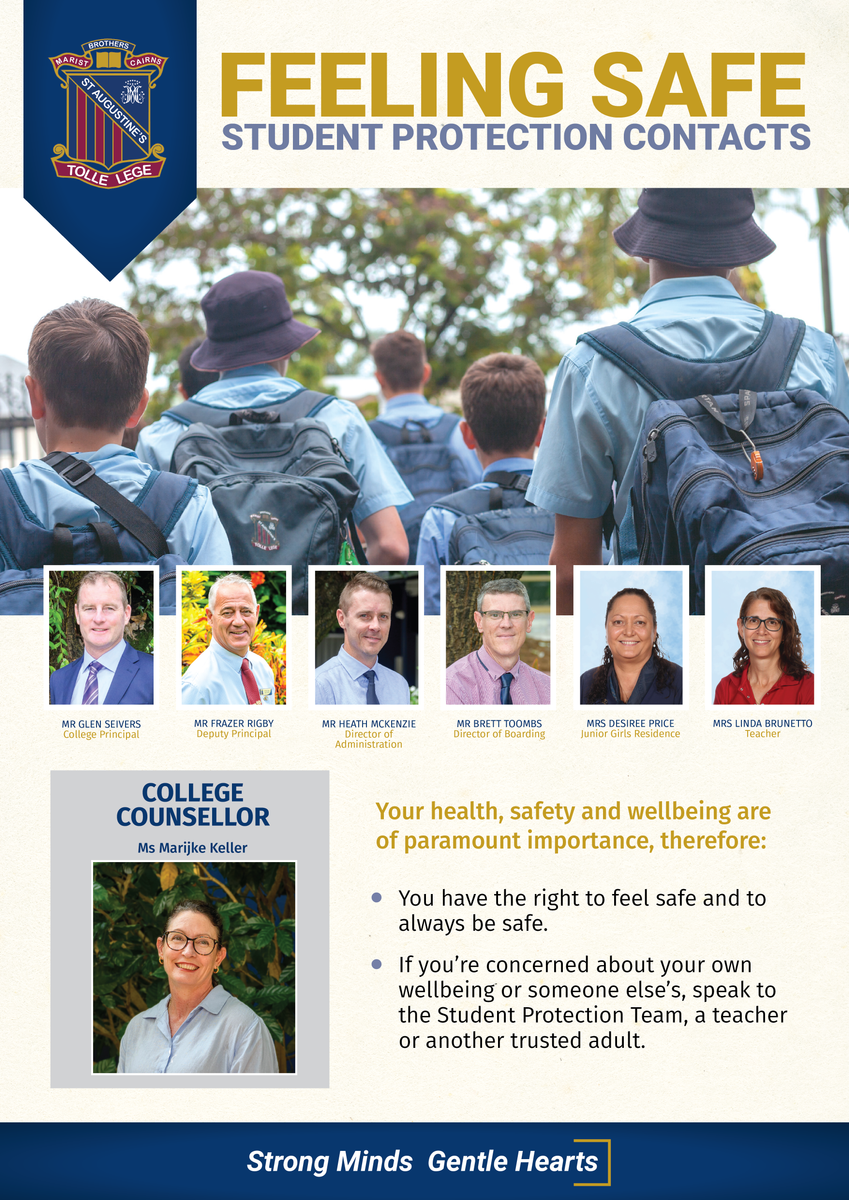
Student protection processes and guidelines. Available through the Catholic Education website.
Student Protection Processes and Guidelines
Student Protection Handbook for Volunteers