
Learning Specialist News
Be Kind
Be Responsible
Be an Active Learner

Learning Specialist News
Be Kind
Be Responsible
Be an Active Learner
At SMPPS, we are continuing to strengthen the way we teach Mathematics by using Concrete–Pictorial–Abstract (CPA) strategies as part of our explicit teaching and instructional model, which we featured in last week’s newsletter.
CPA is a carefully sequenced way of helping children develop mathematical understanding. Rather than asking students to jump straight to numbers and symbols, we guide them through three stages of learning:
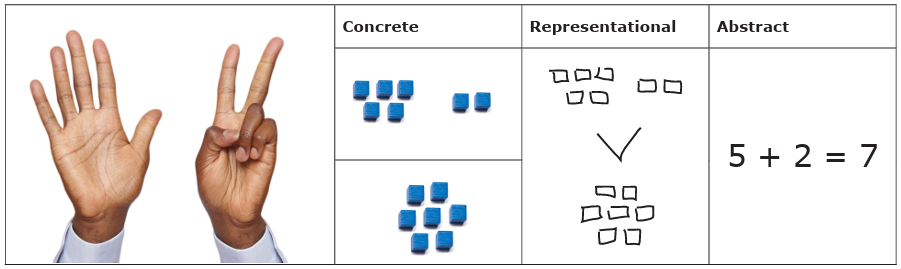
(Source: Merlo, S. 2024)
This approach aligns with the instructional hierarchy, which recognises that learning progresses from acquiring a new skill, to building fluency, and then applying it flexibly in new contexts.
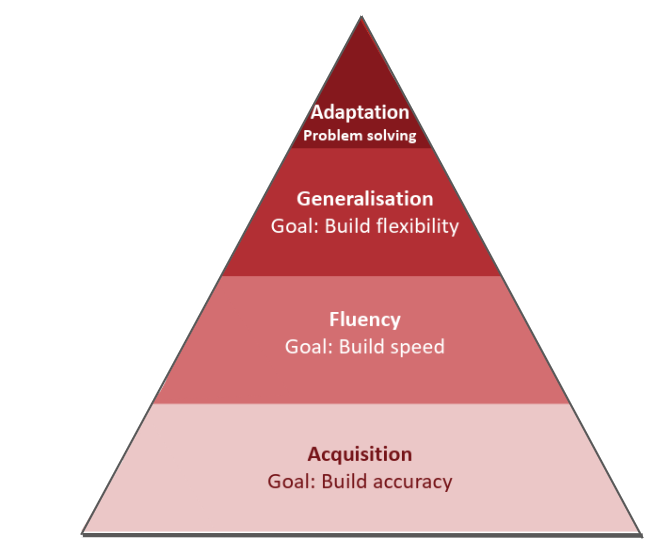
(Source: Harring & Eaton, 1976)
Our aim is to move students “as quickly as possible, but as slowly as necessary” from concrete materials to abstract representations, building both accuracy and efficiency along the way. As students develop proficiency, they are able to transfer their mathematical understanding across different contexts and disciplines; a progression that occurs at every stage of learning, from Prep to Year 6.
As we progress through our professional learning on the instructional hierarchy, we will share what this looks like in practice in the classroom over the coming issues.
Ben Sanderson
Learning Specialist