
Assistant Principal's Report
Katrina Spicer - Wellbeing and Inclusion

Assistant Principal's Report
Katrina Spicer - Wellbeing and Inclusion
IS IT BULLYING?
The word 'bully' is a powerful word that evokes images of harmful intent, power imbalance, fear and intimidation. This word is sometimes used by students and families when students have experienced unpleasant experiences at school.
The Merriam Webster dictionary definition of this word is: 'one who is habitually cruel, insulting, or threatening to others who are weaker, smaller, or in some way vulnerable.'
At WHPS we have clear and consistent messaging about what constitutes bullying. We teach our students that one unpleasant experience does not meet the definition of bullying, and that this behaviour could be described as 'Not Nice' or 'Mean'. Bullying is ongoing, targeted hurtful behaviour.
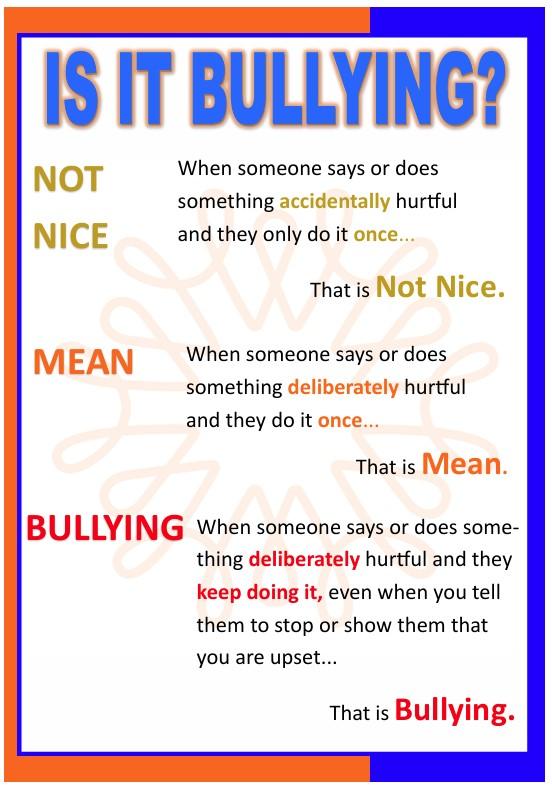
This poster is on display in every classroom and is used by teachers to assist with resolving playground and social issues. Having clear, consistent language around inappropriate behaviour helps our students to understand their own and other students' behaviour and assists school staff to manage such behaviours.
RESTORATIVE PRACTICES
As our students develop their social skills, inevitably some students will make mistakes, behaving in ways that are hurtful or harmful to others. When mistakes like this occur at WHPS, we use a restorative approach to help heal the harm done and set things right.
A restorative approach differs from more punitive approaches to behaviour management, in that we focus on the harm done, and what must happen to set things right. Behaviour mistakes are managed in terms of how others have been affected and we aim to bring about a sense of remorse and restorative action on the part of the 'offender', and forgiveness by the 'victim'.
Research shows that a restorative approach to behavioural mistakes results in more lasting behavioural change than authoritarian measures, and improved relationships between those who harm, and those who have been harmed.
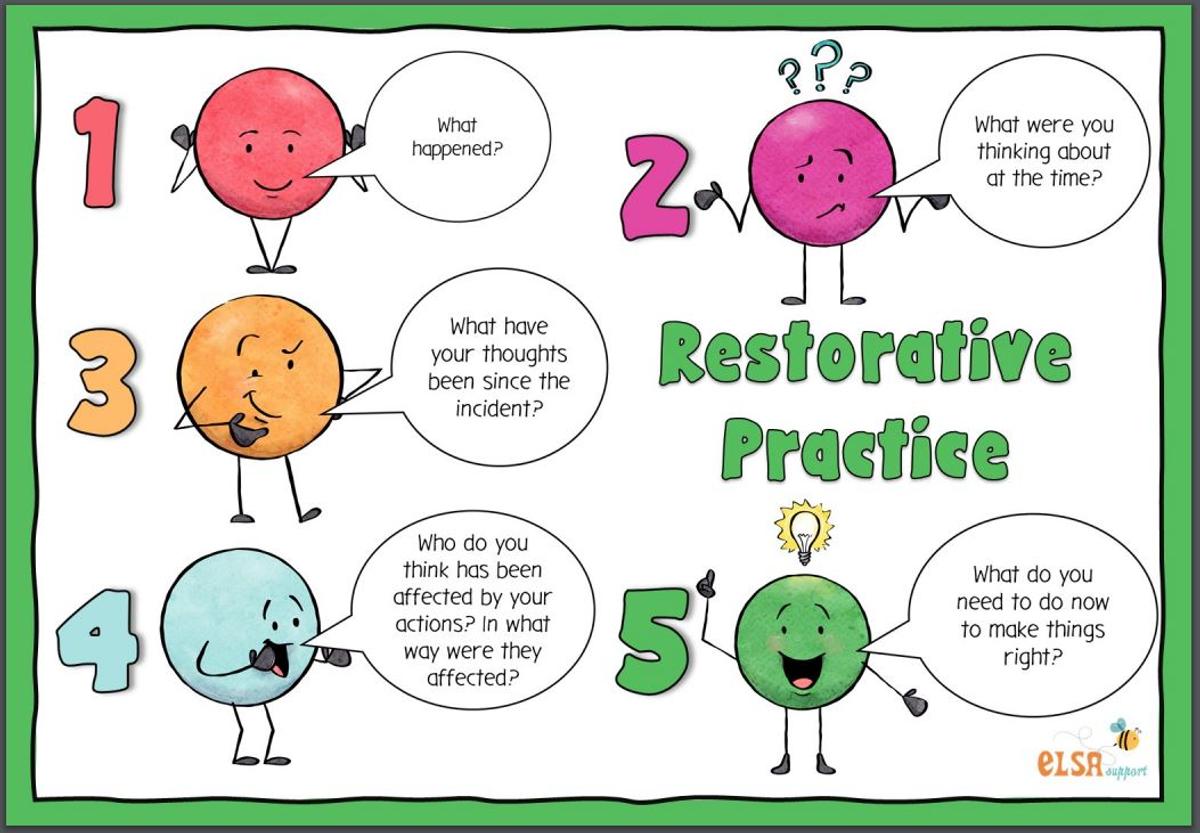
A typical restorative chat would involve all concerned parties. Everybody has the opportunity to explain their side of the story, and those affected are able to say how they would like the situation to be resolved. Usually, children simply ask for an apology and sometimes, if they are not feeling safe around someone, they might ask for the 'offender' to be withdrawn from the playground. 'Offenders' are induced to feel remorse and empathy for those affected, and we aim to mend broken relationships.
Staff members who run restorative chats will follow a set structure or script, to guide the discussion. The majority of behaviour mistakes at WHPS are managed through this restorative process.
A restorative approach may not be appropriate for significant, major incidents. In such cases, students will be referred immediately to school leadership.
Katrina Spicer
Assistant Principal for Wellbeing and Inclusion
katrina.spicer@education.vic.gov.au

THE RESEARCH, THE RISKS AND A BETTER WAY FORWARD
By Dr Justin Coulson
As a new school year begins, many parents find themselves facing a familiar dilemma: "Is it time to give my child a phone?"
The pressure can feel enormous - socially, logistically, and emotionally. Children insist that "everyone has one", other parent reassure us it's what happens in Year 7, and we wonder whether refusing is unreasonable or outdated.
But before making the jump; pause. While smartphones are part of modern childhood, the age a child receives one matters - a lot.
A recent peer-reviewed study in Pediatrics followed more than 10,000 children aged 10 - 12. They found that:
Earlier acquisition of a smartphone is associated with significantly worse outcomes.
Children who received a smartphone during their 12 year had:
The tween and teen brain - particularly the pre-frontal cortex responsible for impulse control, planning and decision-making - isn't mature right now. The never ending whirlwind of apps, games, notifications, and distraction (plus time on social platforms that isn't technically allowed anymore) can be overwhelming for a brain still under construction.
Research internationally suggests a similar theme: Every year we delay smartphone access tends to reduce risk.
WHY PARENTS USUALLY SAY YES, AND WHERE IT GOES WRONG
Parents give me four reasons for handing over a smartphone to their child:
Safety. ("What if they need help?")
Response: Smartphones are not required for safety. A basic 'dumb phone', watch-phone, or even a household landline solves the safety problem without handing over social media, messaging apps, games or endless internet access.
Logistics. ("I need to coordinate pickups and plans.")
Children survived without phones for generations. Clear communication ahead of time works better than constant messaging, and it builds resilience and independence.
- set pickup time and place
- teach children how to ask an adult for help
- make a simple backup plan ("If I'm late, you start walking...")
And a dumb phone will do the job if logistics is a challenge. See #1 above.
Social Connection ("They'll be left out without one.")
Group chats and digital friend circles feel social, but they often increase comparison and competition, exclusion and anxiety, cyberbullying, and sleep disruption. In-person friendships remain richer and more developmentally important.
"They'll Need to Learn Eventually".
Giving a 12 year old a smartphone to ‘learn to manage it’ is a bit like giving the same 12 year old a bottle of vodka to ‘learn to drink responsibly.’ Most children aren’t developmentally ready for that level of stimulation and access.
A FRAMEWORK THAT ACTUALLY WORKS
The standard in our family is simple. "When you can afford it and pay for it yourself - it's yours."
That includes:
replacements if lost or broken
This framework works because it:
Most children don't have $800 - $1500 for a device plus monthly fees until somewhere between 15-17, which aligns with many child psychologists' recommendations.
"BUT MY CHILD ALREADY HAS A SMART PHONE..."
If the horse has already bolted - please don't panic. You haven't 'ruined' anything.
Instead, create clear, developmentally appropriate boundaries.
consistent routines around sleep and charging
If possible, consider stepping back from smartphones to simpler options - plenty of families do this successfully.
ACTION STEPS FOR PARENTS
For Ages 5-10
For Ages 11-14
For Ages 15-18
THE REAL QUESTION
Smartphones aren't evil, and technology isn't the enemy. But access without readiness creates problems that are harder to undo than they are to prevent. Delaying smartphone access - even by one year - can make a meaningful difference to mental health, sleep and learning.
And as parents, that's a difference we can give our children.