from our Principal






































 Wangaratta High School
Strengthening Our Relational Culture: Continuing Our Restorative Practices Journey
On Wednesday, 5th March 2025, our entire staff participated in a full-day professional development session, marking another significant step in our commitment to embedding restorative practices at Wangaratta High School. This follows the launch of our three-year partnership with Real Schools, an initiative that continues to shape our approach to student relationships, behaviour, and school culture.
Restorative practices represent a fundamental shift from adversarial methods of conflict resolution. Instead of focusing on punishment and blame, restorative approaches prioritise repairing harm, fostering accountability, and strengthening relationships. The research is clear: when students feel safe, valued, and connected to their school community, they engage more positively in their learning and development.
The Next Phase: Deepening Our Practice
This year, we are advancing our understanding of restorative language and emotional regulation. The way we communicate—both in the classroom and beyond—profoundly shapes school culture. One of our key areas of focus will be the interplay between shame, conscience, and behaviour, ensuring our practices reinforce responsibility without stigma.
Understanding Shame: Stigmatising vs. Reintegrative
Shame is a powerful emotion, and how we respond to it matters. Research highlights two key forms of shame:
- Stigmatising Shame isolates and labels students, often leading to withdrawal, resentment, or defiance. Punitive responses that focus on guilt rather than repair can damage long-term engagement.
- Reintegrative Shame acknowledges harm while providing structured opportunities for students to take responsibility and make amends. This approach strengthens relationships and supports long-term behavioural growth.
At our school, we are committed to fostering Reintegrative Shame rather than punishment-based approaches. This means helping students recognise the impact of their actions while guiding them towards repair and reintegration within the school community.
Student Engagement Plan: Building a Connected and Responsible Culture
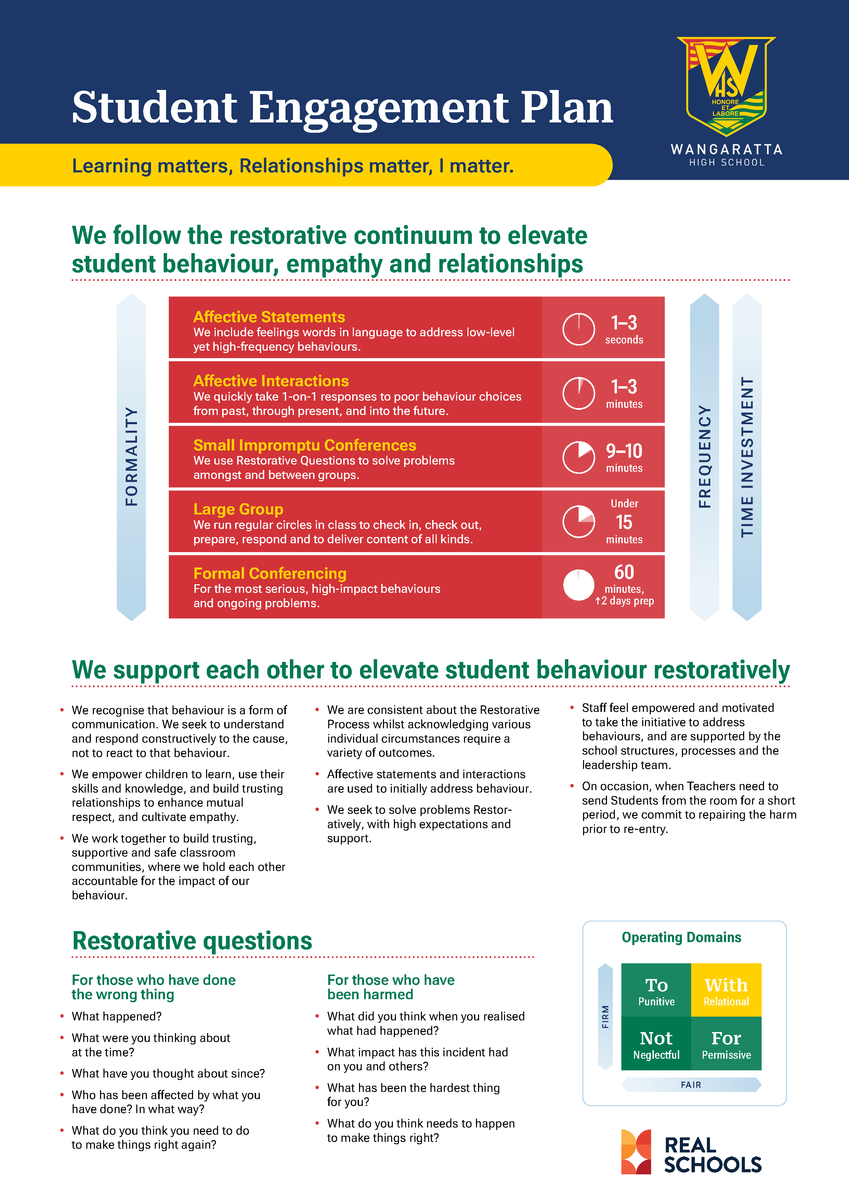
At Wangaratta High School, student engagement is built on three key beliefs:✔️ Learning Matters✔️ Relationships Matter✔️ I Matter
Our Student Engagement Plan outlines our approach to elevating student behaviour restoratively, ensuring that every student feels supported while being held accountable for their actions. Key elements include:
✅ Recognising Behaviour as Communication – We seek to understand the underlying causes of behaviour rather than reacting to it.✅ Restorative Problem-Solving – Affective statements and restorative questions are used as first responses to behaviour.✅ High Expectations with High Support – We balance clear behaviour expectations with support systems that empower students to learn from their mistakes.✅ A Continuum of Restorative Practices – From affective statements to formal conferencing, our approach adapts to the needs of the situation.
A core part of our approach is ensuring that when students are removed from the learning environment for behaviour reasons, restorative repair happens before re-entry.
Shifting Our Language: Small Changes, Big Impact
One of the simplest yet most powerful changes we can make is in our everyday language. Research is clear—language shapes perception, mindset, and culture. This year, we will continue refining our use of restorative language in four key ways:
1️⃣ Affective Language – Instead of directive commands, we will increasingly use the language of emotions. For example, rather than saying, "Pick that up," we might say, "It disappoints me to see you leave that rubbish on the ground. Please pick it up." This subtle shift fosters empathy and self-regulation.
2️⃣ Stored Responses – Emotional moments can lead to unproductive language. We will focus on developing scripted responses for difficult situations, ensuring we communicate with consistency and clarity, even in moments of frustration.
3️⃣ Positive Priming – Reinforcing desired behaviours is more effective than focusing on what not to do. Instead of saying, "Stop running," we’ll try, "Let’s walk safely." This small adjustment helps frame expectations in a constructive way.
4️⃣ Stakeholder Protection – A psychologically safe environment benefits students, staff, and families. We will ensure our language supports an inclusive, respectful, and supportive school culture.
A Shared Responsibility: Extending This Approach Beyond the Classroom
The shift to restorative practices is not just for staff—it’s a whole-school commitment. Parents and carers play a crucial role in reinforcing these principles at home. Simple changes in language can make a meaningful difference in fostering responsibility and emotional intelligence in young people.
For example, instead of reacting to a messy bedroom with frustration, try saying,"This mess is pretty frustrating," and then walk away. You might be surprised by the response. Language is a powerful tool in shaping behaviour, and when used intentionally, it can lead to remarkable changes in young people’s ability to regulate themselves and take responsibility.
Moving Forward Together
As we continue to refine our approach to restorative practice, I encourage all staff, parents, and carers to reflect on the power of language and its impact on school culture. The small changes we make today will help build a more connected, respectful, and high-expectations environment for our students.
I look forward to sharing more about our progress as we continue this important journey.
Dave Armstrong
Executive Principal