
Mental Health in Primary Schools (MHiPS)
Children’s mental health is fundamental to their development and learning. Good mental health means having a positive sense of wellbeing, coping with challenges and being able to realise individual potential. Unfortunately, not all children experience good mental health. Schools are an ideal platform for promoting children’s mental health. Yet, without resourcing and dedicated training and support, it can be challenging for teachers to navigate increasing mental health issues in the classroom.
In 2026, Boroondara Park Primary School will implement the Mental Health in Primary Schools (MHiPS) initiative. As part of this work, I will undertake the role of Mental Health and Wellbeing Leader (MHWL) while continuing in my position as Learning Specialist – Wellbeing.
The Mental Health in Primary Schools (MHiPS) initiative was developed in Victoria, Australia, as a partnership between the Murdoch Children’s Research Institute (MCRI), the University of Melbourne’s Faculty of Education, and the Victorian Department of Education. The framework emerged from a recognised need to address mental health issues in children and the need to support teachers in managing these challenges.
The program aims to:
- build the capability and confidence of educators to better identify and support student mental health concerns
- implement effective mental health strategies aligned to social and emotional learning in the curriculum and whole school approach to health, wellbeing, teaching and learning initiatives
- improve mental health and wellbeing outcomes for students which as a result also improve social and academic outcomes
The core of the framework is the establishment of a Mental Health and Wellbeing Leader. Developed by paediatricians, educators, psychologists, researchers, and teachers, this initiative upskills experienced teachers to become Mental Health and Wellbeing Leaders and aims to increase the capacity of Victorian primary schools to support the mental health of their students.
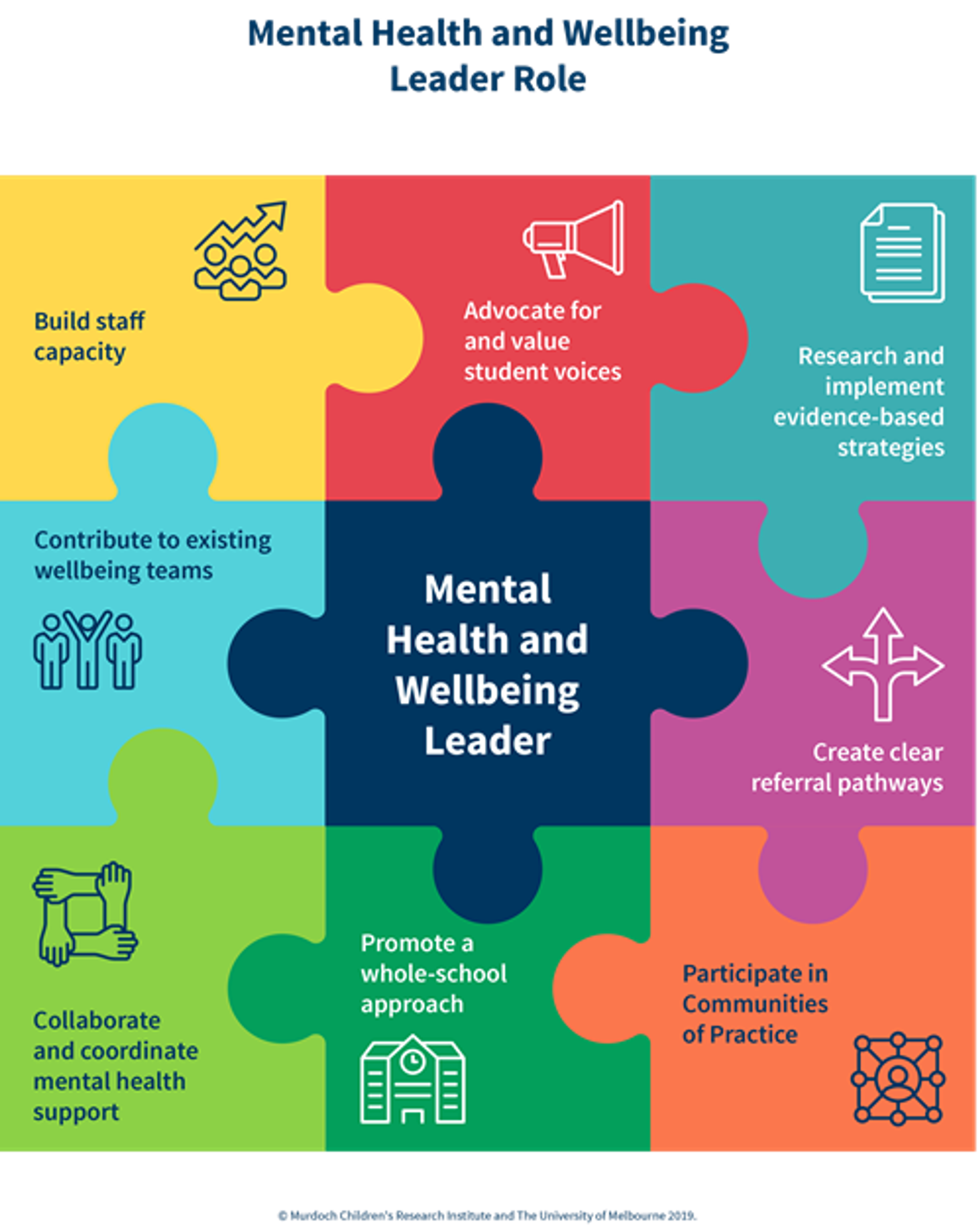
As of 2026, all Victorian Primary Schools must have a Mental Health and Wellbeing Leader, a MHiPS initiative. The role of the Mental Health and Wellbeing Leader (MHWL) is to build the capability of the whole school with regard to mental health and wellbeing (identification, promotion and prevention), provide support to staff to better identify and support students with mental health needs, establish clear pathways for referral for students requiring assessment and intervention, and monitor and evaluate student progress. The role was established specifically to coordinate support for educators in the classroom and to act as a vital link between the school and external support services.
The MHWL role is quite different to a Student Support Services officer, Allied health professionals or psychologist – it is not a clinical role and is not designed for direct intervention or mental health assessment. The role is designed to provide a proactive focus for the promotion and prevention of mental health and wellbeing through assessment and implementation of context-relevant programs, approaches and initiatives based on a broad and extensive knowledge of the needs of the school.
The Mental Health and Wellbeing Leader will support the school to:
- embed evidence-based training and resources across the school to build the capability of staff to better identify and support students
- provide support to individual teachers in the classroom with students who have been identified as in need
- create clear pathways for students who may need further assessment and intervention within the school and to external community-based services
- use informed referral pathways to strengthen linkages between schools and community services
- work proactively with regional education department staff, school wellbeing teams and other health professionals to engage appropriate mental health support
- contribute to the development of larger-scale reform, promoting what works to support students’ mental health and wellbeing
- coordinate targeted mental health support for students by working with regional staff, school wellbeing and leadership teams, teachers, parents/carers, and external agencies.
The MHWL role focuses on mental health and wellbeing promotion, prevention and early intervention, rather than the implementation of clinical or allied health approaches.
The Mental Health and Wellbeing Leader (MHWL) role includes comprehensive training provided by the University of Melbourne’s Faculty of Education, supported by the Murdoch Children’s Research Institute. The training is evidence-based and focuses on equipping qualified teachers to lead a whole-school approach to mental health, including promotion, prevention, and early intervention.
Throughout the year, I will be completing this training as part of the MHWL team with Llaaneath Poor and Shannon Reeve, providing professional learning to staff, working in partnership with the parent community, and supporting students.
The introduction of the Mental Health and Wellbeing Leader (MHWL) role represents an exciting time for primary schools to strengthen their approach to student wellbeing. Aligned with DET priorities of prevention, early intervention, and a whole-school approach to mental health, the role builds school capacity to support the social, emotional, and mental wellbeing of all students. In a primary school context, the MHWL supports educators to identify and respond to emerging wellbeing needs early, when intervention is most effective, while increasing staff confidence and capability through targeted professional learning.
By embedding wellbeing practices across everyday teaching and learning, the role contributes to a positive, inclusive school culture, reduces pressure on classroom teachers and school leaders, and supports improved engagement and learning outcomes.
I'm looking forward to working with the school community in this new role!
Kristen Schultz
Mental Health and Wellbeing Leader and Learning Specialist - Wellbeing