
Teaching and Learning

🐝 Yr 3-6 English Teachers: Prime Minister's Spelling Bee
Year 3-6 students will be participating in an online spelling bee before August 22nd. Students will need to be signed up by their parents via Compass and more information will be provided as to when you can run the spelling bee during class time.
To do in the meantime:
- Year 3-6 English teachers please register as a teacher, which will give you access to your portal: https://www.spelling-bee.com.au/teacher-registration/
Become familiar with the competition here: https://www.spelling-bee.com.au/how-it-works/
I have uploaded some resources such as instructions, practice spelling lists and website links on the drive that will become useful when we conduct the competition: https://drive.google.com/drive/folders/1JBVQ7_Nry7yd4ypfJKC2rivtak6nEtJk?usp=drive_link
Please contact Kellie Jackson if you have any queries. I will send out further information as soon as possible!
Kellie J.
Teaching Maths as opposed to teaching Literacy
Research on teaching Mathematics... important elements to keep in mind...
Comparing the evidence on daily reviews and slide decks to more effective explicit teaching practices - summaries of experts, longitudinal NAPLAN and PISA data, and the student engagement factor.
Based on the research and PL workshops delivered by Dr Matt Sexton (PhD, MEd, BA, BTeach), Director of the Mathematics Teaching and Learning Centre, Australian Catholic University: Explicit teaching is not a slide deck. Explicit teaching in its proper form is a series of strategies that includes multiple exposures creating connections, modelled examples, immediate feedback, questioning prompts, and high-quality task selection planned by a team using the professional learning cycle. The teacher must remain the leading professional who knows their students - they cannot download a set of ready-made slides and still be acting in that professional role. We highly recommend viewing Dr Matthew Sexton's recorded webinar on Rethinking explicit teaching in mathematics: More than just direct instruction.
Based on the research and PL workshops by Professor Linda Parish (PhD), Faculty of Education, with specialities in Mathematics Education and Mathematically Gifted Students, Australian Catholic University:
Early numeracy is different to early literacy. Early literacy is skill-based, while early numeracy is concept-based. You cannot learn a concept on a screen - it requires a carefully crafted series of hands-on, rich learning experiences and manipulatives to build over the course of many exposures, with students carefully led towards constructing that concept using materials.
Based on the research and PL workshops delivered by Emeritus Professor Peter Sullivan (PhD), Mathematics Education, Monash University, past President of the Australian Association of Mathematics Teachers:
Active learning and particularly cognitively challenging tasks (students doing the thinking and generating multiple ways to solve a problem) was found to be the most effective method.
Learning to read is not like learning to do mathematics. The ideas cannot be taught in isolation - the ideas are relational and build on each conceptual understanding. One of the key aspects of mathematics is actually using mathematics to do something else. There is a need to recognise that the curriculum is built around verbs...with students doing the thinking. It is preferable for students to make sense of what they are learning, rather than following step-by-step instructions, to connect conceptual understanding and build knowledge structures to connect ideas in the long-term memory, rather than just memorise a rule to be applied.
Based on the Australian Association of Mathematics Teachers (AAMT) position paper, Pedagogy in Mathematics (2025): No single pedagogical approach can meet the needs of every mathematics learner. Representations and manipulatives are powerful tools for exploring, understanding, visualising and communicating mathematical concepts. Manipulatives, often associated with early learning, are valuable at all stages of mathematical development. Engaging with multiple representations and manipulatives helps students access mathematical concepts, transition from concrete to abstract thinking, extend their reasoning, make connections between ideas and build a robust understanding. Maintaining appropriate challenge involves using meaningful tasks, scaffolding strategically and giving growth-oriented feedback. A classroom culture that values persistence, curiosity, and sense-making helps students connect effort with achievement. When appropriately challenged in a supportive environment, students develop deeper mathematical understanding, greater persistence, and a more positive disposition toward learning mathematics.
Based on PL workshops delivered by Top Ten Numeracy Coach Anna Kapnoullas (LLB Hons. B.Com Dean's Comm GDip Ed), who has led the whole-school approach to numeracy at four of the highest-achieving government schools on record in the past eight years, in terms of NAPLAN student growth for matched cohorts: Fluency is polish after conceptual understanding and reasoning have been firmly developed with materials and hands-on concrete-representational-abstract experiences. Spaced retrieval follows conceptual mastery - it cannot be achieved in the absence of it. Slides are worksheets on a screen, and worksheets have not worked for the past 20 years in Australia, according to our PISA outcomes, particularly compared to CPA/CRA approaches (see results below). If we focus on fluency first, without a depth of conceptual understanding, we will end up with polish, but no shoe. When we visited Singapore's classrooms and researched their approach with school leaders in-person, the main emphasis was the CPA (Concrete-Pictorial-Abstract), as well as problem-solving with students attempting the problem, then receiving feedback from peers and the teacher - there was not a single daily review slide deck in use. That is because spaced retrieval can be achieved in many different ways (activating prior knowledge through the way the task is introduced; building mathematical language and strategy/numeracy walls; the use of place value materials/MAB throughout all operations; number talks; transition songs; daily morning maths chats focused on the months/seasons or number of days at school; daily pauses to tell the time on an analogue clock; shape and angles spotting walks while transitioning to specialist classes; and so on). All these classic, but timeless, mechanisms are far more effective, real-life and engaging spaced retrieval methods than a slide deck, which by its nature can only ever cater for one single point-of-need, while most classes have an extremely wide range of entry points that can be well catered for with stretchable, multiple entry-point, high-quality tasks, not slides.
Based on the classroom modelling delivered by Numeracy Coach Michael Ymer, a renowned expert in primary numeracy instruction in Australia and internationally: A great maths lesson starts with a great story. The pathway to long-term memory is a story, not a sheet or a slide.
Based on the website of Numeracy Coach Rob Vingerhoets, experienced Principal and Curriculum Coordinator, who has also worked with thousands of schools across Australia and internationally as a numeracy consultant and subject matter expert, to increase student thinking and engagement levels: We need adults and businesses want employees who can think, communicate, be creative, solve problems, apply logic and reasoning, and work cooperatively. What I have not heard yet is the 'slide approach' rationalised with the four proficiencies in Mathematics (understanding, reasoning and problem-solving, not fluency alone) – these proficiencies are not vague or unimportant – they are what should be aiming for.
For French Teachers: RALLYE LECTURE 📚
As mentioned at the end of Term 2, our first French Rallye Lecture organised in collaboration with Killarney Heights Public School is about to start. It will take place in weeks 3, 4, 5 & 6 of this term.
Our goal is to encourage students to immerse themselves in French literature just for the pleasure. Over 4 weeks, we will challenge and motivate our students to read as many French books as they can!
When ?
Over 4 weeks from Monday 4th August (T3 W3) to Friday 29th August (T3 W6).
Who?
- All Year levels:
- The whole class will listen to 2 books read by the teacher and compare them (your Year level will be provided with these 2 books - same 2 books as KHPS).
- Students will vote for their favourite book out of the 2.
- Yr2 to Yr6:
- Individual students will also borrow books to read at home from a selection of books prepared for your class (thank you to the amazing Bilingual Aides team for organising the box of books you will receive !).
Time to be allocated in your weekly Planners ?
- Week 3
- start of the week: 10 minutes to introduce the RALLYE LECTURE to your class(es).
- during the week : teachers to read to the class the 2 books selected for your Year level. Allow a bit of time every day.
- end of the week 3:
allow 1 lesson to reflect on the 2 books read during the week. Students will answer questions about their favourite book. Questions for each Year level can be found here: Rallye de Lecture 2025
You can print the questions for your students:
https://drive.google.com/drive/folders/1pHnhpMurV3g6CXsW-L383-UblJeA3_DU
Please take pictures of the most interesting answers and post them here: Work samples photos. We will share these comments with KHPS.
- Then get your class to vote for their favourite book. Record the vote results here: Vote: notre livre préféré. Stefan and Caroline will then share the results of the vote with KHPS.
- Week 3 to Week 6
- every day: allow 5-10 minutes for students to borrow/change the book they will read at home. Track the books borrowed by students using their book number as well as the number of books read by students: Comptabilisation des livres lus et empruntés.xlsx
- Week 5 - BOOK WEEK
- 1 lesson allocated for Buddy Reading (F/Yr6, Yr2/Yr5, Yr1/Yr4, Yr3 to read with another Yr3 class).
- Teachers in each Year level will be responsible for organising a suitable time in Week 5 with their buddies.
Certificates
- Each Yr2 to Yr6 participating student will receive a certificate mentioning the number of French books read over the course of the 4 weeks. The certificates will be printed for you and delivered to your tub in Week 5. You will just need to write the number of books for each child and sign the certificate.
- A special certificate and a prize (a book) will reward the student having read the largest number of books over the course of the 4 weeks in each year level (Yr 2 to Yr 6). This certificate will be signed by Janet.
Any questions? Contact Stefan or Caroline E.
Stefan W. & Caroline E.
NAIDOC - Thanks!
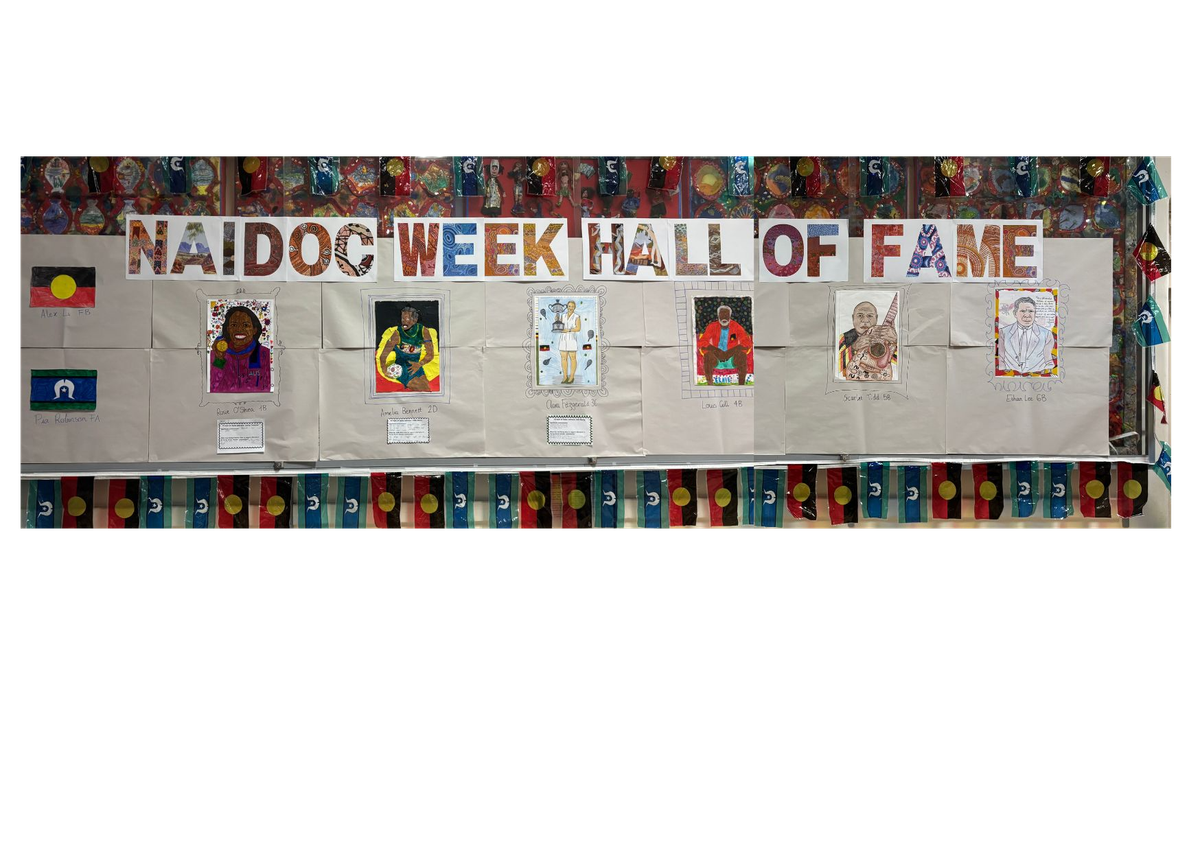
Thank you everyone for your participation in NAIDOC Week in your classes. We were so thrilled with the artworks that students created and that they were able to learn about, appreciate and celebrate the significant achievements of First Nations peoples.
The Hall of Fame is on display outside the Science room on the Senior Campus. Feel free to take your kids for a wander or to let them know to go have a look!
If you have any photos from NAIDOC Week this year please add them to this folder on the Drive!
Thanks, The RAP Committee
AMC - Australian Maths Competition
Hi everyone,
As mentioned in last week's briefing notes, please find attached a Google Sheets link to the list of attendees (broken down in tabs per class) as well as their usernames and passwords.
The AMC will be held on Tuesday, August 5th (Week 3). We ask that as a team, you discuss what sessions would be best to run the AMC for your year level and organise what teacher(s) will host the attendees in their classroom. In the past, the Maths teacher has taken the competition students into one class while the English teacher takes the students who are not competing but we will leave that to each team's discretion.
If you have any questions, please let me know.
Julian L.
Elastik
Just a reminder that if you spot any errors with student details etc on Elastik please take a screen shot and send it to Kim. I will then contact the support team at Elastik to get everything fixed. Thanks!
Kim C