
Teaching & Learning Page:

Web Pages:

A digital monument for peace. Send translated messages of peace to any country in the world. Anonymous, free, and available in 189 languages.



https://www.nasa.govlearning-resourcesnasa-kids-club/
Techie Tips:


Turn any file into a template 📄
You know how every time you start a new planning document, you open the blank one, hit ⌘+Shift+S (Save As), rename it, and hope you didn’t overwrite the original? There’s a one-click toggle that does this for you, forever — called Stationery Pad.
Pick any file — a Pages template, an Excel sheet, a .txt skeleton, whatever — and do this.
Select the file → ⌘+I → tick Stationery Pad.
From now on, every time you double-click that file, macOS will open a copy of it. “The original stays untouched.”
You can write into the copy, save it wherever you like, and the template waits — pristine — for next time. Stationery Pad works on almost every file type. Photoshop, Word, Numbers, plain text. Anything that has a parent app.
Sketches:
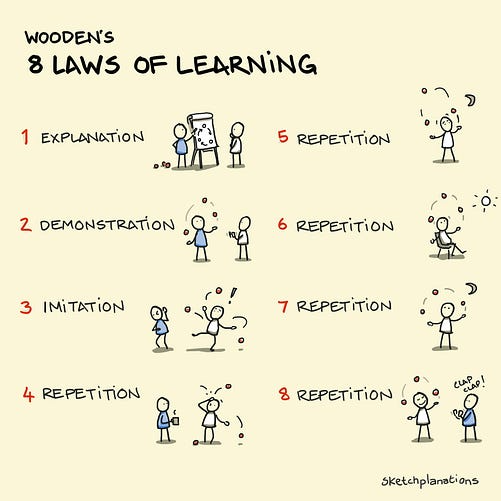
Legendary basketball coach John Wooden won 10 national championships in 12 years with the UCLA men’s team—a record yet to be bettered. His thoughts on coaching still provide insights and wisdom across all sports and teaching generally.
He was a big advocate for preparation, dedication in practice, and repetition so that a player could perform instinctively when it counted. To achieve this, he created eight laws of learning:
- Explanation
- Demonstration
- Imitation
- Repetition
- Repetition
- Repetition
- Repetition
- Repetition
I’ve unknowingly followed John Wooden’s “laws” in sports and music—piano practice. Perhaps you have, too. Whether it’s writing, teaching, coding, drawing, or playing an instrument, Wooden reminds us that unconscious competence comes after repetition, not just once you’ve figured something out.
Sport is not the same as many of the environments we encounter in our lives. Patterns repeat over and over, and feedback is generally accurate and rapid. It can often be what’s called a “kind learning environment”—where experience leads to predictable improvement. Nevertheless, I’d hazard that running through all of Wooden’s 8 Laws to develop skills in most domains we work in is likely to be a good start. Replicate then innovate.
As an aside, creating “laws” of something always sounds great—simple, authoritative, axiomatic. But once something is a “law,” it becomes easy for people to stop looking for alternatives or solutions that circumvent it. But I can’t deny that it’s catchy.
What would happen if you spent twice as much time on laws 5–8 as on laws 1–3?
Article:
The Case for Writing More … and Messily
From a writer and teacher

I’m hearing it over and over as I ask primary school teachers what is happening within the new Writing Curriculum - something has gone missing from their classrooms despite the designated 1 hour of writing: the time and space for tamariki to actually write. Across schools in New Zealand, writing is being stripped of the exploratory, messy, generative joy that makes it powerful in the first place.
Literacy educators advocating for “quality over quantity” in children’s writing have proposed reduced writing goals for our beginning writers.
“It’s easy,” I’ve heard, “all you need to do is reduce the goal to one guided, correct sentence a day in Year 1, two sentences in Year 2, and three sentences in Year 3.”
Whether intentional or not, this is the only writing practice some tamariki may now be getting. Writing has been reduced to transcription.
Building writing fluency by strengthening handwriting, spelling, and sentence construction makes a lot of sense, but this comes at the expense of personal and expressive writing.
Composition (the higher-order, meaning-making side of writing) is where voice and creativity live. When professional leaders claim that transcription skills must be mastered before engaging in personal and meaningful writing, they are taking an unsupported stance. I cannot find any research study that supports withholding genuine writing experience until foundational skills are secured. Five-year-olds are perfectly capable of composition, alongside developing transcription skills. They can use drawing and “kid writing” to communicate their own ideas, or receive support with scribing.
I understand the instinct of seeking quality. We want children to take care with their writing. However, research on how children learn anything points, again and again, toward increasing the quantity of practice, with a developing shift toward quality. In writing, this means getting words down, lots of them, regularly in short or sustained bursts, across many contexts, before obsessing over polish. High-frequency, low-stakes writing is the key.
Childhood and writing are both messy endeavours!
Writing development moves through increasingly advanced stages of skill. Supported along the way, tamariki steadily grow their capacity to communicate ideas. While “kid writing” is initially full of run-on sentences, missing punctuation and “invented” spelling, these are part of the developmental stage, not bad habits or something to recoil from.
Rather than seeing transcription mistakes as deficits, they can be seen as an honest picture of where a child is in their development, helping the teacher to focus on new learning. As a writer becomes more proficient, most of these errors will disappear, but even adult writers know the process is still a messy one and first drafts rarely earn the signoff: “The end”.
This impulse to “tidy up” childhood writing rushes our tamariki toward some false ideal. The term ‘first draft’ exists for a reason: it permits writers to be imperfect. Nearly every writer I have ever met describes getting something rough on the page first as foundational to their process.
Impatience with childhood’s (and writings’) natural messiness has its consequences. When correctness is imposed too early, the first casualty is often motivation. Children who are corrected before they have had the chance to feel the pleasure of making something, however imperfect, quickly learn that writing is a place where they get things wrong, rather than a place where they discover what they think and feel. They begin to self-censor, choosing simpler words, shorter sentences and safer ideas that seem to “please the teacher”. The result is writing that is competent but in the narrowest sense.
When Fixing Gets in the Way
Redrafting must not be confused with the practice of premature editing, correcting every sentence before moving on. Not only does this approach impede the kind of risk-taking and idea generation that builds writerly confidence and voice, but it also overloads working memory and is strongly associated with writer’s block. Stopping after each idea or sentence shifts attention from meaning-making to error-avoidance.
When the writing process is short-circuited by premature demands for correctness, children are denied the developmental experiences through which understanding is built: doing, experimenting, making mistakes and building meaning. The writing process is being replaced in our classrooms by a “performance” of writing, in which the goal is to satisfy an externally imposed standard.
Most troubling are the long-term consequences for identity. Children who encounter early and persistent correction don’t see themselves as writers. A child’s sense of themselves as a capable writer is one of the strongest predictors of their future writing performance. Once that self-belief is damaged, it is difficult to restore.
All this does not mean that quality is unimportant. Quality emerges from great feedback and sustained practice rather than precedes it. It may be messier, but it’s worth it.
Quality follows, it doesn’t lead
The “quality not quantity” framing is intuitive, but it gets it backwards: quantity produces quality over time. The pedagogy that actually produces strong writers and is supported by evidence looks like this:
- High-frequency low-stakes writing (a playful phase)
- Guidance with redrafting (a problem-solving phase)
- Explicit editing support (a polishing phase)
- Plus expert feedback timed to the redrafting stage
We need to resist the impulse to tidy, to correct, to rush toward a “standard”. The tamariki in our classrooms are not unfinished adults waiting to be corrected into competence. They are writers already, messy, imperfect, and full of things worth saying.
Book Recommendation: