
Teaching & Learning at Milgate

Building Thinking Classrooms
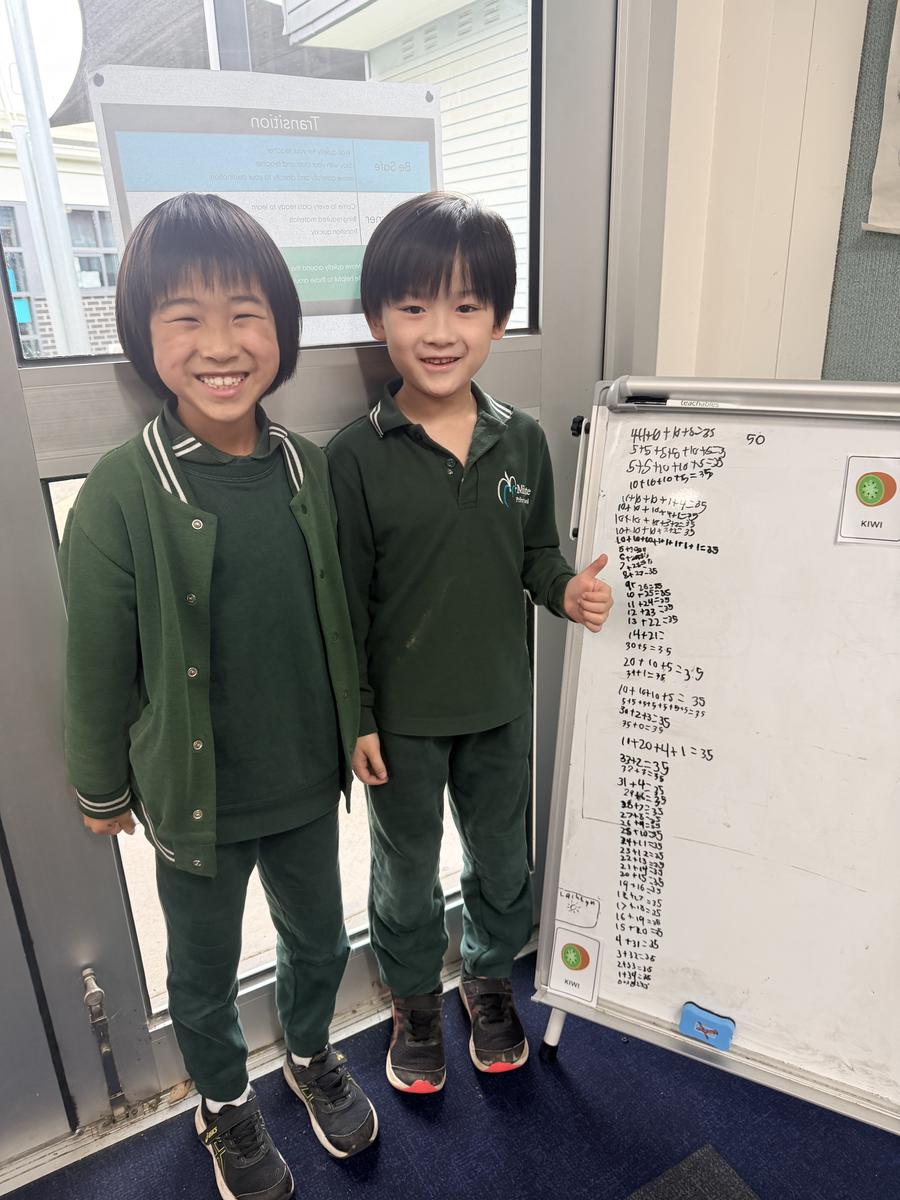
At Milgate Primary School, we are continuing to strengthen our approach to mathematics teaching through our work with Peter Liljedahl and the Building Thinking Classrooms framework. This work is grounded in research about how students learn best when they are actively engaged in thinking, collaborating, and problem-solving, rather than simply mimicking procedures. Our staff were very fortunate to have had a professional learning session with him this week where we learned about four key elements of the framework:
- what types of tasks we use
- how we form collaborative groups
- where students work
- what we choose to evaluate
One of the key ideas behind Building Thinking Classrooms is the concept of thinking to learn, rather than learning first and then thinking later. Research shows that students develop deeper understanding when they grapple with meaningful tasks, explain their reasoning, and build ideas together. Across the school, students are increasingly engaging in rich mathematical discussions, solving open-ended problems, and using a variety of strategies to explain their thinking.
You may hear students talking about being placed into random groups during mathematics lessons. This is another important aspect of the research. Random groupings encourage students to work with a range of peers, reduce social barriers around “ability”, and increase participation and engagement. Students learn to communicate their thinking, listen to different perspectives, and build confidence in sharing ideas. We have seen students become more willing to take risks, persevere through challenges, and contribute to discussions.
Students may also talk about working at vertical whiteboards around the room. Research from Building Thinking Classrooms has shown that when students stand, collaborate, and work on vertical surfaces, they are often more engaged, more willing to contribute ideas, and more likely to revise and improve their thinking. The whiteboards also allow teachers to quickly observe student thinking in real time, ask targeted questions, and respond to misconceptions as they arise. Importantly, the work is visible to peers, which encourages discussion, sharing of strategies, and collective problem-solving.
Another important component is the design of the tasks themselves. Rather than focusing only on questions with one straightforward method, teachers are increasingly using tasks that encourage reasoning, discussion, creativity, and multiple solution pathways. These tasks are designed to create productive struggle, where students are challenged enough to think deeply, while still being supported to succeed. This helps students build stronger conceptual understanding and develop confidence as mathematicians.
This work also strongly aligns with both the Berry Street Education Model and the Victorian Department of Education Victorian Teaching and Learning Model (VTLM 2.0). Through Berry Street strategies, we know that students learn best when they feel safe, connected, and regulated. Collaborative routines, predictable structures, and positive classroom relationships help create the conditions for students to engage deeply in learning. The VTLM 2.0 further highlights the importance of explicit teaching, student engagement, active participation, and responsive teaching practices, all of which are strengthened through this approach.
Importantly, this work is not separate from academic achievement, it is designed to improve it. By increasing student engagement, reasoning, collaboration, and confidence in mathematics, we are building stronger conceptual understanding and helping students become more capable, independent learners. Our goal is not only for students to achieve success in mathematics now, but to develop the thinking skills, resilience, and problem-solving abilities that will support them across all areas of learning.