Learning Area News
Foundation
In Literacy, we have been exploring the letters 's' and 'm' and the sounds that they make. Students have enjoyed identifying words that begin with each sound and coming up with their own creative examples. We have also been practising the correct, lower-case letter formation of these letters, using both whiteboards and paper to strengthen writing skills.
In Numeracy, we have been learning to sequence familiar events to the time of the day. We are about to extend this thinking by recalling days of the week and understanding of the difference between weekdays and the weekend.
In Religion, our topic is, ‘We Can Pray to God’. Students have been learning about all the different ways that we can Pray and experiencing different types of formal and informal prayer.
In Inquiry, we have been learning about our school rules:
- Be on time & ready to learn
- Wear the school uniform correctly (hats in Terms 1 & 4)
- Behave safely & respectfully
- Follow instructions
- No smart devices
At home you could reinforce learning by:
- Read a story with someone at home.
- Practise writing your name with a capital letter at the start, followed by lower case letters (we may need an adult to assist/model this)
- /m/ and /s/ sound I Spy – Use the sounds we have learnt at school to play I Spy with someone at home. For example, I spy with my little eye, something beginning with the sound /s/.
- Practise the days of the week.
- Each day, identify what day is today, what day is tomorrow and what day was yesterday.
Year One
In Literacy, we have been learning about compound words and nouns. The children have been making compound words out of 2 small words. They have been naming nouns in our classroom. We have been learning about generating sentences, combining sentences and expanding sentences.
In Numeracy, we have been learning about counting and place value. We have been practicing counting backwards and forwards up to 100. We have been using MAB and place value charts to make 2-digit numbers. We have compared numbers and ordered them from smallest to largest. We have also used bundling and tens frames to compare numbers.
In Religion our topic is ‘Lent and Easter’ we are learning that Lent as a special time in the Church. We have discussed the important signs and symbols associated with Lent and Easter.
In Inquiry our topic is History. Students created a flip book detailing their family, school, church and Shepparton. We are now learning about the history of Shepparton including how places and items have changed over time.
At home you could reinforce learning by:
Literacy:
- Practice reading and spelling our tricky words friend, saw, school, here, what, want.
- Listening to your child read each night.
Practice writing a sentence using a connector word like but to expand the sentence.
Numeracy:
- Practise counting by 1's, 2's and 10's to one hundred.
- Pick a number under 100 and practice counting forwards and backwards from that number.
Year Two
In Literacy, we have been revising words using long and short vowel sounds, words with the bossy 'e' and words using spelling choices ai, ay, a_e, ee, ea, e_e. The students have been orally sounding out and spelling words with these sounds.
In Numeracy, the students have been developing their understanding of analogue clocks and learning to tell time to the half and quarter hour.
In Religion our topic is ‘Lent and Easter’ we are learning that Lent as a special time in the Church. We have discussed the important signs and symbols associated with Lent and Easter.
In Inquiry we have been learning about different ways to communicate. We have been exploring ancient storytelling through dreamtimes stories. We read "Tiddalick'" and made our own frogs to retell the story.
At home you could reinforce learning by:
Literacy:
- Practice reading and spelling our tricky words (home, where, women, different, why, family).
- Write a list of words with the spelling sound ‘ai’ and áy’ spelling choice in words.
Listening to your child read their reader each night.
Numeracy:
- Draw a clock and show on it the time you go to bed.
- What are some things you do in the morning and some things you do in the afternoon?
- What things could you do that take about one hour?
Year 3
In Maths students have been building confidence with time – choosing the right units (seconds, minutes, hours, days) and making sensible estimates for how long everyday activities take. Students have also been practising elapsed time (working out how much time has passed between a start and finish time).
In Literacy, we’ve been practising how to use correct punctuation so our sentences make sense to the reader. We’ve also learnt about different sentence types (statements, questions, commands and exclamations) and when to use them in our writing. We have also been busy preparing for NAPLAN which students will complete in the coming weeks.
Students have begun our new Religious Education topic on the season of Lent. They have been learning how this is a special time of preparing for Easter. We explored the three key Lenten practices of prayer, fasting and almsgiving (giving to others) and how these help us grow closer to God.
In Inquiry we have continued to develop our knowledge of community and how rules and consequences help a community run smoothly. We are moving into our last week of learning about Heat in Science and have explored the different ways heat is transferred.
Some homework activities could include:
Time estimate challenge: Pick 3 tasks at home (e.g., set the table, pack a bag, brush teeth). Your child guesses seconds/minutes/hours, then you time it and compare.
Daily routine timer: Use a kitchen timer for 1–2 minutes and see how many star jumps, claps, or written numbers your child can do before it beeps (record the result and try to beat it next time).
Sentence type hunt: Find 2 statements, 2 questions, 1 command and 1 exclamation in a book/TV subtitles, then write one of each about your day.
Practicing multiplication tables using flashcards
Practicing neat, joined handwriting using horizontal joins between the letters
Reading Fluency practice with a familiar text:
1. First read: student reads it once (adult tracks any tricky words).
2. Second read: student reads again, aiming for smoother reading.
3. Third read: student reads with expression (voices for speech, pauses at full stops).
Year 4
Our Year 4 students continue to impress us with their focus, effort, and growing independence in the classroom. It has been wonderful to see their confidence develop as they deepen their understanding across all subject areas. They are becoming more thoughtful learners who are willing to challenge themselves and take pride in their work.
Below is an overview of what we have been learning in English and Mathematics, along with some new activities you can try at home to support these skills.
English:
This week, we have continued reading Kensuke’s Kingdom by Michael Morpurgo, using the novel to further strengthen reading comprehension, vocabulary development, and writing skills. Students are engaging in deeper discussions about character motivations, themes, and the author’s message.
At the sentence and writing level, we have been focusing on:
- Concrete and abstract nouns
- Sentence types (statements, questions, commands, exclamations)
- Independent and dependent clauses
- Persuasive writing
High modality words
A key addition to our persuasive writing unit has been the use of high modality words (e.g., must, should, definitely, certainly, will). Students are learning how these powerful words strengthen arguments and make opinions sound more convincing and authoritative.
English Activities to do at Home:
1. High Modality Upgrade (10 minutes) Write a simple opinion sentence such as:
- “Students can bring pets to school.”
Ask your child to rewrite it using high modality words to make it stronger:
- “Students must be allowed to bring pets to school.”
- “Schools should definitely allow pets.”
Discuss how the meaning changes when stronger words are used.
2. Persuasive Debate at Dinner Choose a fun topic such as:
- “School days should be shorter.”
“Children must do chores.”
Have a short family debate where your child must:
- State a clear opinion
- Use at least two high modality words
Give two strong reasons
Mathematics:
In Mathematics, we have now completed our unit on fractions. Students developed their understanding of:
- Fractions as part of a whole
- Representing fractions visually
- Comparing and ordering fractions
Identifying equivalent fractions
We are now beginning our new unit on time. Students are learning to:
- Read and write time on analogue and digital clocks
- Calculate elapsed time
- Solve real-world time word problems
Telling time to the minute
A major focus is carefully reading time-based problems and determining what information is needed before solving.
Maths Activities at Home:
1. Daily Schedule Maths Ask your child to record the times of 3–4 daily activities (e.g., dinner at 6:00pm, soccer at 4:15pm).
Then ask:
- How long is it from the end of school until dinner?
- How many minutes until bedtime?
- What would this time be in 24-hour time?
2. Elapsed Time Challenge Create real-life scenarios such as:
- “A movie starts at 3:40pm and finishes at 5:25pm. How long is the movie?”
“We leave for sport at 8:15am and arrive at 9:05am. How long did the trip take?”
Encourage your child to show their working clearly.
Thank you for your continued support at home. It is wonderful to see how much progress the students are making, and we look forward to another exciting few weeks of learning ahead!
Year 5
Religious Education:
In Religious Education, students have been looking at a new topic which is how can lent transform our lives? During this topic students explore lent and the history of the 40 days with the end assessment being creating their interpretation of journey from light to dark through a variety of different methods.
English:
In English, students have been continuing reading our classroom novel War Horse by Michael Morpurgo. They have been learning to take notes using background information on their persuasive topic 'Should horses have been used in World War 1?’ Students have been asked to choose a side for or against horses being used in World War 1 and provide 3 to 4 supportive details about their point of view.
Mathematics:
In Mathematics, students have undertaken a new topic of multiplication and division after a two-week topic of factors and multiples to strengthen their understanding of times tables. They will be learning about different mental strategies to help them solve multiplication and division problems.
Science:
In Science, students have completed a topic on how animals adapt to their environment to survive, the structural features of animals they help them hunt if they're a predator or how it helps them to survive if they are considered prey. Students are now entering a new topic of space, exploring the milky way and our solar system.
Humanities:
In Humanities, students have been looking at Australia colonisation and the impact it had on our Indigenous people when the British came over on the First Fleet. Describe aspects of First Nations peoples’ lives before colonisation. Explain how colonisation changed First Nations peoples’ lives, including their languages and culture. Use sources to identify different perspectives about colonisation.
Home Learning:
Independent/Guided Reading:
In Grade 5, students are expected to read for at least 20 minutes each evening. This can be independent reading or reading aloud to a family member. Students are also welcome to come to the library from 8:30am each morning to read quietly on their own or with a staff member.
Practicing multiplication tables and division facts.
Developing strong multiplication and division fact recall is essential, as these skills support many of the key concepts we are currently learning in Mathematics. Students are encouraged to regularly practise their times tables and division facts at home. This can be done using flashcards, skip counting, or other quick recall activities.
Year 6
Literacy:
In Literacy, we have been learning about identifying prepositions and adding appositives to our sentences to add more detail to our writing. Students have been continuing to work on their persuasive pieces adding their conclusions to their drafts.
Numeracy:
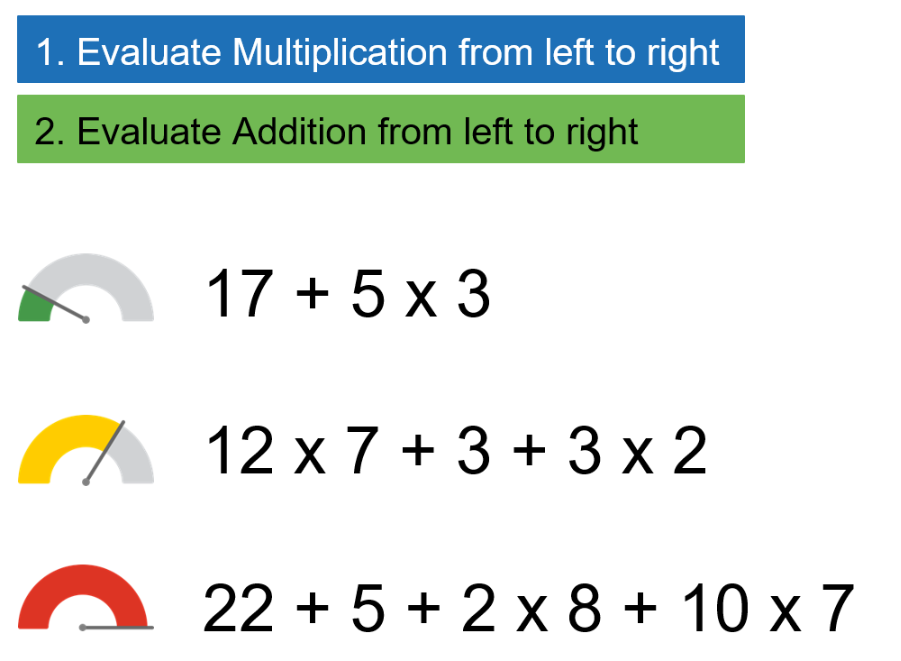
In numeracy, we have been learning about the order of operations. Students have been working through expressions that contain multiple operations and following the correct sequence to retrieve the correct answer.
Religious Education:
In Religion, our topic is, "How can Lent transform our lives". Students have been learning about the symbols and words that relate to the season of Lent. Students have been reflecting on key themes like Light and Darkness and how they relate to the world around them.
Science:
In Science, we have been continuing to learn about reversible and irreversible changes. Students have investigated the irreversible change of curdling milk and how heat influences reversible and irreversible changes.
Humanities :
In Humanities, we have been learning about the globe. Students have looked at the key features for how the earth is divided and investigating how to read choropleth maps and their purpose.
At home you could reinforce learning by:
Independent/Guided Reading
It is the expectation in Grade 6 that your child practices reading independently or to a family member for 20 minutes a night minimum. This will help develop good routines for secondary school and reinforce reading fluency. Students are also welcome in the library at 8:30am every day to read to themselves or a staff member.
Practicing following the order of operations.
Following the correct order of operations allows everyone to arrive at the same answer and remove any opportunity for ambiguity. You can create your own questions starting with just two operations and progressively add more or complete the following task: