Grade 6 News
Dear Parents and Guardians,
Upcoming Dates
- 27/3 -House Athletics
- 31/3 -Regional Swimming
- 2/4 - Happy Hat Parade
- 2/4 - Last day of Term 1 (dismissal at 2.30pm)
Reminders
- Icy poles will be sold on Monday and Tuesday at the Senior School during lunch.
- Canberra forms are to be returned to the office as soon as possible.
Learning in Action
Literature – Once
Over the past fortnight, students have continued to read Once by Morris Gleitzman. In this part of the story, Felix and Zelda are staying on a farm with a kind family who provide them with food and a place to rest. For a short time, the children experience a sense of safety after spending so long travelling and hiding.
While they are there, Felix continues to tell stories to comfort Zelda and keep her spirits up. They also meet the farmer’s son, Barney. However, their safety is threatened when Nazi soldiers arrive at the farm. Knowing the danger, the farmer’s family bravely hide Felix and Zelda to protect them.
The tension increases as the soldiers search the property, and the children must remain completely silent while hiding. This moment highlights the risks people took to help Jewish children during the war. After the soldiers finally leave, Felix once again realises how dangerous their situation is, but he continues trying to stay strong and hopeful for Zelda as their journey continues.
Vocabulary
Sodden – soaked with liquid
Straggling – wandering in a scattered way or arriving late
Rampage – to move or act violently and angrily
Writing focus:
Over the past fortnight, students have been developing their skills in planning and writing an information report. The focus has been on constructing clear and detailed body paragraphs by identifying key ideas and supporting facts.
To build background knowledge, students read and discussed a non-fiction article about the flora and fauna of Poland. Through this reading, they explored the different plants, animals and natural environments found in the region. Students also examined how authors organise information in factual texts and how this supports reader understanding.
Students then practised taking notes on the most important information from the article. They identified key points about Poland’s wildlife and plant life, and organised their notes so they could use them to write their own information report paragraphs. This process helped strengthen their research, note-taking and informational writing skills.
Preview:
Students will continue developing and preparing their information report on Poland. Over the next two weeks, they will focus on completing their final body paragraph and writing a clear conclusion that summarises the key information from their report. Students will use the Single Paragraph Outline (SPO) to help organise their ideas. A Single Paragraph Outline structures their writing in a logical order, making it easier for readers to understand and supporting the development of clear, cohesive paragraphs.
Maths:
Order of Operations and Area:
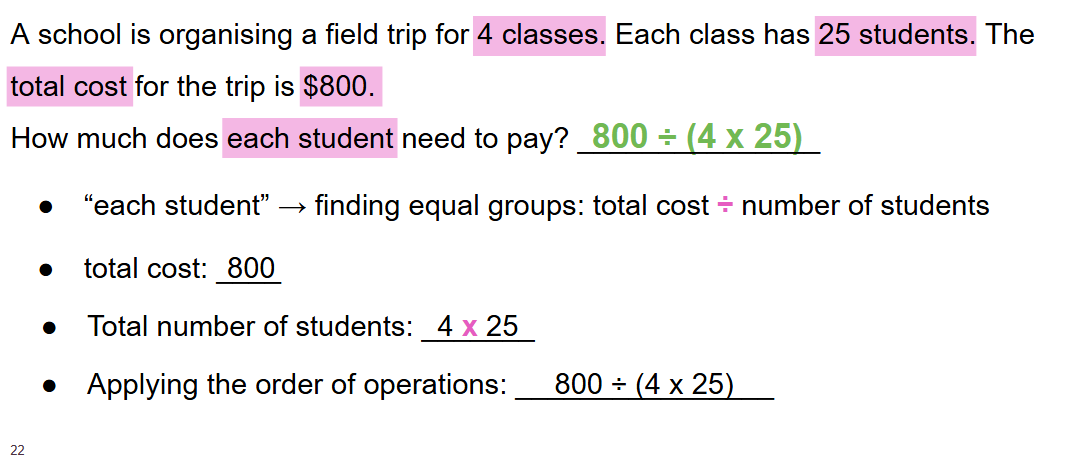
Over the past fortnight, students completed their Order of Operations unit by practising how to create mathematical expressions from worded problems. They focused on identifying key information and translating it into accurate numerical expressions using the correct order of operations.
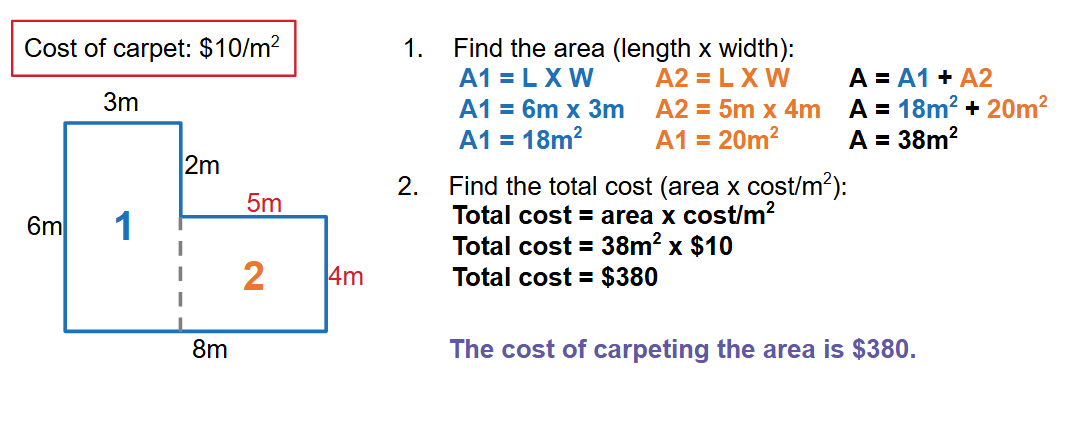
Students then began a new unit on area, learning how it can be measured and applied in different contexts. They were introduced to the formula for calculating the area of rectangles by multiplying length by width and applied this understanding to a range of problems.
Students also explored composite shapes, learning how to break more complex figures into smaller rectangles, calculate the area of each part, and then combine these to find the total area.
As part of their investigations, students examined the relationship between area and perimeter. They explored rectangles with the same area but different perimeters, as well as rectangles with the same perimeter but different areas. These activities encouraged students to identify patterns, test ideas, and explain their mathematical thinking.
Preview:
Over the coming weeks, students will develop their understanding of elapsed time. They will begin by learning how to calculate elapsed time to the minute using an empty number line. Students will start with simpler scenarios that do not involve crossing midday, such as calculating the time between a bus leaving at 2:42 pm and arriving at 4:38 pm. As students build confidence, they will move on to more complex problems, including calculating elapsed time across midday, such as a train journey from 10:09 am to 4:30 pm.
Knowledge Rich: Australian Democracy
Over the past fortnight, students have been introduced to the fundamentals of democracy. They explored the key principles that allow citizens to participate in decision-making and developed an understanding of the importance of democratic values in society.
Students also learned about the three levels of government in Australia, federal, state and local, focusing on the responsibilities and roles of each level in making and enforcing laws, providing services, and representing the community. Finally, students examined Australia’s electoral process, including how citizens vote, the role of political parties, and how representatives are elected. This study helped students understand how democracy operates in practice and how individuals can participate in shaping their government.
Preview:
Over the coming weeks, students will explore key aspects of Australia’s political system.
First, they will learn about referendums and constitutional change in Australia, examining how the Constitution can be amended, the process required for a referendum, and the role of citizens in approving changes. Students will consider why referendums are important and study examples of past constitutional changes.
Next, students will focus on the roles and responsibilities of elected representatives. They will investigate what elected officials do at the federal, state and local levels, how they make decisions, and how they represent the interests of their communities.
Through these lessons, students will deepen their understanding of democratic processes and the ways Australians participate in shaping their government, preparing them for our upcoming visit to Canberra.
Wellbeing
Using the Friendology program, students explored their “inner ninja,” focusing on self-compassion and self-care. They discussed how to use these strategies during emotional “slumps” and how to treat themselves with the same kindness they would show a friend.
Students were introduced to the RAIN strategy, which can support emotional awareness and regulation:
- Recognise what is happening
- Allow the experience to be there, just as it is
- Investigate with interest and care
- Nurture with self-compassion
We also explored different ways to recharge, calm and regulate when feeling overwhelmed. Students considered whether they tend to be more introverted or extroverted, whether they gain energy from being around others or from quiet time alone. We discussed how a friend’s need for space can sometimes be misinterpreted as rejection, rather than a way of recharging.
Preview:
Students will revise the four Friendship Facts and discuss:
- What trust is and how it takes time to build
- That not all friends are confiding friends
- What close friendships need
Canberra Camp:
We are getting very excited about our upcoming camp to Canberra. This will be a fantastic opportunity for students to explore Australia’s capital city and take part in a range of engaging and enriching learning experiences.
During the trip, students will visit Parliament House to see where important decisions about our country are made, explore the Royal Australian Mint to discover how Australian coins are produced, and tour the Australian Institute of Sport to learn how elite athletes train. They will also visit the Australian War Memorial to learn about Australia’s history and acts of bravery, and experience the interactive science exhibits at Questacon.
With so many incredible places to visit and experiences to share, our Canberra camp is sure to be a memorable and exciting adventure for everyone.
We will be sending home further information shortly about what students need to pack and bring, including a detailed packing list, important reminders and other helpful details to ensure students are well prepared for the trip. Please contact your child’s teacher if you have any questions.
Kind regards,
The Grade 6 Team
Melissa Adams, Caillin Ibbotson, Craig McKenzie, Lisa Dealy & Chloe McElroy