Senior School

Now that our senior students have settled into the school year it is a timely reminder to visit the Study Skills Handbook web site to learn about some skills and tips to assist with and learn about skills to achieve our students’ best outcomes.

All students have received numerous assessment tasks this term and will continue to do so over the school year. These task are mandatory.
How to Break Down Complex Subjects - Taming Big Topics, One Step at a Time
We’ve all faced it—that overwhelming moment when you look at a massive topic and wonder, “Where do I even start?”. Whether it’s preparing for a history essay, learning a difficult science concept, or tackling a big project, it’s easy to feel stuck. But breaking down complex subjects into manageable steps can make studying not only easier but also more effective. Here’s how you can master the art of simplifying the complex.
1. Understand the Big Picture
Before diving into the nitty-gritty, take a step back and ask: What is this topic really about? For example, if you’re studying photosynthesis, the big picture might be understanding how plants convert sunlight into energy. Write this overarching goal at the top of your notes—it’ll act as a guide for everything you learn.
Tip: Look for summaries in your textbook or online resources to help you grasp the main idea. Tools like YouTube explainer videos can also offer quick overviews or ask ChatGPT to explain the concept to you in a simple way.
2. Break It Down Into Sections
Once you understand the big picture, split the topic into smaller, more manageable chunks. Think of it like dividing a pizza into slices—it’s easier to tackle one piece at a time than trying to eat the whole thing at once. For example:
Studying ‘The Nervous System’ can be broken into ‘Brain’, ‘Spinal Cord’, and ‘Nerves’.
Preparing for an essay might involve planning the introduction, body paragraphs, and conclusion separately.
Focus on one section at a time to avoid feeling overwhelmed.
Tip: Use your syllabus, textbook headings, or teacher’s notes to identify these sections. If the subject feels particularly dense, ask your teacher for clarification on what’s most important.
3. Create Visual Aids
Many students find it easier to remember information when they can see it laid out visually. Try these tools:
Diagrams: Perfect for subjects like science or geography. Draw a labelled diagram to understand relationships between components.
Flowcharts: Great for processes like historical events or problem-solving methods.
Mind Maps: Ideal for summarising ideas and seeing connections between subtopics.
Visual aids not only help you organize your thoughts but also make revision more enjoyable and less monotonous.
4. Learn in Layers
Think of studying like peeling an onion—learn the surface-level basics first, then delve deeper as your understanding grows. For instance:
First pass: Identify the key terms and concepts.
Second pass: Learn how these terms connect.
Third pass: Dive into details and examples.
Tip: Use multiple resources during this process. Your textbook might provide one perspective, but online videos or practice questions might give you a new way of looking at the material.
5. Review and Consolidate
Once you’ve mastered each section, it’s time to fit the pieces back together. Review how the smaller parts connect to the big picture. This step helps you see the subject as a whole and prepares you for tasks like essays, exams, or projects.
Tip: Try summarising the topic in your own words. If you can explain it simply, you’ve truly understood it.
From Chaos to Clarity
Complex subjects might seem intimidating at first glance, but with the right approach, you can simplify them into manageable steps. By understanding the big picture, dividing the topic into sections, and using tools like diagrams and mind maps, you’ll gain confidence and clarity. Remember, learning is a process—take it one step at a time, and you’ll find that even the most challenging topics can be conquered.
SAVE THE DATE!
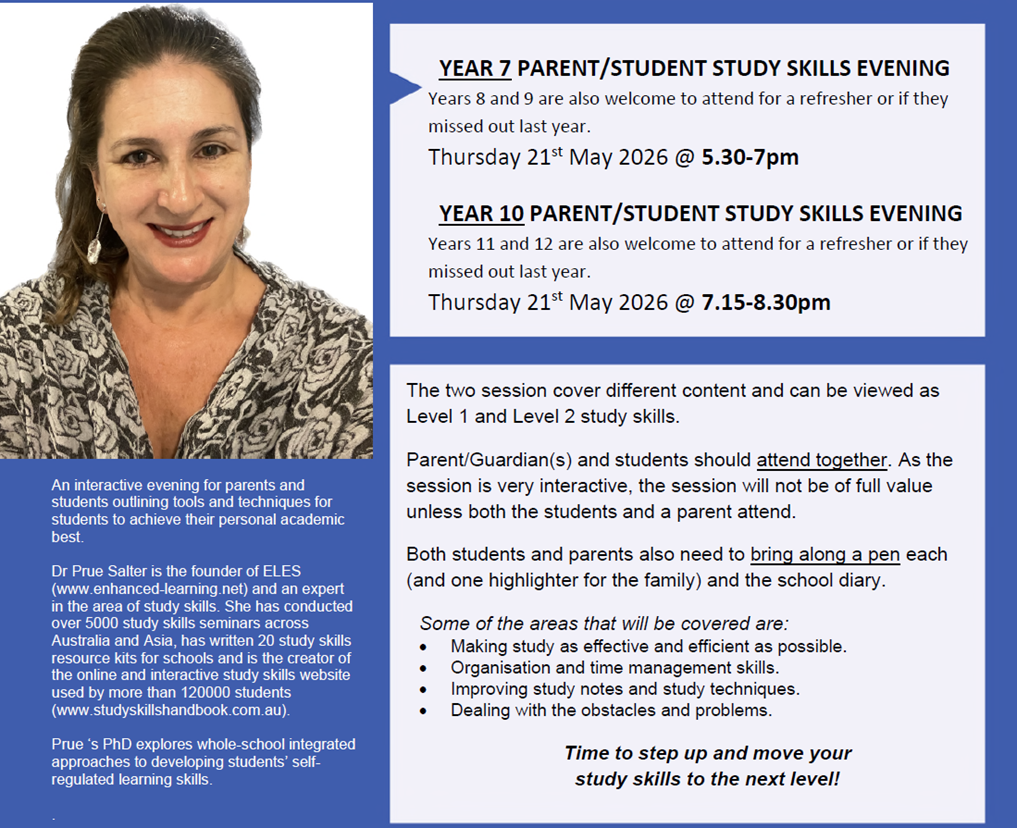
Throughout the evening, families engage in discussions that encourage a thoughtful assessment of the changes that could be implemented to help students move confidently and efficiently toward achieving their personal best. Dr. Salter's expertise provides valuable insights into key areas, including the home study environment, effective organisation and management of resources, strategies for successful home-based learning, handling distractions, and managing the high school workload.
All families at our school also have access to a comprehensive study skills website aimed at further developing students’ academic skills.
In early Term 2, all parents will be emailed the booking information.
Year 11 and Year 12
These school holidays are the time to make sure all subject study notes are up to date. Parents, please assist your son to develop and follow a study schedule over this two week break, it will make his life less stressful when he returns in Term 2.
Elizabeth Meek
Head Teacher Senior School