
Catholic Identity

St Kilian's Parish Easter Market
Saturday 21st March
10.00am - 1.00pm
Parish Grounds

Coffee van/drinks & BBQ
Live music
Raffles & silent auction
Variety of stalls including bric-a-brac, handmade gifts,
plants, cakes, clothing and produce
All proceeds to support the development of St Kilian's Community Garden
Please bring cash - no card facilities available
What is Lent?

Lent is a special time in the Church where we prepare our hearts for Easter. It is a season of reflection, prayer, and growth, where we are invited to pause, think about our choices, and try to become more like Jesus in the way we live, love, and treat others.
Traditionally, Lent focuses on three key practices: prayer, fasting, and giving to others. These help us to grow in faith, self-control, and kindness.
How Families Can Support at Home
Families play a powerful role in helping children understand and live out Lent in simple, meaningful ways. You might:
- Spend a few quiet moments together in prayer
- Encourage small acts of kindness at home or in the community
- Talk about making good choices, even when it’s hard
- Choose something small to give up or do differently (e.g. less screen time, more helping)
- Support Project Compassion by discussing how we can help others in need
Lent is not about being perfect — it’s about trying our best, growing together, and keeping our hearts open to God and others.
Project Compassion
Project Compassion is Caritas Australia’s annual Lenten campaign, inviting us to live out our faith by supporting people in need, both in Australia and around the world. Each year, it shares real stories of individuals and communities who are working to overcome challenges such as poverty, lack of access to education, and limited healthcare.
Through Project Compassion, we are reminded that even small acts of generosity can make a big difference. Funds raised go towards sustainable, long-term solutions — helping communities to become stronger, more independent, and full of hope.
As a school community, we are invited to take part through prayer, awareness, and giving, putting our faith into action and standing in solidarity with others.
Find out more about Project Compassion here: Project Compassion 2026 School Films on Vimeo

This week we learn about Monoranjon from Bangladesh. Monoranjon lives in a village in Bangladesh close to the sea, where floods and storms often damage his crops and his home. With support from Project Compassion, he learnt climate-resilient farming techniques and new ways to diversify his income, helping his family survive and build a safer, more sustainable future.
You can watch his story here: https://www.youtube.com/watch?v=zRSBcJ03Poo&pp=ygUScHJvamVjdCBjb21wYXNzaW9u
Discussion
- What is Monoranjon’s job?
- What is making farming difficult for Monoranjon?
- How did Caritas Australia and Caritas Bangladesh help?
- Why did Monoranjon learn to farm fish, prawns and crabs?
- What new skills did Monoranjon learn?
- How will you share Monoranjon’s story with others?
Gospel Reflection
4th Sunday of Lent
Summary
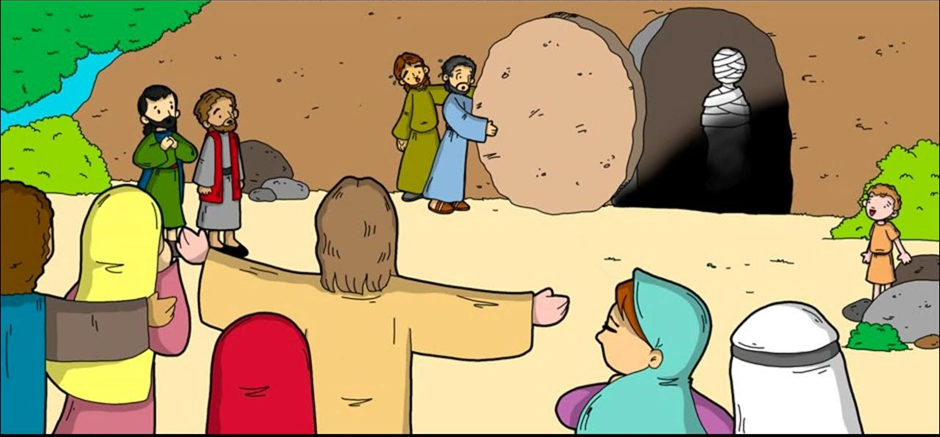
Jesus’ friend Lazarus becomes very sick. His sisters, Mary and Martha, send word to Jesus asking for help. But Jesus doesn’t rush—he waits two more days before going to them.
By the time Jesus arrives, Lazarus has already died and been in the tomb for four days. Martha goes out to meet Jesus and tells him that if he had been there, her brother wouldn’t have died. Jesus responds, “I am the resurrection and the life. Whoever believes in me will live.”
Mary comes to Jesus, weeping, and Jesus is deeply moved. He even weeps himself.
Jesus goes to the tomb and tells the people to roll away the stone. Martha hesitates, but Jesus reassures her. He then calls out, “Lazarus, come out!”—and Lazarus walks out alive.
Many who see this believe in Jesus.
Scripture – John 11:1-45
There was a man named Lazarus who lived in the village of Bethany with the two sisters, Mary and Martha, and he was ill. It was the same Mary, the sister of the sick man Lazarus, who anointed the Lord with ointment and wiped his feet with her hair. The sisters sent this message to Jesus, ‘Lord, the man you love is ill.’ On receiving the message, Jesus said, ‘This sickness will end not in death but in God’s glory, and through it the Son of God will be glorified.’
Jesus loved Martha and her sister and Lazarus, yet when he heard that Lazarus was ill he stayed where he was for two more days before saying to the disciples, ‘Let us go to Judaea.’ The disciples said, ‘Rabbi, it is not long since the Jews wanted to stone you; are you going back again?’ Jesus replied:
‘Are there not twelve hours in the day?
A man can walk in the daytime without stumbling
because he has the light of this world to see by;
but if he walks at night he stumbles,
because there is no light to guide him.’
He said that and then added, ‘Our friend Lazarus is resting, I am going to wake him.’ The disciples said to him, ‘Lord, if he is able to rest he is sure to get better.’ The phrase Jesus used referred to the death of Lazarus, but they thought that by ‘rest’ he meant ‘sleep’, so Jesus put it plainly, ‘Lazarus is dead; and for your sake I am glad I was not there because now you will believe. But let us go to him.’ Then Thomas – known as the Twin – said to the other disciples, ‘Let us go too, and die with him.’
On arriving, Jesus found that Lazarus had been in the tomb for four days already. Bethany is only about two miles from Jerusalem, and many Jews had come to Martha and Mary to sympathise with them over their brother. When Martha heard that Jesus had come she went to meet him. Mary remained sitting in the house. Martha said to Jesus, ‘If you had been here, my brother would not have died, but I know that, even now, whatever you ask of God, he will grant you.’ ‘Your brother’ said Jesus to her ‘will rise again.’ Martha said, ‘I know he will rise again at the resurrection on the last day.’ Jesus said:
‘I am the resurrection and the life.
If anyone believes in me, even though he dies he will live,
and whoever lives and believes in me will never die.
Do you believe this?’
‘Yes, Lord,’ she said ‘I believe that you are the Christ, the Son of God, the one who was to come into this world.’
When she had said this, she went and called her sister Mary, saying in a low voice, ‘The Master is here and wants to see you.’ Hearing this, Mary got up quickly and went to him. Jesus had not yet come into the village; he was still at the place where Martha had met him. When the Jews who were in the house sympathising with Mary saw her get up so quickly and go out, they followed her, thinking that she was going to the tomb to weep there.
Mary went to Jesus, and as soon as she saw him she threw herself at his feet, saying, ‘Lord, if you had been here, my brother would not have died.’ At the sight of her tears, and those of the Jews who followed her, Jesus said in great distress, with a sigh that came straight from the heart, ‘Where have you put him?’ They said, ‘Lord, come and see.’ Jesus wept; and the Jews said, ‘See how much he loved him!’ But there were some who remarked, ‘He opened the eyes of the blind man, could he not have prevented this man’s death?’ Still sighing, Jesus reached the tomb: it was a cave with a stone to close the opening. Jesus said, ‘Take the stone away.’ Martha said to him, ‘Lord, by now he will smell; this is the fourth day.’ Jesus replied, ‘Have I not told you that if you believe you will see the glory of God?’ So they took away the stone.
Then Jesus lifted up his eyes and said:
‘Father, I thank you for hearing my prayer.
I knew indeed that you always hear me,
but I speak for the sake of all these who stand round me,
so that they may believe it was you who sent me.’
When he had said this, he cried in a loud voice, ‘Lazarus, here! Come out!’ The dead man came out, his feet and hands bound with bands of stuff and a cloth round his face. Jesus said to them, ‘Unbind him, let him go free.’
Many of the Jews who had come to visit Mary and had seen what he did believed in him.
Reflection
This story hits on something really real—loss, waiting, confusion, and hope.
One of the most interesting parts is that Jesus doesn’t rush in straight away. That can feel frustrating. Mary and Martha probably wondered, “Why didn’t you come sooner?” It’s a question people still ask God today.
But Jesus isn’t absent—he’s present in a deeper way. He feels their pain. He cries with them. And then he does something incredible—he brings life where there was none.
This shows us two big things:
- Jesus cares deeply about what we go through (he even cries with us)
- Even when things feel too far gone, God can still bring hope and new life
It’s not always about fixing things instantly—it’s about trusting that God is still working, even in the waiting.
- Have you ever had to wait for something really important? How did it feel?
- Why do you think Jesus didn’t go straight away to help Lazarus?
- What does it mean when Jesus says, “I am the resurrection and the life”?
- Can you think of a time when something felt “hopeless” but then got better?
- How can this story give us hope when things are hard?
Prayer
Loving God, Thank you for being with us, even when life feels hard or confusing. Help us to trust you, especially when we have to wait. Remind us that you bring hthat you bring hope, even in the darkest moments. Just like you called Lazarus out of the tomb, help us to step into new life with you each day. Amen.