Specialists News

Sport/Phys Ed News
Grades 3-6 Swimming Sports – Wednesday 11th Feb
On Wednesday, 11th of February we will be conducting our Senior School Swimming Sports for all children in Grades 3 to 6. The Sports will be held at Bendigo East Swimming pool from approximately 12pm to 3pm. A bus has been organised to transport the students. They will participate in their age group in a number of timed or untimed swimming races, varying in lengths (depending on the child’s competency level).
Fun and participation will be the main focus of the day and students do not need to be confident swimmers, nor display correct stroke technique to take part. They will be able to choose the races that they would like to go in. Novelty games in the small shallow pool will be organised for less confident swimmers to allow for maximum student participation. House points will be awarded for each event your child participates in, including novelty games. Winning students of the timed, full length (50m) races may then be selected to represent the school at the upcoming Division Schools Carnival (depending on their time and correct stroke technique). Students will also have a ‘free swim’ if time permits.
An approximate timeline for the day will be:
50m Races (approx. 12pm to 1pm)
Freestyle – 12/13 Years Girls, 12/13 Years Boys, 11 girls, 11 boys etc.
Backstroke – as above
Breaststroke – as above
Butterfly – Open Girls & Open Boys
Novelty Races in Shallow Pool (approx. 12.15 to 1pm)
For those not doing 50m races
25m Races (approx. 1pm to 1.30pm)
For those not doing 50m races
House Relay
Free Swim (approx. 2pm to 2.30pm)
Spectators are welcome to attend. There will be a designated area for spectators to sit near the canteen/entrance side of the pool and we remind you that photographs can only be taken of your own children (this includes the podium.)
Consent and payment for this event can now be done through Compass.
Auslan News
Welcome to the Auslan Classroom for 2026!
We have started the year with a focus on setting up classroom routines and expectations in Auslan. All students have positively contributed to our Auslan Classroom Positive Behaviour Matrix and I am looking forward to giving out GuGu stickers to students displaying our Core Values of Respect, Resilience and Responsibility in Auslan to help students fill their GuGu Reward Sticker Books!
This year we will be learning Auslan via a LOTE program through Bilby Publishing, including SignPlanet.net. We will launch into this program within the next 2weeks.
All classes will be doing some revision for the first couple of sessions:
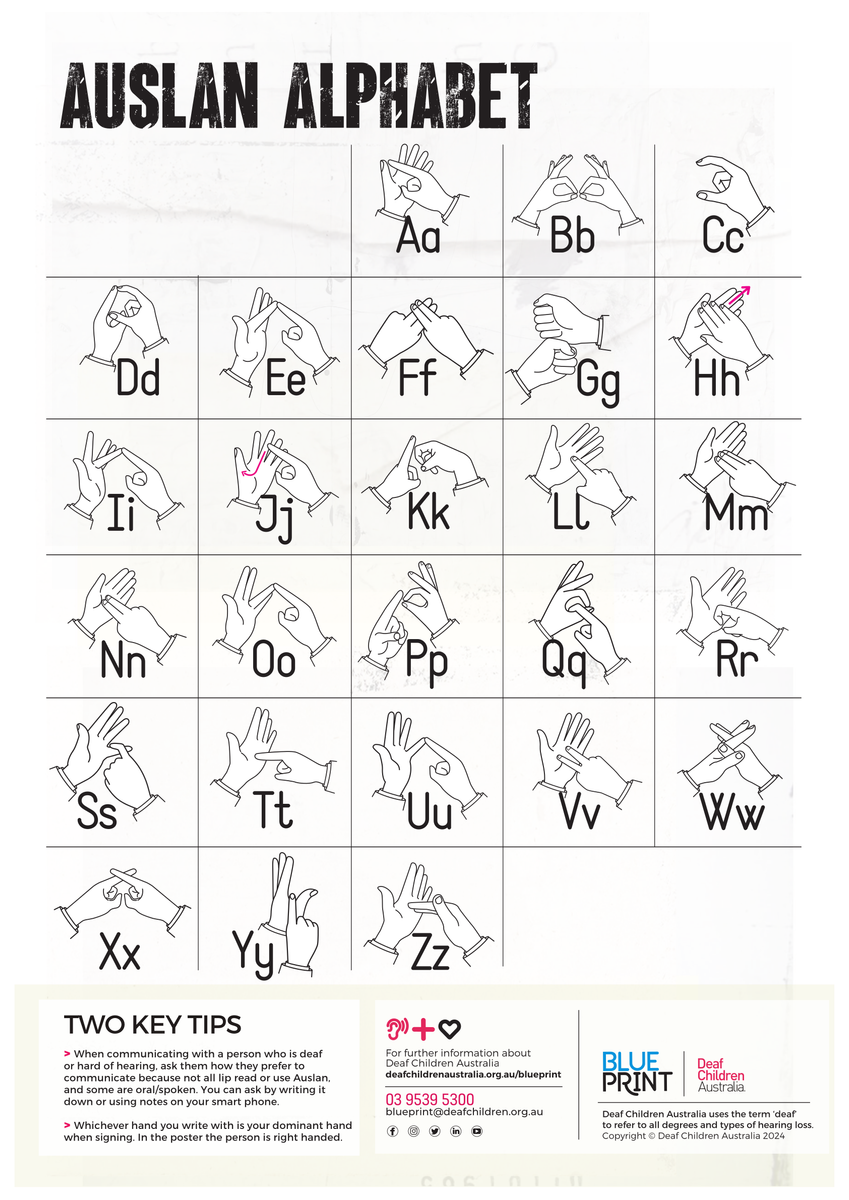
What is Auslan? Simple Greetings, Auslan Fingerspelling Alphabet A-Z.
Preps will NOT be learning the A-Z Fingerspelling at this point. Prep students will instead focus on learning simple Greetings and then Colours in Auslan, before moving onto other topics!
Prep students have started learning a Greetings song called: “Hello, how are you?” to practise some Auslan Greetings.
All students from Prep to Grade 6 have identified their preferred Dominant Hand for signing this week, and are completing a Dominant Hand art activity to help them remember to use their Dominant Hand when signing. Once students work out which hand is their Dominant Hand, they are encouraged not to interchange between hands when signing.
I have attached an Auslan Fingerspelling Alphabet Mat for Grades 1-6 students and their families to refer to at home when practising. All students will also have a copy of this in their Auslan workbooks to refer to throughout the year.
Here are a few things to help you out at home when practising Auslan with your child/ren:
1. Auslan is not written in capital letters (unless it is displayed as a heading.)
2. The name Auslan is taken from the words Australian Sign Language.
The Au is for Australian. The s is for Sign, and the lan is for Language.
3. Auslan is not the same as English. The language actually has its own structure and grammar.
4. There is not always a sign for an English word in Auslan.
5. At times there can be more than one correct Auslan sign for an English word.
6. There are 2 dialects of Auslan in Australia; the Northern Dialect and Southern Dialect.
Our Auslan program teaches the Southern Dialect.
7. When you are signing it is important to know your dominant hand, as this hand does most of the moving. (Your dominant hand is usually the hand that you write/draw with.)
The learner uses their dominant hand, as does the signer, whether they be left-handed or right-handed.
8. As we become more fluent in our Auslan lessons, over time we will be aiming to include more ‘voices off’ time during lessons.
I am always open to hearing from our SGPS families who might have suggestions, Auslan resources or contacts within the local Deaf Community that you wish to share with me. Please feel free to drop in and see me at school, or email me: Adele.Riordan@education.vic.gov.au
I am looking forward to another year of learning and teaching Auslan at SGPS, and expanding on what we already know!!
Mrs Riordan