Science of Learning Update

Assistant Principal: Donna Geritz
Learning Specialist Science of Learning: Vanessa Dennis

Science of Learning and Reading (SOLAR) Team Update
2026 has started with a strong push towards Staff Professional Learning around the Science of Learning. This term staff have undertaken learning on Cognitive Load Theory, as well as taken a deeper dive into the way teachers Check for Understanding (CFU) in their lessons each day.
Cognitive Load Theory Professional Learning
All staff have completed further Professional Learning this year on Cognitive Load Theory, to better understand that learning is most effective when the amount of information placed on a person's working memory is managed to avoid overloading it. Working memory has a limited capacity (about 4–7 items), while long-term memory is, for practical purposes, infinite. Effective instruction reduces unnecessary mental effort, allowing for better retention.
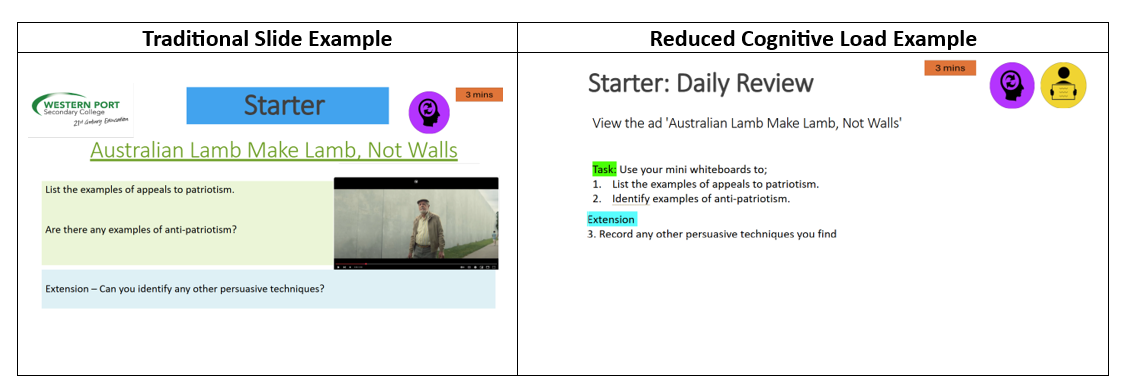
Staff have been adjusting their lesson slides to remove extraneous items that are unnecessary and detract from the main idea or content. Your students may be coming home sharing how ‘boring’ their slides look – but this removal of unnecessary pictures, colours, changes in font size is done with purpose and intent. This allows students to focus on what is important and get lost or distracted with other things on slides or around the room.
Checking for Understanding (CFU) Professional Learning
The Bayside Principals Association held their annual conference in Week 9 of this term, and not surprisingly, the focus for the professional learning for all school leaders across the network was on Cognitive Load Theory and the work of Formative Assessment (and how teachers check for learning and understanding). The conference Keynote Speaker was leading educational expert Dylan Wiliam, who led the two days of professional learning around the work our school is already well-established in.
The Professional Learning our teachers have completed so far this year includes building on the CFU learning from 2025, where staff have spent time reviewing how we are using our CFU protocols and ways we can continue to refine our practice. Our Term 1-2 focus is on;
Learning about questions as hinges directing our learning
Learning about surface and deep questions
When teachers ask the right questions at the pivotal points in each lesson, student learning is maximised. The teacher can confidently determine if something needs to be reviewed or gone back over, of whether the class is ready to move on.
How do we as a school know what is working?
The staff observation process allows teachers to be observed regularly in their classrooms and gain feedback on the elements above in real time. Formal, informal and peer feedback is an excellent practice that allows for constant reflection and adjustments to continuously improve.
Intervention and Supports Update – Tier 2
LEAP - Tier 2 Literacy Intervention is well underway at WPSC. Students who were not yet at the standard for Reading are placed into Literacy Enhancement classes (LEAP) to explicitly and systematically target reading improvement strategies. These students are currently withdrawn from LOTE Indonesian, until their reading level can be brought to standard.
So far this year, we have had 4 students graduate LEAP and will commence Indonesian in Term 2 – well done to those students who are from 7C (x2), 7F and 8C. A huge congratulations to those students who are now back at the standard level for reading!

SOME - At Year 8 this year we are trialling an equivalent Tier 2 Science of Mathematics Enhancement (SOME). Students across two Home Groups who are not yet at the standard for Maths have been selected to trial this support. This class runs during the scheduled science block, and while the trial is very new, students are already showing some excellent progress towards addressing gaps in their numeracy skills.
If the trial continues to show successes, the college will look to roll out this support more widely in the coming semesters/years.
DIBELS (Reading) and Acadience (Maths) Assessment and Monitoring – Tier 3
All students in Year 7 and 8 have had the Beginning of Year screeners for both reading and maths completed by the SOLAR team. This gives the school a clear measure of skill and allows the selection of the classes above. It also allows the school to determine which students need further monitoring and intervention to enhance their progress in a one on one or small group setting (time and resources dependent).
If your student is in a LEAP and/or SOME class, please ask them to share with you how they are progressing. They should be able to tell you how their progress monitoring is going and if their reading or maths are improving and by how much.
Semester One reports will show parents/carers the Beginning of Year and Middle of Year scores, but if you would like an update sooner, please reach out to the Year Level teams, or ask in your next Student Support Group (SSG) meeting. The team is very excited about the growth students are making.
Science of Learning Team