Learning
and Teaching

Learning
and Teaching

Week 1 & Week 2 – Term 2: ‘We try our best’
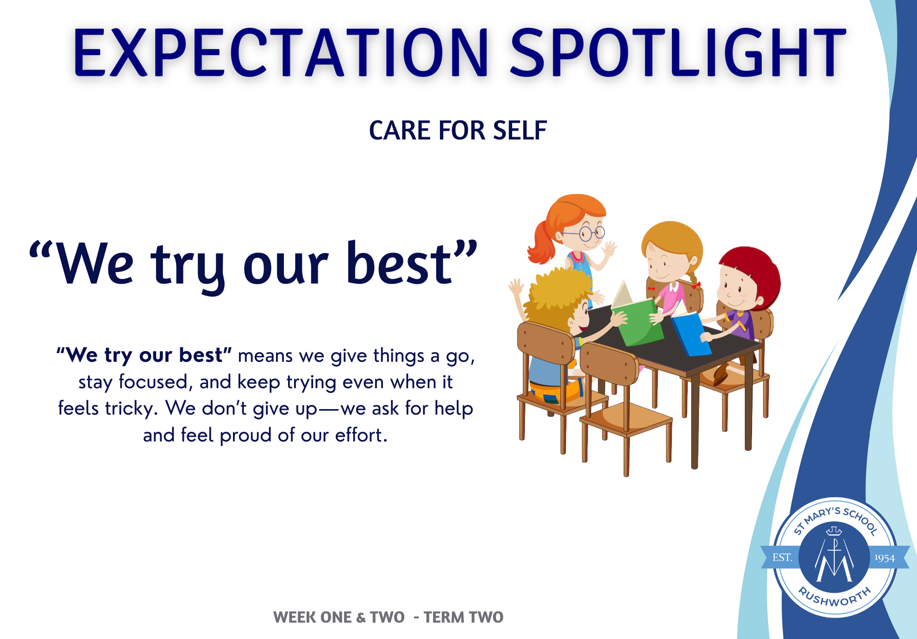
As part of our whole-school approach to creating calm and supportive learning environments, we have been focusing on our Expectation Spotlight: Care for Self – “We try out best.”
Our current Expectation Spotlight is “We try our best,” linked to our value of Care for Learning. This means encouraging students to have a go, stay focused, and keep trying—even when learning feels challenging. We talk about using a “growth mindset,” where mistakes are part of learning, and it’s okay to not get things right the first time.
In the classroom, this looks like students joining in, listening carefully, sharing their ideas, and asking for help when they need it. We encourage students to keep going, use helpful strategies, and feel proud of their effort and persistence.
As part of our Knowledge Society routines, we are introducing two key focus areas this term to strengthen consistency in classroom practice and support student engagement.
The first focus is on answering and asking questions. During daily reviews and lessons, all students are expected to actively think about each question, be prepared to respond, and listen carefully to the contributions of others. Students are also encouraged to ask questions to clarify their understanding and extend their thinking.
The second focus is the use of mini whiteboards during daily review and lessons. Students are explicitly taught clear routines, including when to record their thinking, when to share their responses, and how to check and refine their work. This approach ensures all students are actively involved, provides immediate feedback, and supports responsive teaching within the classroom.
On Monday, our staff came together for a full day of professional learning focused on strengthening teaching and learning across our school. It was a valuable opportunity to reflect on how students learn best and how we can continue to support every child to succeed.
Throughout the day, we explored research around student engagement, motivation, and how the brain learns, helping us better understand what supports strong, lasting learning. A key focus was the importance of clear, structured whole-class teaching, ensuring all students—especially those who need it most—can access learning in a consistent and supportive way.
We also worked on practical classroom strategies, including clear routines, active participation, and checking for understanding, to ensure every student is engaged and learning throughout each lesson.
This learning will continue to shape our teaching, ensuring calm, focused classrooms where all students can thrive and achieve their best. Some of the most important information is about how students remember. We continue to use the CESL Instructional model; one component of which is the model of Memory.
Model of Memory
The Simple Model of Memory (Willingham, 2009) provides a simple but powerful model of the interplay between the environment (what we wish to learn), attention, working memory, long-term memory and forgetting.
This model of memory provides us with important messages regarding learning:
a. attention is required to begin the learning process - no attention = no learning
b. working memory is the site of our thinking - thinking leads to learning
c. our working memory does two things:
(i) it processes new information from our environment, and
(ii) it brings up information from long term memory for us to think about and to connect new
learning to
d. new learning must be processed in working memory before it can move to long term memory
e. working memory is limited and quickly overwhelmed by too much new information too quickly
f. the limits of working memory can be overcome by information stored in our long-term memory
g. retrieving information from long term memory strengthens learning and makes it more durable and accessible; and
h. forgetting is a natural process that can be minimised via revisiting previously learned material on a regular basis