From the Principal
Dear Blue Mountains Grammar School Families,
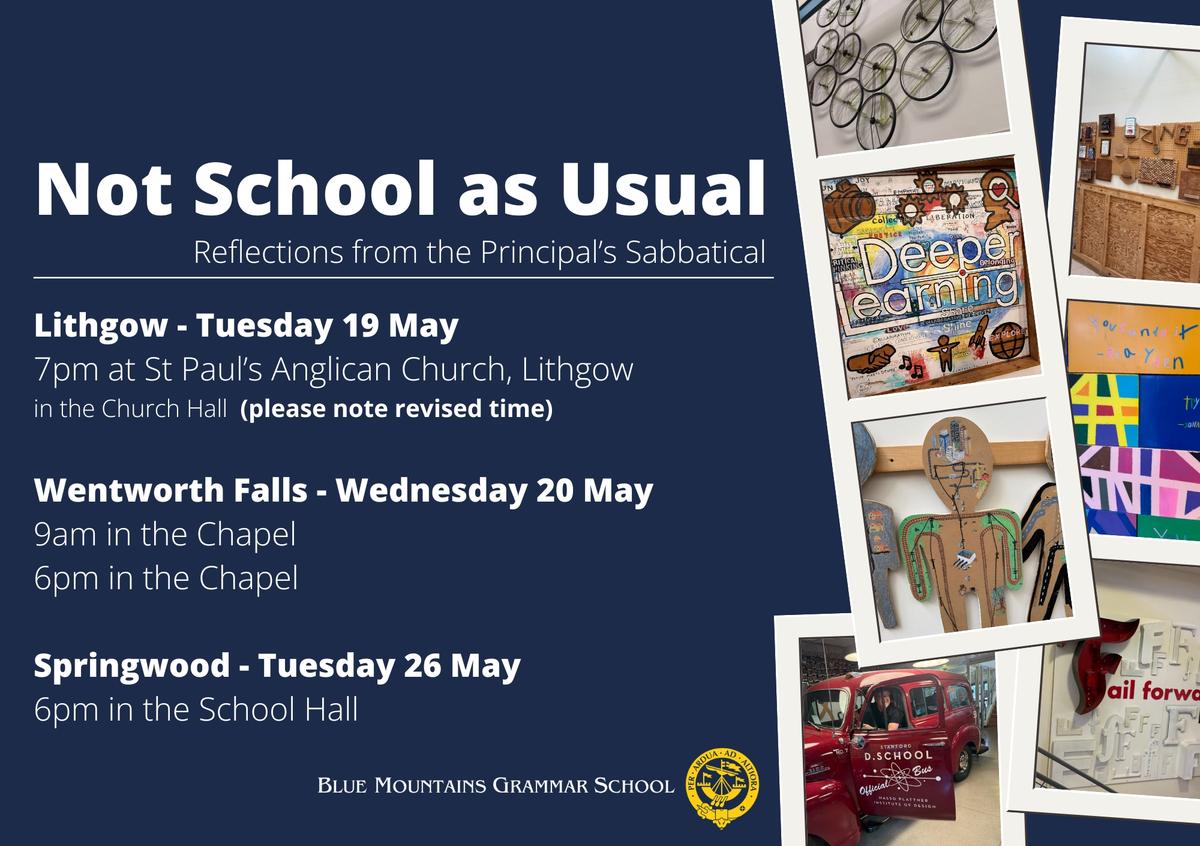
Sabbatical Sessions
One of the great privileges of a sabbatical is being given the permission by the BMGS Board to look up and step out of the day-to-day to spend time asking bigger questions about where education is heading, what is working in schools around the world, and what the most thoughtful educators are grappling with right now.
Over the coming weeks, I will be hosting a series of community sessions. These will be informal evenings and mornings when I will share the insights, ideas, and questions my sabbatical has surfaced. I will talk about what I have seen in schools in Australia and internationally, the global conversations shaping education right now, and, most importantly, what any of it might mean for our students and our community here at BMGS.
These are not lectures; they are observations. BMGS is shaped not just by its leadership's decisions but also by the wisdom and engagement of its whole community, and these sessions are an expression of that.
We have deliberately scheduled sessions at different times and locations so that as many families as possible can attend, regardless of work commitments or where you live along the range.
We are also pleased to include a session at Lithgow, recognising that the ongoing closure of Victoria Pass has made the journey to our campuses difficult for many families, and we want to bring the conversation to them.
I hope to see many of you there. Please see session details below.
Our New Website is Live!
I am thrilled to announce that our new school website has officially launched, and I encourage you to take a moment to visit and explore what has been created together.
It has been almost six years since we last refreshed our online presence, and a lot has changed in that time, not least our deeper understanding of who we are as a community. This new site is more than just a digital facelift; it is a reflection of our values and our people. We are, at our heart, a school built around people, and I believe the new website captures that well.
An acknowledgement goes to Nicole Law, whose creativity, dedication, and effort brought this project to life. From design through to implementation, Nicole's contribution has been outstanding, and we are grateful.
This was also very much a community effort. To everyone who participated, contributed ideas, or took the time to provide feedback along the way, thank you also. Your input shaped something of which we can be proud.
I invite you to visit our new website. You can find us at www.bmgs.nsw.edu.au
What Becomes Possible When We Truly See One Another
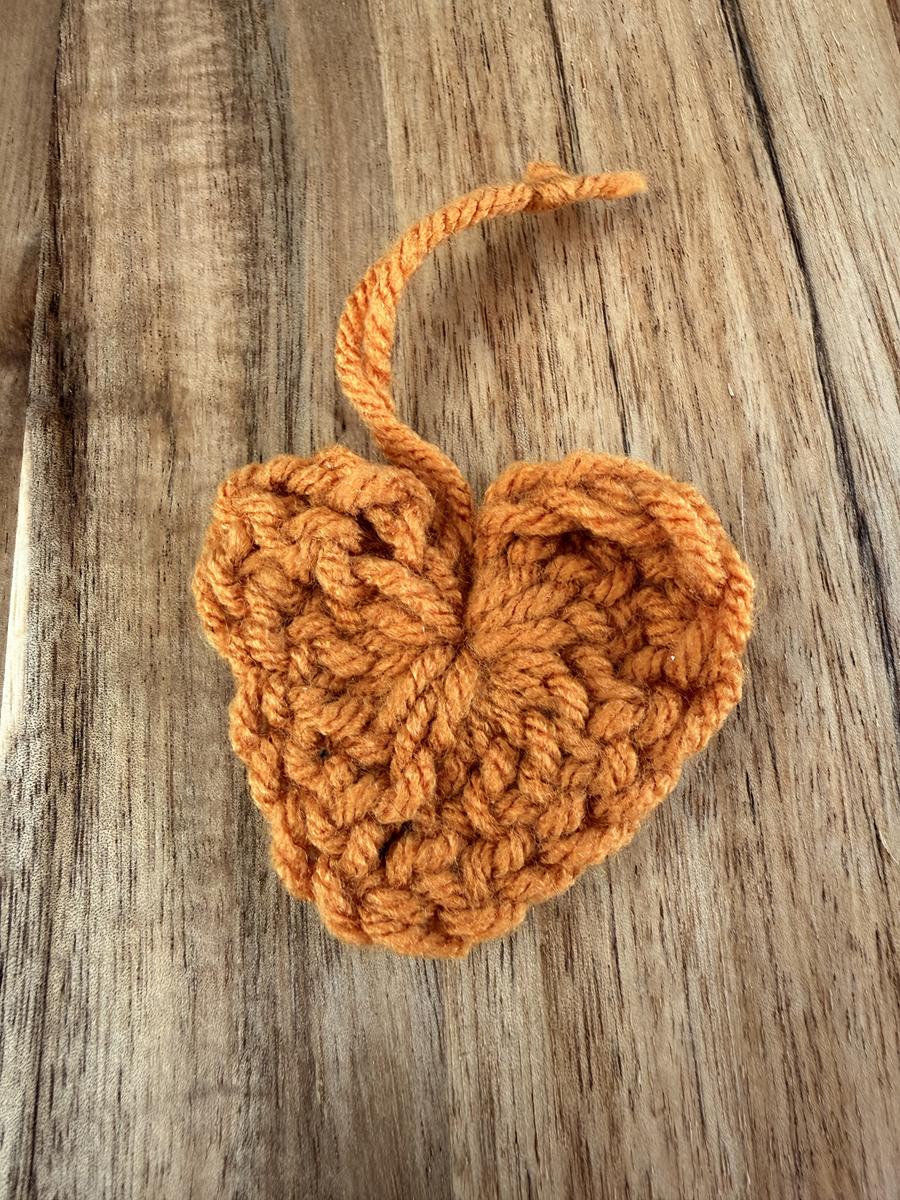
The small crocheted heart shown in the picture was given to me by a relative stranger at the Deeper Learning Conference in California. The simplicity and profound nature of the gift has stayed with me for weeks. Not because of its size, but because of what it did to me and a room full of people. On reflection, it should quietly ask something of all of us.
This little crocheted heart now sits in my office. It is orange, slightly uneven, and made by a pair of hands I will probably never see again. It was given to me by Catherine, a young learning support teacher from Minnesota, who was in my group at High Tech High in California. I know almost nothing else about her. Here is what I do know: she crocheted hearts for every single person in the room. Not just her colleagues. Not just her friends. For strangers. One after another, across an entire conference, she quietly gave handmade hearts to people she had never met and would likely never see again.
And every single recipient I saw her give one to responded in the same way. I could see it happen, something in the expression of their face opening up. It was not just gratitude. It was something deeper. The experience for those people, I think, is of being truly seen.
I have been turning that moment over ever since. And I want to share it with you, not simply as a nice story, but as a genuine invitation to reflect on what it might mean for our community here at BMGS.
I also do it in the context of Genesis 1:27: “So God created all of mankind in his own image, in the image of God he created them; male and female he created them."
Something We Are All Navigating
It would be fair to say that the world our students are growing up in makes genuine connections a little harder than it used to be. Not because people are worse, but because so much of our public life now rewards a particular way of engaging with one another. Too often, the platforms we use, the news we consume, the conversations that travel furthest tend to be the ones built around disagreement, around finding fault, around reducing a complex person to the single thing about them we find most objectionable.
Perhaps it is an understandable pattern. When life feels uncertain or fast-moving, it is natural to reach for clarity, and pointing to what someone else has got wrong can feel like a kind of clarity. But it rarely leaves us feeling more connected. And it rarely helps us see the full person in front of us.
What Catherine reminded me, without saying a word, is that there is another way entirely. She appeared to have no agenda; she didn’t seem to be performing. It seemed to be a quiet, handmade act of seeing people, strangers, as worth something. And it changed the room every time.
The Image of God in Every Person
The biblical tradition that underpins a school like ours begins from a remarkable premise: that every single human being is made in the image of God. The imago Dei. Every person has value; not just the people who are easy to love, nor just the ones who have their lives together, or who agree with us, or who haven't yet disappointed us.
Every person, with all their remarkable capacity and capability, and all their very human shortcomings, carries something of the divine.
This is not a sentimental idea. It is both generous and demanding. It asks us to look at the person in front of us, whether it's our colleague, our student, a parent with a concern, the teacher we don’t seem to get along with, or even the stranger at the conference. It calls us to begin our engagement from the assumption that this person has depth, and story, and gifts, and struggles, just as we do.
It is worth asking: what would our community look like if that were simply where we started? Not pretending there are no problems to address, no growth edges to work on, no honest conversations to have. But beginning, always, from the recognition that the person in front of us is more than their worst moment.
What if we were so counter-cultural in this space that people were drawn to us because of it?
Ephesians 4:29 calls us to this when it instructs, “Do not let any unwholesome talk come out of your mouths, but only what is helpful for building others up according to their needs, that it may benefit those who listen."
What We Model Matters
Our children are always watching. Not in a way that should make us nervous, but in a way that is simply true. They notice how we speak about people when we are frustrated. They notice whether we move toward understanding or toward judgment when someone makes a mistake. They learn the grammar of relationships not from what we tell them in a lesson but from what they observe us doing in the corridor, at the school gate and around the dinner table.
As adults, how are we showing them what it looks like to see people first? To hold space for someone's complexity? To offer grace before delivering a verdict?
If we can do this, even imperfectly and inconsistently, I believe we are giving them something far more durable than any curriculum outcome. We are showing them exactly how community is actually meant to work.
1 Thessalonians 5:11 says it beautifully, “Therefore encourage one another and build each other up, just as in fact you are doing."
Why is this important?
After thirty years in schools, I have watched something gradually shift, and then shift all at once. It is in the way people relate to one another. It is not dramatic. It is quiet. But it is real.
We live in an age that has become extraordinarily skilled at outrage.
This phenomenon is called ‘outrage culture’.
Research into online behaviour and social dynamics consistently shows that expressions of moral indignation, including anger, contempt and public shaming, spread further, faster, and more virally than almost any other form of human communication. A 2021 study published in Science Advances found that, on social media platforms, each moral-emotional word in a post increased transmission rates by approximately 20 per cent. Outrage is, in a very measurable sense, contagious.
This is not a trivial finding, and I am convinced it tells us something important: the architecture of modern communication actively rewards the dehumanisation of the person we disagree with. It doesn't ask us to see them. It seems as though, in too many cases, we are being asked to ‘defeat’ opposing views, expose where others fall short, catalogue their failures, and broadcast those failures widely.
Outrage culture does not seem to see humans, as it only sees disagreement. It approaches people as positions to argue against, not lives to connect with. I think we can do better.
The Hopeful Part
Here is what I do find encouraging: we already know how to do this. It is not a new skill. Every one of us has experienced what it feels like to be truly seen by another person, and most of us have experienced the gift of being the one who sees. We know the warmth of a conversation that left someone feeling better about themselves. We know the difference between a classroom where students feel known and one where they feel managed. We know, intuitively, that communities built on recognition and genuine regard are simply better places to be.
Catherine didn't do anything complicated. She just decided, one heart at a time, that the people around her were worth acknowledging. Worth a small, handmade gesture of recognition. And it was enough to change the feeling of an entire room. To build community, we need to build one another up.
Imagine what becomes possible in our school community if that is the posture we bring? Where students feel genuinely known by their teachers? Where parents feel seen, not just managed? Where staff feel valued for what they contribute, not just evaluated for where they are perceived to have fallen short?
The research on what this kind of culture produces is clear: deeper trust, greater resilience, more creativity, and stronger belonging, it turns out, is not a nice extra. It is a precondition for everything else we hope to achieve.
Thank You
As I stated, the small orange heart in my office is now a reminder that seeing people is a choice, one available to me and everyone else every single day. In a quick conversation at the beginning of a lesson. In the way we respond to an email. In the way we ask a question of a staff member. Whether we ask a follow-up question or move on. In the small, unremarkable moments that accumulate over time, they become the culture of our school.
That is the community we are building at Blue Mountains Grammar School. Not perfectly, because we are all human and have our shortcomings. But intentionally. One act of recognition at a time.
Thank you, Catherine. Your crocheted heart is a daily reminder of what is possible when we simply decide to see one another.
Warm regards
Steven Coote
Principal
This document has been reviewed for spelling and grammar. Please note that as such, it may identify some content as being generated by AI.