Cycling with primary school-aged children
Help your child prepare for independent riding:
- Encourage your child’s school to run a bicycle education program.
- Pick routes they will ride often and help them get familiar with the journey.
- Explain where and how to lock up a bike.
- Talk about what to do if something goes wrong, like getting a flat tyre.
When riding on streets with children:
- Use quieter local streets and ride in bike lanes where available. Use the footpath when you need to.
- If there are two adults, have one ride in front and one at the rear, with children in between. If there is one adult, ride at the rear. Ride slightly to the right of the child or children, so vehicles don’t pass too close.
- Teach children how to ride through intersections using hook turns, hand signals and the correct positioning.
- Call out any instructions early, to give children time to respond.
- Use lights, hand signals and your bell.
Bicycle helmets
You must wear a bicycle helmet if you’re using a bicycle, scooter or e-scooter to help protect you.
On this page
- Choosing a bicycle helmet
- Approved safety standards
- Bicycle helmet exemptions
- Helmets reduce the risk of a serious head injury
- Rules for helmets
You must wear a helmet when you’re riding a:
- bicycle - including e-bike
- e-scooter
- human powered scooter.
If you don’t follow these rules, you can be fined.
It's also illegal to ride an e-unicycle, hoverboard or segway on a public road, footpath or shared path in Victoria.
Choosing a bicycle helmet
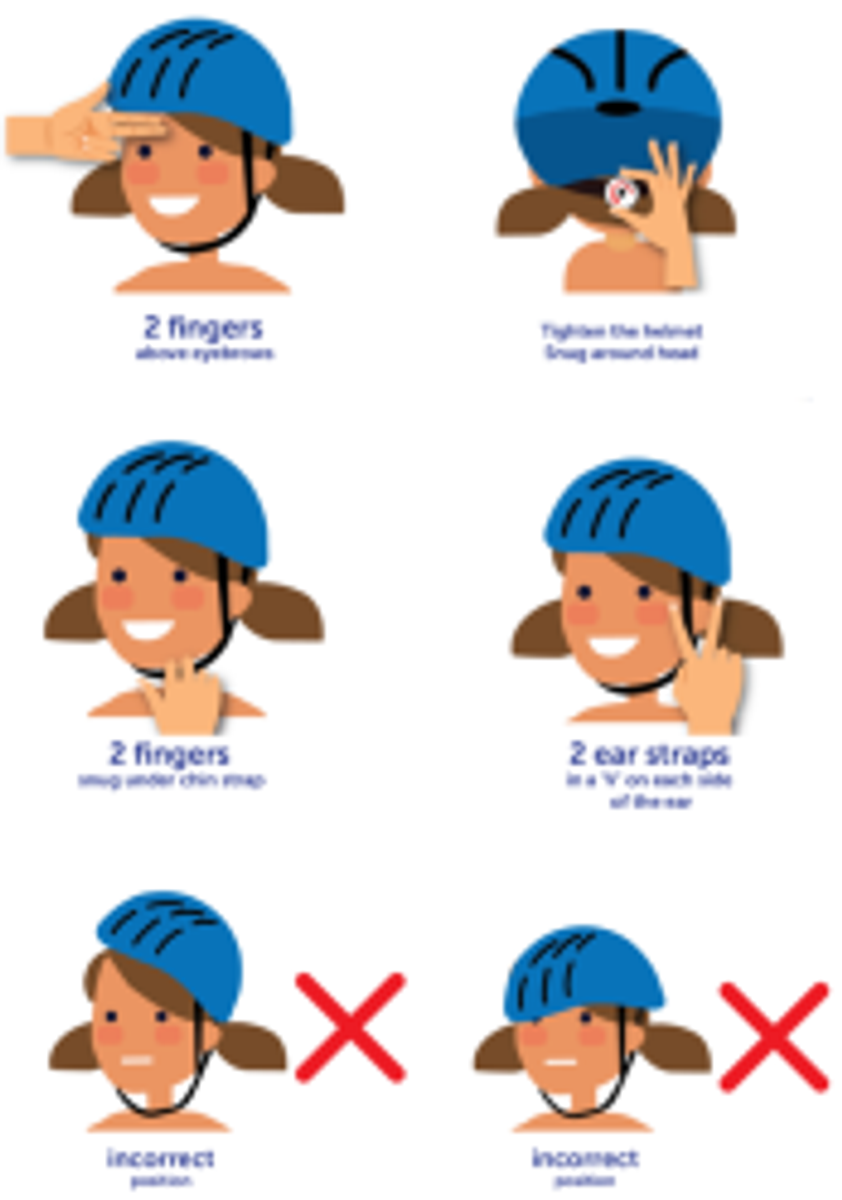
When choosing a bicycle helmet for you or your child, make sure:
- it is not damaged
- it fits firmly and comfortably on your head – the gap between your eyebrows and helmet should be no more than two fingers wide
- the helmet doesn’t tilt too far forwards, backwards or sideways – the rim of the helmet should sit just above your eyebrows
- the straps around your chin are firm, not slack, and the straps make a ‘v’ just under your ears
- it has a label showing it meets any of the approved safety standards.
For children’s helmets, measure the size of your child’s head just above your child’s eyes and ears. Select a helmet to fit a head of that size.Helmets should usually be replaced every 5 years because the protective foam can wear out over time. If a helmet is involved in an accident or dropped on a hard surface, it should be replaced immediately.
Approved safety standards
Victorian laws allow you to use bicycle helmets that meet any of the following safety standards:
- Australian/New Zealand Standard AS/NZS 2063:2008 Bicycle helmets,
- Australian New Zealand Standard AS/NZS 2063:2020 Helmets for use on bicycles and wheeled recreational devices
- Australian/New Zealand Standard AS/NZS 2063:1996 Pedal cycle helmets (to be phased out on 03 April 2026)
- European Standard EN 1078:2012+A1:2012 Helmets for pedal cyclists and for users of skateboards and roller skates
- U.S. Consumer Product Safety Commission standard US CPSC 16 C.F.R. Part 1203 Safety Standard for Bicycle Helmet
- American Society for Testing and Materials Standard ASTM F1447-18 Standard Specification for Helmets Used in Recreational Bicycling or Roller Skating
- Snell Standard B-95, 1995 Bicycle Helmet Standard, 1998 revision, Standard for Protective Headgear for Use in Bicycling.
When buying a bicycle helmet, it is important to check it has a label on it showing it meets one of these standards.
Bicycle helmet exemptions
You may be exempt from wearing a helmet if your religious headdress means a helmet won’t sit correctly on your head.
You may also be exempt for medical reasons. If so, you must carry a medical certificate from your doctor when you ride. This certificate may expire if you have a short-term condition.
Relevant medical conditions may include:
- severe skin conditions
- hearing aids or bionic ears
- a head that is larger than normal
- a head injury that may be more painful while wearing a helmet.
Helmets reduce the risk of a serious head injury
In 2016, the Australian Health Protection Principal Committee (AHPPC) issued a statement supporting mandatory bicycle helmet laws. The AHPPC is made up of the chief health officers of each Australian state and territory.
Also in 2016, a comprehensive, systematic review of 40 helmet-related studies was published in the International Journal of Epidemiology. The review found bicycle helmets reduce the chances of a serious head injury by almost 70 per cent.
Two years after introducing bicycle helmet laws in 1990 there was:
- a 16 per cent reduction in head injuries in metropolitan Melbourne
- a 23 per cent reduction in head injuries in Victoria.
Rules for helmets
The rules for helmets are published the Road Safety Road Rules 2017:
- Part 14: division 2, rule 244B – Wearing of helmets and other requirements for users of scooters
- Part 14. division 3, rule 244P – Wearing of bicycle helmets by persons travelling on electric personal transporters
- Part 15, division 1, rule 256 – Bicycle helmets
You may be fined for not wearing a bicycle helmet.
If your child is in grades 4, 5 or 6, think about enrolling them in a bike education program.