Student Excellence Program

PROBLEM OF THE WEEK SOLUTIONS
How did you go with the challenges from the last newsletter? See below for the link to the solutions video’s.
1/2: Find My Number
https://youtu.be/r28kHGwoicI?si=ltQSlDDmD2aG5l3Q
3/4:Shellshttps://youtu.be/WbYVcmYXioA?si=BVZnUYDPZfZYcjzL
5/6: Eclairs and donutshttps://youtu.be/OonmMacDP-U?si=vUkBu4SWsgpNTmd6
APSMO Maths
It has been a real privilege to work with our APSMO maths groups. A personal highlight for me is hearing the year 3 children blame their parents if they are incorrect with homework challenge questions. It sounded like some parents were going to be in a bit of trouble. It is wonderful to hear that
children are engaging with their families in this work. Our hope is to give children the knowledge and confidence to come home and not just know the answer, but to be able to justify their reasoning and share that with you.
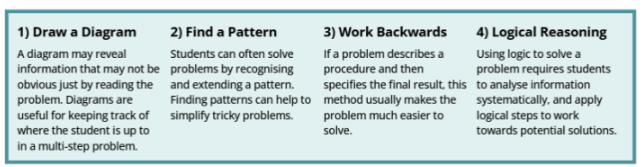
A common theme we have noticed in error analysis across Maths Explorers, Maths Games and Maths Olympiads seems to be reading and interpreting what the question is asking children to do and understanding just how many steps are required to get the end result. If you are working with children on any problem, encourage them to justify and show their working out. Our students have incredible minds with very quick recall and automaticity of many different mathematical processes, sometimes they find it really challenging to justify their reasoning, meaning they are unable to review and check their answers. Below are some of the suggested strategies that we model and work through in the APSMO program.
Extra Reading/information
Understanding Underachievement in High Ability Students - Department of Education Victoria
Some high-ability students are at risk of underachieving. Research shows that up to 50% of high-ability students do not reach their full potential in education or work. Many factors can cause this.
Teachers can play a key role in identifying students who might not show obvious signs of high ability.
Four broad types of underachievement are outlined below.
• Involuntary underachievers: these students want to do well but are overlooked due to language barriers or disabilities. Their underachievement might be worsened by a lack of suitable learning opportunities, due to disadvantage or geographical location and/or isolation.
• Classic underachievers: these students underperform in all areas of the school curriculum. Their underachievement often starts in the early years of secondary school, when they face pressure to choose between fitting in socially or achieving academically.
• Selective underachievers: these students put effort into subjects they like or are confident in. They may also work harder in classes where they like the teacher. In other subjects, they put in little effort.
• Underachievers who fly under the radar: these are the high-ability students who coast through school, only doing what is necessary to get by. They receive good grades but are not meeting their potential. Their lack of effort may go unnoticed because their work is still acceptable.
They avoid academic risks, struggle to learn from failure, and subsequently may not build resilience.
Considering the whole child and their situation helps in understanding the causes of underachievement. Once the cause is identified, it is recommended that teachers work together with the student to help them succeed. This may include:
• increasing opportunities for independent practice
• providing opportunities for the student to demonstrate mastery
• the use of open tasks with a focus on problem-solving
• teaching through guided, structured inquiry
• providing emotional support to the student.
There are a lot of questions coming through. I apologise if there is a slow response time. I attempt to go through all accessible data to answer the question as thoroughly as possible. I appreciate all enquiries and endeavour to respond in a timely fashion. Thank you for reaching out, it is really great to be able to talk to families about what we have on offer and your child/children. Your opinion and feedback matter, unfortunately we are limited in what we can offer at times, however, your input can help shape the direction for further opportunities. We have very high trust in the exceptional teachers here at Tarneit Rise at identifying potential and making the necessary adjustments in class to help children reach that potential.
As always, your child’s classroom teacher is the first point of contact for any questions around your child and their academic progress, but I am here to answer any questions in relation to the student excellence program.
Cobie Canny
Leading Teacher | High Ability Practice Leader
PH: 7002 6580
Email: cobie.canny@education.vic.gov.au