
Assistant Principal's
Message
Be Kind
Be Responsible
Be an Active Learner
Assistant Principal's
Message
Be Kind
Be Responsible
Be an Active Learner
One of our key priorities at SMPPS is ensuring that every student feels safe, connected, engaged and ready to learn. This commitment sits at the heart of our current Annual Implementation Plan (AIP) and aligns with our School Strategic Plan 2025–2028 goal: to maximise the wellbeing and engagement of all students.
This year, our wellbeing improvement work is focused on: strengthening teacher capabilities to engage and challenge students through consistent, positive and inclusive practices. As part of this work, we continue to embed our School-Wide Positive Behaviour Support (SWPBS) framework, which encourages expected behaviours, provides clear support when students need guidance, and promotes consistency across all classrooms.
A key element of this approach is recognising and reinforcing our three school values: Be Kind, Be Responsible and Be an Active Learner.
Across the school, teachers monitor and celebrate positive behaviours through classroom token systems, helping to ensure that positive interactions significantly outweigh corrective feedback. Research consistently shows that when students experience strong relationships, encouragement and a sense of belonging, they are more likely to engage deeply in their learning and develop confidence in themselves as learners.
Throughout the semester, our Mental Health and Wellbeing Leader, Johanne Abbott, and I have worked alongside staff to build our collective understanding of wellbeing and student engagement. At the same time, Johanne has continued to coordinate a carefully planned wellbeing curriculum that incorporates Resilience, Rights and Respectful Relationships curriculum, Inform and Empower online safety education, our school values, anti-racism education and the role of being an Upstander. Together, these learning experiences help students develop the knowledge, skills and dispositions needed to thrive both at school and beyond.
This week, I will be facilitating the second of four professional learning sessions focused on neurodiversity and inclusive education. Inclusive practice is an area I am deeply passionate about, having spent many years supporting students with disability in schools both internationally and within the Victorian education system. Since joining SMPPS in 2024, part of my role has been to support Disability Inclusion processes, while also working alongside teachers to strengthen inclusive practices at the student, classroom and whole-school level.
Many families may be surprised to learn that according to Australia's Nationally Consistent Collection of Data (NCCD), 27% of Australian students receive some form of reasonable adjustment at school. A reasonable adjustment is a change to teaching, learning, communication, assessment or the environment that enables a student to access education on the same basis as their peers.
• Based on a student's individual strengths and needs• Designed to support access, participation and achievement• Developed in partnership with students and families where appropriate• Focused on maintaining high expectations for learning• Practical and sustainable to implement• Regularly monitored and reviewed Importantly, reasonable adjustments are not about lowering expectations. Rather, they are about removing barriers so that students can demonstrate what they know and can do.
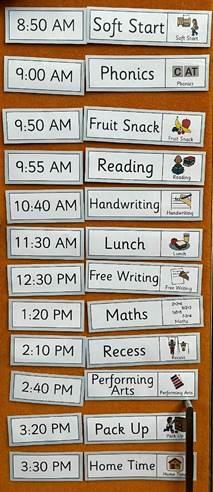
One example of this at SMPPS is our whole-school visual timetable. By using consistent visuals, language and formatting across all classrooms, students experience greater predictability throughout their day. Whether a student requires an individual timetable at their desk, attends a specialist program, joins a split class, or transitions into a new year level, the consistency of this approach reduces anxiety, supports smoother transitions and allows students to focus their energy on learning.
I am incredibly proud of the inclusive practices demonstrated by our teachers every day. Staff routinely make thoughtful adjustments that support student success, including providing visual supports, breaking tasks into manageable steps, modelling expectations, repeating instructions and offering scaffolded learning opportunities. While these practices may be designed with particular students in mind, they often benefit many others as well—including students learning English as an additional language, students who are new to the school, students who have experienced trauma, or simply those who may be having a challenging day.
This reflects an important principle in education: what is good for some is often beneficial for many and harmful to none.
At their best, reasonable adjustments act as temporary scaffolds that support students to develop confidence and independence over time. As students grow in capability, these supports are gradually reduced, allowing them to take increasing ownership of their learning and wellbeing.
Families play an equally important role in this journey. As parents and carers, we regularly provide supports and adjustments at home to help our children develop the skills they need for life. One simple way to support your child's success at school is to encourage independence in everyday routines. For example, can your child unpack their own bag, organise their belongings and follow familiar morning routines without adult prompting? These seemingly small skills contribute significantly to confidence, responsibility and self-management.
It has been wonderful to see so many of our youngest learners already demonstrating these capabilities. Watching our Prep students independently organise themselves each morning is a reminder that children are often capable of much more than we realise when given the opportunity and encouragement to practise.
As this is our final newsletter for the term, I would like to thank our students, families and staff for their ongoing partnership and commitment to making SMPPS a welcoming, inclusive and supportive learning community.
I wish everyone a safe, restful and enjoyable winter break and look forward to welcoming students back for an exciting Term 3.

Sam Smrekar Thompson