Assistant Principal
Mr Jon Cullerton

Assistant Principal
Mr Jon Cullerton
At St Aloysius College, we know that timely, meaningful feedback is essential to student growth. To support this, the College maintains a two school week turnaround for the marking and return of all formal assessments. This timeframe ensures teachers can assess student work thoroughly while providing feedback that is still relevant and actionable for learners.
As part of this process, students can expect instructive/constructive feedback on their work. Teachers typically provide a series of comments throughout the response to highlight strengths, identify areas for improvement, and guide students toward next steps. Each assessment also includes a final summary comment and a mark awarded against the relevant criteria, ensuring students understand both their achievement and the specific skills or knowledge they can continue to develop.
An important part of this cycle is student reflection. We encourage all students to take time to read their feedback carefully, consider the criteria, and reflect on what their mark shows about their current level of understanding. This reflection helps students identify clear goals for improvement and take ownership of their learning, ensuring they know exactly “where to from here” as they prepare for future tasks.
By returning assessments promptly and offering clear, targeted feedback, we help students understand their progress, build confidence, and apply their learning to future tasks. This commitment reflects our focus on high quality teaching, consistent expectations, and supporting every student to achieve their personal best.
At St Aloysius College, the idea of what is fair and reasonable sits at the heart of how we work together each day. It guides the way teachers support students, the way expectations are communicated, and the way our community maintains a safe, respectful and productive learning environment. When teachers make requests of students—whether in the classroom, on the playground, or during College events—those requests are always grounded in what is fair, reasonable and in the best interests of learning and wellbeing.
A fair and reasonable request is one that helps maintain safety, supports learning, upholds College expectations, or ensures the smooth running of the school day. This might include instructions such as moving to a different seat to support focus, handing a phone into the office, wearing the uniform correctly, or following directions during transitions. These requests are never arbitrary; they are made to help students succeed, to minimise disruption, and to ensure that every member of our community can learn and feel safe.
Because these requests are fair and reasonable, we expect students to follow them the first time they are given. Doing so shows respect for others, supports positive relationships, and helps create a calm and orderly environment where everyone can thrive. When students respond positively to teacher directions, they demonstrate responsibility, cooperation and maturity—qualities that reflect the St Aloysius Way and prepare them for life beyond school.
By upholding this shared understanding, we strengthen our community and ensure that St Aloysius remains a place where learning is prioritised, expectations are clear, and every student is supported to be their best.
Just as we see on signs in supermarkets, hospitals and other public institutions, St Aloysius College does not tolerate rude, hostile or abusive language or behaviour towards staff or students. Respectful communication is a non-negotiable expectation in our community. By upholding this standard, and complying with fair and reasonable requests we can ensure that our College remains a safe, supportive and respectful environment for all.
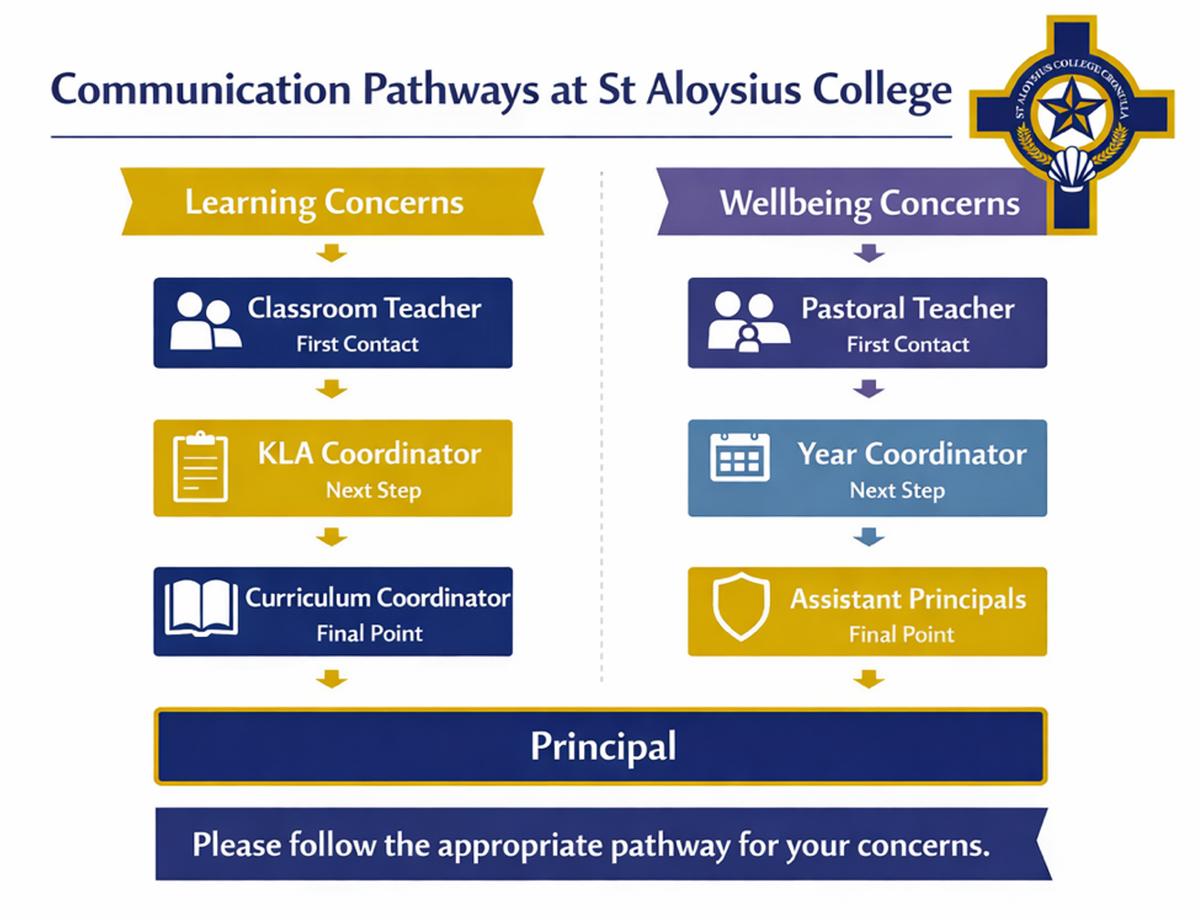
At St Aloysius College, we value strong, respectful and efficient communication between home and school. To ensure enquiries are directed to the right staff member and responded to promptly, we ask parents and carers to follow our established communication pathways.
For learning or classroom based concerns, the first point of contact is always your child’s classroom teacher. They know your child’s learning best and can address most questions directly. If further clarification or support is needed, the matter can then be referred to the KLA Coordinator, who oversees teaching and learning within that subject area. For more complex curriculum matters, the final point of escalation is the Curriculum Coordinator.
For wellbeing concerns, parents should first contact their child’s Pastoral Teacher, who works closely with students each day and has a strong understanding of their social and emotional needs. If additional support is required, the next step is to contact the Year Coordinator, who oversees the wellbeing of the entire year group. More significant or ongoing concerns may then be referred to the Assistant Principals.
By following these pathways, parents help us ensure that communication is clear, efficient and directed to the staff member best placed to support your child. This shared approach strengthens our partnership and ensures every student receives the care, guidance and attention they need.
As we move into the cooler months, we remind all families of the College’s expectations regarding winter uniform and grooming. The appearance of our students—both at school and while travelling to and from the College—creates a strong impression in the local community. Wearing the correct uniform and meeting grooming standards is a condition of enrolment, and ensures our students present with pride and consistency.
During Terms 2 and 3, all students are required to wear the winter uniform. The College blazer must be worn when travelling to and from school. Students may also wear the College jumper for additional warmth; however, spray jackets or non-uniform jumpers are not permitted at any time. Winter shirts must be tucked in, and boys are required to wear ties. Girls’ skirts must be knee-length, with navy stockings worn as part of the winter uniform.
Grooming expectations continue to apply throughout the winter period. Male students must be cleanly shaven, female students may use minimal natural tone make up, natural eyelashes, and natural or nude nail polish only. Hair should be neat, tidy, and natural in colour, with no extreme styles such as mullets, rats’ tails or braided designs. Girls’ hair must be tied back using navy, white, gold or black ribbons or elastics. Students may be sent home to correct hairstyles that do not meet expectations.
Permitted jewellery remains limited to two pairs of plain gold or silver sleepers/studs per ear lobe and one simple necklace, with no other facial piercings allowed.
Footwear is also an important part of the winter uniform. Students must wear proper lace up hard leather school shoes (e.g., Clarkes or ROC). Black leather sneakers are not acceptable. For sport, students require supportive lace up joggers, not casual brands such as Vans or Converse.
We thank families for supporting the College in maintaining high standards of presentation. Ensuring students are correctly attired each day helps reinforce pride, belonging and respect—cornerstones of the St Aloysius Way.
As we approach Easter, we are reminded of the deep significance this season holds—a time of renewal, hope and reflection. At St Aloysius College Cronulla, Easter invites us to pause, to reconnect with our faith, and to celebrate the message of compassion, forgiveness and new life that lies at the heart of the Gospel.
In our College community, we see these values lived out daily—in the kindness shown between students, the dedication of our staff, and the support of our families. Easter reminds us that even in times of challenge, light and hope prevail. It is a season that calls us to look forward with courage, and to nurture the spirit of generosity and grace in all that we do.
We wish all our families a safe, peaceful and blessed Easter. May this time bring rest, renewal and joy to your homes, and may the message of Easter continue to inspire us as we walk together in faith and community.