
MENTAL HEALTH & WELLBEING


What is Occupational Therapy?
At Chilwell, as part of our Wellbeing Team, we are fortunate enough to be able to draw on the expertise of Occupational Therapist (OT) Amy Frueh one day each week. Amy works closely with school staff to support and develop our skills. She has presented professional learning to our whole staff on a number of occasions and at our next Curriculum Day will present to our Education Support Staff regarding emotional regulation.
We are also fortunate that Amy works alongside our Engagement and Wellbeing Leader, Jason Cole, to run some small groups with identified students. While Amy does not offer 1:1 student sessions, there are Occupational Therapists available in Geelong if you think your child may benefit from this type of short term or longer term support.
Many parents ask questions about the type of support an Occupational Therapist (OT) can provide. Occupational Therapists are able to support the development of many skills as Amy has outlined below.
Virginnia Gilham
Inclusive Practices Leader
Every child develops in their own way. Occupational Therapists (OT) support children and families to participate in what is meaningful to them and part of their day to day life. Your child may benefit from OT if they need further support with:
- Fine motor skills- this includes reviewing skills needed for writing, cutting, opening lunch packets, fastening buttons/zips etc. This can look like- short bursts of writing, swapping hands a lot during task, asking for help for self-care tasks (like opening packet/undoing a button/shoe laces).
- Gross motor skills- this includes skills needed to dress, accessing playground equipment successfully, moving through classroom environment and sustaining seated position. This may look like- coordination difficulties, reduced participation in sport activities, body awareness challenges.
- Emotional/sensory regulation- this includes reviewing skills for attention and focus for learning task, being in an optimal state of arousal for activities throughout the day and having language to check in/express needs. Common support includes environmental adaptations and tools for learning that support sensory needs. This can look like- difficulties regulating body movement, seeking input, internalising feelings and difficulties participating in one task for prolonged periods of time.
- Executive functioning- this includes reviewing cognitive skills needed for learning like planning, organising, time management, working memory, emotional control, flexible thinking to follow routine and initiate learning tasks. Some supports can include visual timers and targeted/functional visual schedules. This can look like- cluttered working spaces, consistently losing items and challenges completing routines independently.
- Play skills for younger years- this includes skills like interacting with others, initiating play ideas, flexibility in play, narrative (following a play theme, script, start- finish), attention and regulation. This can look like – jumping from one group of play to the next, having one peer as preferred play peer, repeating actions in play, overwhelms quickly with too many sequences or changes in play.
- Routine support- this includes being able to transition between activities in the school day, understanding what may be next. This may look like- big emotions with changes to routine, overwhelm with change of environments.
Amy Frueh
Occupational Therapist
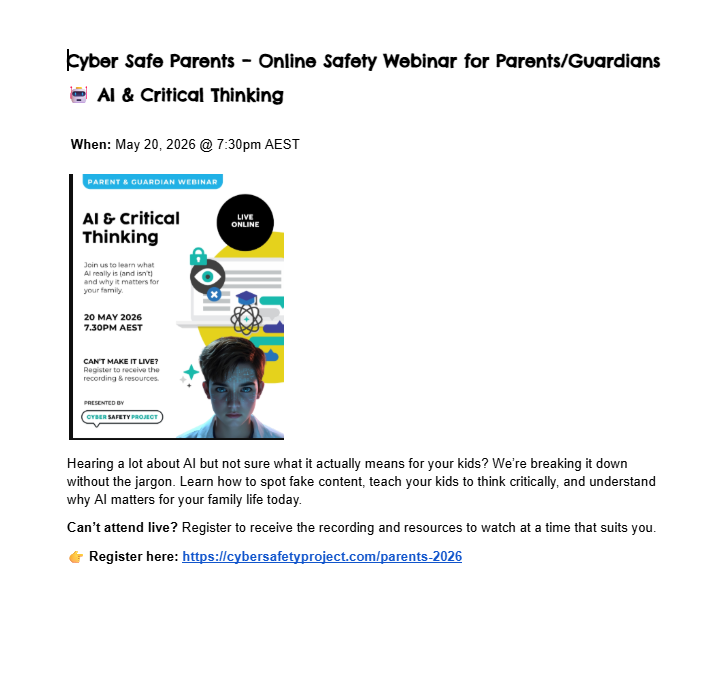
Cyber Safe Parents – Online Safety Webinars for Families
We’re thrilled to announce our school has partnered with Cyber Safety Project to offer parents access to the Cyber Safe Parents 2026 Webinar Series. These practical, easy-to-understand sessions, available live or on demand, will provide simple strategies to help families manage online safety, screen time, AI, and digital wellbeing. Pop these important dates into your calendars now: Our first session is a practical session on Cyber Safety in the home. It is encouraged that you attend with your child. This is coming up on the 10th of March. If you cannot attend the session there is a 7-day re-watch available.
2026 Topics & Dates: 1. Cyber Safety at Home (Family session) – 10th March
2. AI & Critical Thinking (Parent/Guardian session) – 20th May 3. Balancing Life & Tech (Parent/Guardian session) – 3rd August 4. Cyberbullying & Resilience (Parent/Guardian session) – 27th October All sessions start at 7.30pm AEDT/AEST.
Can’t attend live? Register to receive the recording and resources to watch at a time that suits you.
👉 Register here: https://cybersafetyproject.com/parents-2026 (do not share this link on social media)
|