
Learning and Teaching

Welcome to the 2026 School Year
This year we have already seen some fantastic learning taking place. To inform all parents of
some of the curriculum areas / programs we teach at OLSC, here is a bit of a breakdown.
Religious Education - all levels learn about prayer, sacraments, liturgical year and will participate in prayer, meditation and liturgical experiences.
Prep - 2 Little Learners Love Literacy (LLLL) - this is a phonics program.
Years 3 - 6 Phonology, Orthography, Morphology and etymology (PhOrMeS) - this is a word reading and spelling program.
Literacy - this involves learning areas such as; reading, language, literature, literacy, viewing, speaking, listening, comprehension, writing and handwriting.
Maths - we follow the structure of daily review, checking for understanding, explicit teaching and independent practice. We teach areas such as number, algebra, measurement, space, statistics and probability. Each of these areas are broken down into units to teach and are taught at different times, depending on year levels.
Wellbeing - this includes learning about our school values; Respect, Responsibility and Resilience, Social Emotional Learning (SEL) and we use the Respectful Relationships program. Wellbeing is explicitly taught during our Wellbeing Hour as well as incidentally each day.
Inquiry - this is when we learn about many different areas of the curriculum. To assist in understanding we usually spend one term on each curriculum area. This may include; health, civics and citizenship, economics, geography, history, science and design technologies.
The Capabilities; critical and creative thinking, ethical, intercultural, personal and social are taught within all areas of learning.
Specialist subjects include; visual arts, performing arts, physical education, Mandarin, science and digital technologies.
Teaching is always planned with our students in mind. We look at what each student already knows, what they might need clarification or practice with and how to extend their learning further. Therefore students may sometimes state that they "didn't learn anything today" but they are reinforcing or practicing skills to consolidate the learning into their long term memory.
Further information about these curriculum areas and programs, as well as an overview of when they are taught will follow in the coming weeks.
NAPLAN 2026
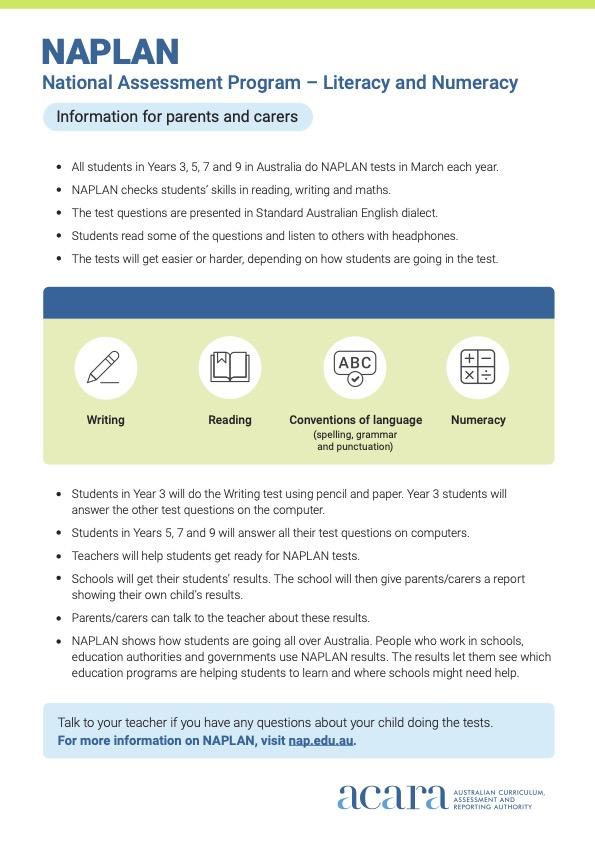
NAPLAN (National Assessment Program – Literacy and Numeracy) is an annual assessment for Australian students in Years 3, 5, 7, and 9, testing skills in reading, writing, conventions of language, and numeracy. Conducted online in March, it measures literacy and numeracy proficiency against national standards.
Our Year 3 and Year 5 students will sit these assessments beginning on Wednesday the 11th of March. A schedule of the assessments will be sent home in the coming weeks. To prepare students should become familiar with the functionalities of the browser. A public demonstration site is set up to explore and have a practice.
For Year 3s - http://pages.assessform.edu.au/pages/year-3-demos
For Year 5s - http://pages.assessform.edu.au/pages/year-5-demos
We ask that all parents of Year 3 and Year 5 students ensure that their child has their own Chromebook (not a Windows based laptop as they are not compatible with our systems) and a Google licence so that the NAPLAN browser and assessments can be used on their own device.
Below is a parent information page explaining some of the key NAPLAN information.
Bec Tardrew
Deputy Principal
Learning and Teaching Leader