Teaching and Learning
Assessment and Reporting Updates

Teaching and Learning
Assessment and Reporting Updates

All students from Years 10-12 may soon be undertaking their first cycle of assessment tasks, at Homestead these are called SACs. A SAC is completed at the conclusion of each Topic or Area of Study and are generally completed in one of the four Assessment Centres under test conditions.
Most subjects will have three SACs for each Unit (Semester). All SACs must be completed satisfactorily (minimum 50% pass / E). If a student fails to meet this standard, the teacher will consult the S Tasks (coursework) completed in class throughout the Outcome.
A student must receive an 'S' (satisfactory) for all Outcomes, to pass the Unit / Semester.
When a student is at risk of unsatisfactory completion of an Outcome and/or Unit, the classroom teacher or student management team will contact families.
Each subject will have different conditions that students must adhere to during the completion of SACs, please check with the classroom teacher if you are unsure. SAC dates are notified via the Learning Tasks section of Compass, as well as through the SAC Calendar, which can be accessed via the star menu on Compass, or on the Google Sites Homepage.

Students will be provided with guidance to assist them with the preparation for SACs and are also encouraged to utilise Period 0 each morning or Homework Club each Thursday afternoon. Should you have any questions or concerns, please contact the relevant teacher via Compass.
Please find attached a snapshot of Homestead's grading scale for your reference. Both the percentage and letter grade will be reported against each SAC on Compass for parents and students to access.
Aimée Thorpe
Assistant Principal (Teaching, Learning and Student Outcomes)
Homestead Senior Secondary College publish progress reports regularly to parents via the Compass Parent Portal. Progress Reports are scheduled approximately every five weeks, with publication dates are communicated via the College Compass calendar.
Progress reports are available twice per term to provide an indication of student progress in the areas of achievement, behaviour and effort.
Progress Reports provide parents an indication on student progress in the categories of Achievement, Behaviour and Effort, these are called ‘Work Habits’. Each of the three areas are rated on a 5-point scale by the classroom teacher, ranging from ‘Excellent’ through to ‘Needs Improvement’. A more detailed description of these categories and ratings is outlined below.
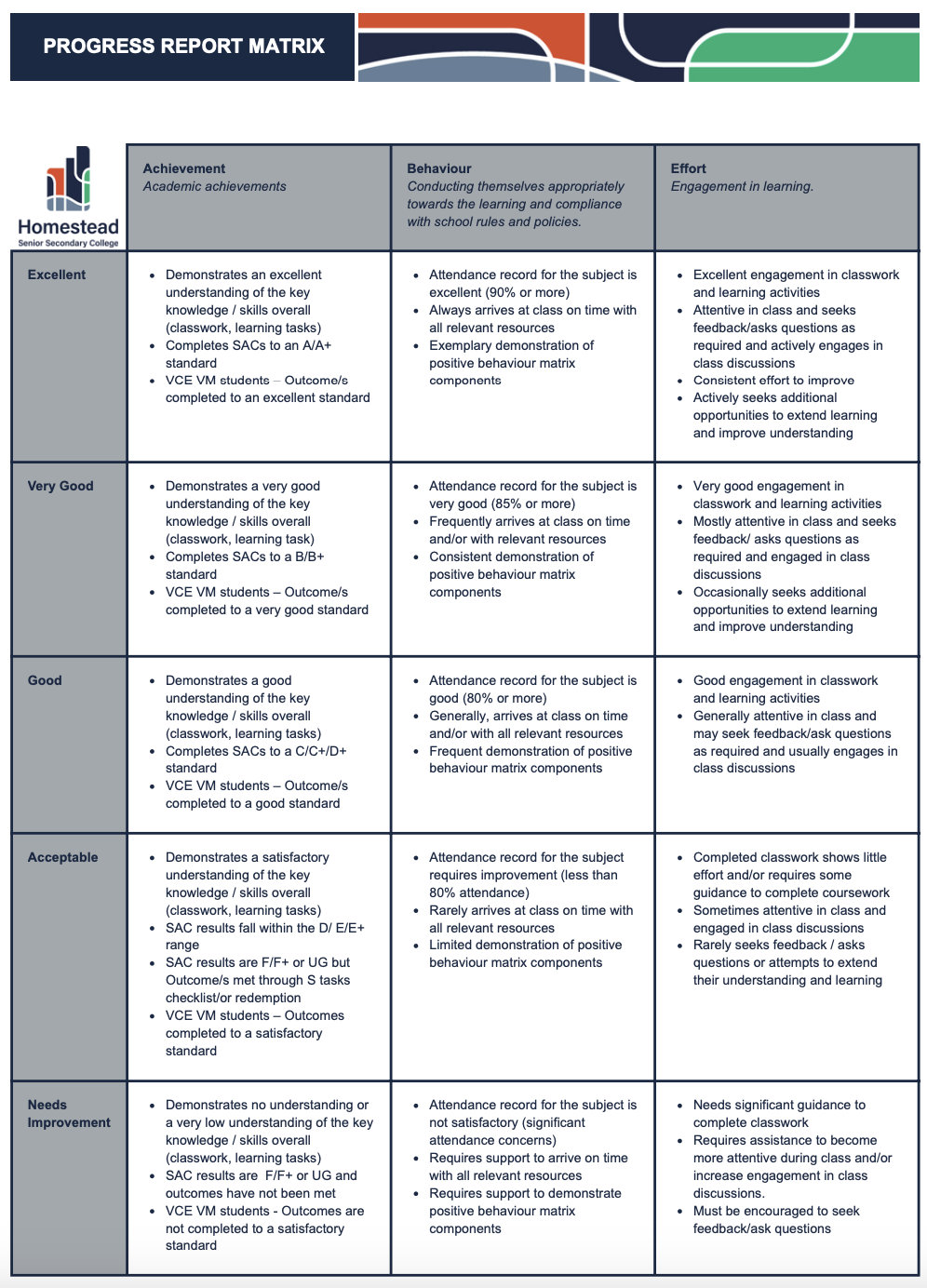
These ratings assist parents and students when discussing areas for celebration and areas for improvement in relation to their academic performance. Parents and carers are encouraged to consult these reports upon publication, engage in a conversation with their student about these reports and contact the classroom teacher via Compass with any additional questions or concerns.
The reports are also extensively used by staff to ensure student progress throughout a Unit and for early identification of those who students who may be at risk and require support and intervention.
The first progress reports was published on Friday 20th February, with the next cycle released on the morning of Parent / Student / Teacher Conferences, Thursday 26th March. Please make sure you take the time to read through these with you child and create appropriate goals where needed.
Semester Reports are released in the first week of Term 3 for Semester 1 and include a summary of the achievement of the whole semester. Semester 2 reports will be released on Friday 11th December, however Year 12 students do not receive a Semester 2 Report as they receive their VCE or VCE VM certificates from VCAA.
Should you have further questions about assessment or reporting, please email me at aimee.thorpe@education.vic.gov.au
Aimée Thorpe
Assistant Principal (Teaching, Learning and Student Outcomes)

Year 10 English and Mathematics classes, are currently completing the ACER’s Progressive Achievement (PAT) assessments, PAT helps to identify student ability in both Literacy and Numeracy.
Here are some frequently asked questions regarding these processes and initiatives here at Homestead:
1. What is PAT testing?
ACER’s Progressive Achievement Testing (PAT) is an adaptive assessment which, unlike traditional assessments, does not set out to test assess and grade every student’s performance on the same body of taught content. Instead, these assessments assist teachers in establishing what our year 10 students already know and understand, which can be used to identify the next steps in teaching and learning to monitor progress over time. As an adaptive test, PAT is not a one-size-fits-all approach, but rather an assessment that responds to the answers provided by individual students and tailors subsequent questions to the ability of each student.
2. When does PAT occur?
PAT testing occurs in terms 1 and 4 at the college, allowing us to track and monitor student growth over the course of their year 10 programs. During term 1, students will be undertaking PAT testing in their English and Maths classrooms across weeks 3 to 5, with their data being made available to their teachers shortly after.
3. How will PAT testing run at Homestead?
PAT testing will occur in students’ regular English and Maths classrooms for one session across the testing period. Students will be provided with adequate time to complete the test, which should take at least 45 minutes for students to complete in full. Students who are absent will complete this in the next appropriate English/Maths class.
4. What is the purpose of PAT?
PAT assessments are used in various ways by teachers to maximise the learning of students and assist in differentiation and understanding each students’ strengths and areas for growth. Later, the final test in Term 4 is used to determine the effect that our learning programs and support have had on student learning throughout the year. The aim for these assessments is to not only track student performance, but to ensure that all students achieve growth across the 12 months that is targeted at their point of need.
Some ways in which the data is used here at HSSC:
• To target student learning at point of need
• Create differentiated groupings in the classroom.
• Understand how literacy levels of students will impact all subject areas and adjust learning programs accordingly to support the literacy needs of students.
• Understand how numeracy levels of students will impact all subject areas.
• To ensure programs are tailored to each new cohort of students each year as no two years are the same!
5. Who can I contact for more information regarding PAT testing?
A first point of contact for any further queries regarding these programs here at Homestead is Aimee Underwood, Leading Teacher - Teaching and Learning. Aimee can be contacted at aimee.underwood@education.vic.gov.au
We look forward to working with you in 2026.
Aimee Underwood
Leading Teacher (Teaching and Learning)
At Homestead Senior Secondary College we aim to support all of our learners and their diverse needs within the classroom environment. As such, we ensure that we encompass differentiation into all of our programs to best support our students and ensure they are being met at their point of need. Working with both parents and students, we aim to develop co-ownership of learning, creating a partnership to ensure that the 3 years of schooling are safe, supportive and that learning experiences are maximised for each student.
In a senior school setting, differentiation may look a little different than what may have previously been experienced in the junior secondary sector. In previous junior schooling this may have looked like inquiry-based learning where students all choose different content, or final assessment tasks may have been selected based on individual preferences and areas of interest, meaning that there were no common assessment tasks. However, in a senior setting, due to the nature of preparing students for VCE (Year 10) and the rigours of VCE itself (Year 11/12) this is not always possible. VCAA set clear guidelines around how and what can be adapted within the curriculum, usually allowing teachers to differentiate portions of coursework where possible, but final assessment tasks (SACs) are unable to be adapted for any student looking to pathway into VCE.
We aim to differentiate classrooms and programs where we can through one of the four ways below:
If students require, there may be situations in which programs in Year 10 are modified to suit the individual need of that student. This is done in consultation with the Wellbeing and Transitions Teams. Students who are completing a modified program may choose other learning pathways for Year 11/12 rather than completing VCE.
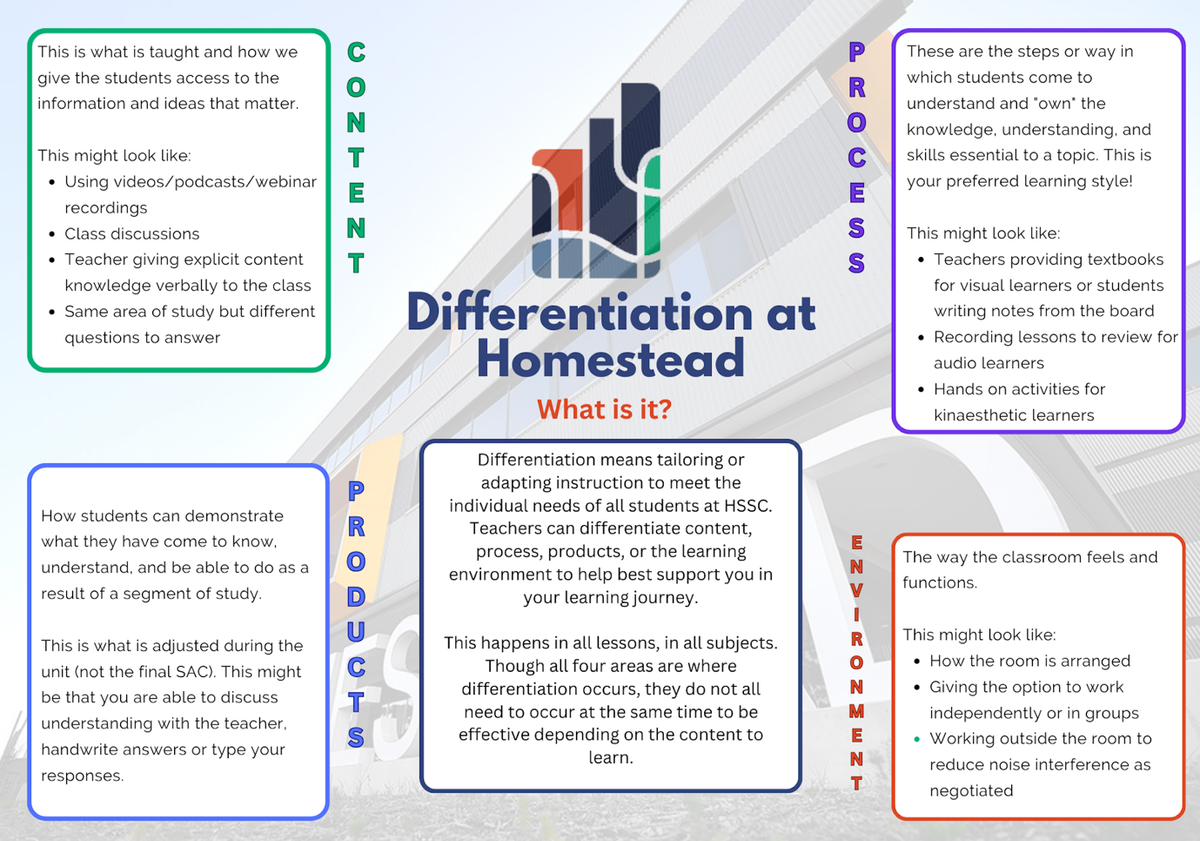
This competition is open for 14 to 18-year-old western suburbs writers. The prize is $250! Entries for this competition close at midnight Sunday 8th March 2026. If you would like further information, please see the flyer below, or contact Elise Garro - Learning Specialist (Head of English).