Assistant Principal's Message

A message from our Assistant Principal
Real Schools Partnership - Restorative Practices & Culture
As you know, we have re-partnered with Real Schools for the next three years to review and enhance our Restorative Practices and Culture at MPPS.
We worked with Daniel Vella, our Real Schools Expert Facilitator, on our curriculum day on Friday March 6th. Across the day, Daniel presented professional learning around the three key elements of Restorative Practices 2.0 (RP 2.0) – Language, Mindset and Conduct.
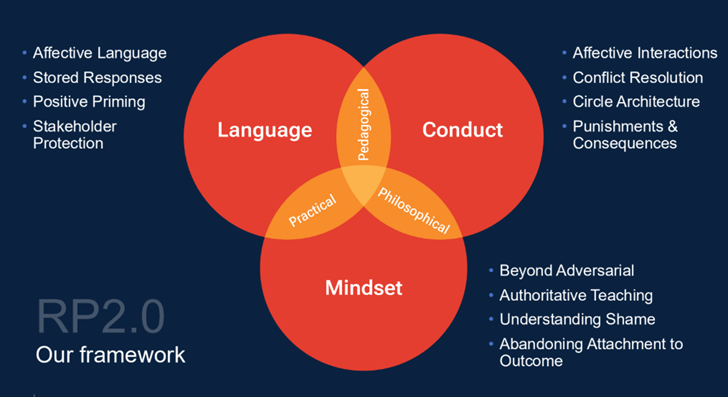
Throughout Term 1, and the first half of this term, we have continued to focus on the language sphere of RP 2.0. Language is fundamental to all elements of RP 2.0 and is the foundation of restorative practices and culture.
Our Real Schools partnership provides us with a great opportunity to involve all stakeholders (parents, students and staff) to support our students to develop into the best humans they can be.
As restorative practices and culture involve all stakeholders, the three key elements are highly relevant and impactful for families at home and how parents interact with their child’s school.
Here are some tips and quotes for parents from the articles available through Real Schools.
Affective statements:
Affective statements express personal feelings, both negative and positive, to communicate how a child’s behaviour makes them feel.
How do I create these at home?
You simply throw in a feelings word to a comment or request you normally use. For example, “Put your towel on the rack” becomes “It upsets me that you leave your towel on the floor, can you please hang it up”. And a positive example “I am really pleased that you hung up your towel.”
Why do we use them?
We use them to develop empathy and to build an understanding of how their actions influence other people. In time children will think about their actions and adjust their behaviour accordingly.
Positive Priming:
What’s the trick to getting your kids to do more of what you want without the nagging?
Priming is a psychological phenomenon that allows us to influence the unconscious brain and the actions of our children. By using the right words, we can increase the probability of getting the behaviour we desire. In a nice way it is manipulating our kids to do what we want, when we want, without them even knowing about it.
How does positive priming work?
Our world is full of negative words and demands. Think about recent interactions with our children. We often resort to ‘Stop that’, ‘Don’t do that’, ‘No you can’t.’ When we say ‘Stop running’ the only word heard is running and this causes the brain to send the message that running is ok. Bychanging our words and adding a feeling (affective) word we are wiring the brain to a different outcome.

Daniel Vella, Expert Facilitator form Real Schools, is visiting MPPS on Tuesday May 26th.
During the day, he will be working with our staff and students in classrooms and teaching team meetings. We will all meet with him after school for our staff meeting to debrief about the day’s experiences, ask questions and to continue our professional learning.
In the evening, Daniel will be conducting a parent session from 6.30pm – 7.00pm. We will let you know the school space we will be meeting in once we have confirmed numbers.
We encourage all of you to come along on Tuesday May 26th to hear more about restorative practices and culture directly from Daniel and how these practices can support your child at home and school. Come along and enjoy the discussion and drinks and nibbles with fellow parents.
Please see his introductory video for the parent evening below:https://www.youtube.com/watch?v=dOwBPEcVdbw
Please RSVP via the link provided to support our planning for the session.
We’re looking forward to seeing many of you on Tuesday May 26th 6.30pm – 7.00pm.
Kind regards,
Sue Gordon
Assistant Principal