
Assistant Principal's Report
Katrina Spicer - Wellbeing and Inclusion

Assistant Principal's Report
Katrina Spicer - Wellbeing and Inclusion

All organisations who work with children in Australia must abide by eleven mandatory Child Safety Standards. These standards ensure organisations have policies and processes in place to protect children from abuse.
Our school's commitment to Child Safety and the eleven Child Safe Standards are outlined here on our website. The Child Safe Standards are outlined in detail here.
Our school has a number of processes in place to ensure the safety of our students. Staff (teachers and support staff, both permanent and casual) and School Council members receive Child Safety Standards training every twelve months.
All visitors to our school including contractors, tradespeople, visiting therapists, and other visitors such as visiting educators and presenters must present a valid WWCC before they can commence work.
Volunteers, such as parent helpers, must provide the school with a valid Working With Children Check and must also complete the Volunteer Induction that is available on the school's website.
All school staff undertake Mandatory Reporting training every 12 months. In this training we learn how to identify signs of child abuse, and we learn that child abuse can take on many forms including physical abuse, emotional abuse, sexual abuse and neglect. School staff members are Mandatory Reporters. This means that if a member of staff suspects a child has been abused or is at risk of abuse, they MUST report this to Child Protection, even if they are not 100% sure.
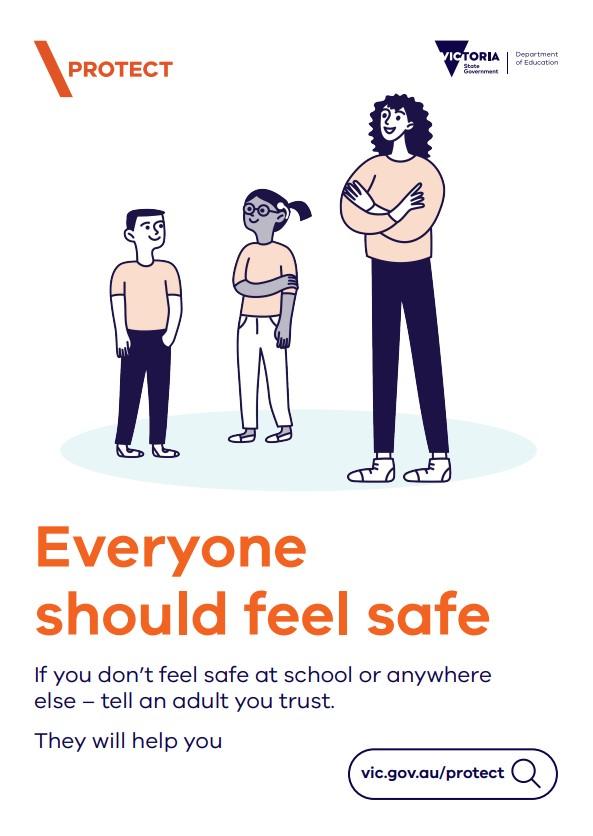
At school our students are encouraged to speak to a trusted adult if they feel unsafe. Students' concerns will always be taken seriously.
You may have noticed this Protect Poster on display in classrooms and in various locations around the school. Ensuring our children are safe is everyone's responsibility.
If you would like further information around physical punishment of children go to the Australian Institute of Family Studies website here.

Every year, all schools in Australia participate in the Nationally Consistent Collection of Data on School Students with Disability (NCCD). The NCCD process requires schools to identify information already available in the school about supports provided to students with disability. These relate to legislative requirements under the Disability Discrimination Act 1992 and the Disability Standards for Education 2005, in line with the NCCD guidelines (2019).
Information provided about students to the Australian Government for the NCCD includes:
level of adjustment provided: support provided within quality differentiated teaching practice, supplementary, substantial or extensive.
This information assists schools to:
The NCCD provides state and federal governments with the information they need to plan more broadly for the support of students with disability.
The NCCD has had no direct impact on your child and your child has not been involved in any testing process. The school has provided data to the Australian Government in such a way that no individual student will be able to be identified – the privacy and confidentiality of all students is ensured. All information is protected by privacy laws that regulate the collection, storage and disclosure of personal information. To find out more about these matters, please refer to the Australian Government’s Privacy
Policy (https://www.education.gov.au/privacy-policy).
Further information about the NCCD can be found on the NCCD Portal (https://www.nccd.edu.au).
If you have any questions about the NCCD, please contact Mrs Spicer.
Katrina Spicer
Assistant Principal for Wellbeing and Inclusion
katrina.spicer@education.vic.gov.au

By Dr Justin Coulson
We all have those nights...
We're running late, dinner is burning, the phone is ringing, and at least one child is dramatically upset. As we push through the frantic chaotic stressful moments, we become aware of our youngest child, vying for some attention amid the stress.
"I know you want me. I'll be right there", we say as we race past our little one time and again.
"Just let me take care of this and I'll be with you."
"I hear you... I'm coming in just a minute."
Finally, in a burst of exasperation these words cut through the noise and endless to-do list;
"Mummy (or Daddy)... I NEED you!"
The Job That Never Clocks Off
Sometimes it would be nice to not be so needed. If only we could stop being a parent at 8pm (or 6pm!). Life would be so much simpler if we could clock off for the day, like an employee. But parenting doesn't work like that. It's an on-call 24-hour a day, non-stop role. The ongoing, always-at-the-ready, nature of being a parent makes it extremely challenging to always be there for our children - to always be emotionally available.
But that is precisely what the need - a parent who is emotionally available. And it is the single most important thing we can be to create a happy, peaceful home, and a happy, secure child.
What 40 Years of Research Tells Us
In 1955, a research team led by Emmy Werner began a research study into resilience. She and her team followed 698 children born on the Hawaiian island of Kauai for forty years. This has become one of the longest running and most-cited developmental studies in the world.
For kids to be resilient, there are a handful of 'protective factors' that impact their ability to thrive despite hard times. The linchpin? In Werner's words, "We noted the importance of a caregiver's sensitivity and responsiveness to the [child's] needs that led to a foundation of trust, a basic ingredient in the process of [resilience] in adulthood.
At the core of a child's ongoing thriving is... you.
This idea of being sensitive and responsive is sometimes called being 'emotionally available'. So how's that looking at your place right now as you juggle emails, cost of living stress, increased workload, relationships, washing, cooking, buying a birthday gift for the kid you don't know who has invited your child to a party this weekend, and everything else?
Parents who are emotionally available make a conscious decision to be mindful. They are aware of their children's needs and respond attentively. When a child comes to them with a request, or with a need, an emotionally available parent listens to her children's request. The parent does not necessarily indulge her child, give in, or be a the child's beck and call. Instead, the parent attempts to comprehend their children's emotional state, and respond in a deliberate and careful manner.
What Emotionally Available Parenting Looks Like to a Child
Children who experience emotionally available parents agree to statements like these:
My parents support me
My parents console me when I am upset
My parents show they care about me
My parents show a genuine interest in me
My parents remember things that are important to me
My parents are available to talk at any time
My parents ask questions in a caring manner
My parents spend extra time with me just because they want to
My parents are willing to talk about my troubles
My parents talk with me about my interests
My parents value my input
My parents make me feel wanted
Take a moment and pretend that you are your child. Would you agree with those statements about you? Would your children agree with those statements? (Maybe you can ask them... but be ready. The answers might challenge you.)
Now think of a time when you were able to respond in such a way for your child. How do you know your child sensed your availability? What words did you use? What body language made your child feel safe and heard? How did it make your child feel about the thing that was troubling him or her? How did your child respond to you?
Being emotionally available is not a new problem. In the 1800s Mark Twain said:
"We are always too busy for children; we never give them the time or interest they deserve. We lavish gifts upon them; but the most precious gift - our personal association, which means so much to them - we give grudgingly."
What's actually happened is we've found more sophisticated ways to be distracted.
The principle of emotional availability is arguably one of the simplest things we can do for our children. We don't need a course, a technique, or a perfect response. We just need to be there - fully, unhurriedly, genuinely there.
Your child isn't asking you to be perfect. They're asking you to show up. And on the nights when dinner burns and the phone rings and everything is loud and demanding, the small voice cutting through the noise is worth stopping for.
"Mummy, I need you."
They do. And you're en
