From the Principal
Dear Blue Mountains Grammar School Families,
Words Matter: Hate Speech Laws, Our School, and the Call to Build One Another Up
There are moments when the wider world reminds us of something we should perhaps never have needed to forget: words matter.
Over recent months, new hate speech laws introduced in New South Wales and at a Federal level have generated significant public discussion. Over the coming weeks, I will be speaking with our students about these changes, what they mean, and why they matter. I also want to encourage you, as parents and carers, to continue those conversations at home and to partner with us in helping our young people understand the seriousness and responsibility of how we speak about others. This is helpful regardless of how old your child might be.
To be candid, there is something deeply sad about the fact that we need laws and Acts of Parliament to remind society that people should not be targeted, demeaned, isolated, or vilified because of their race, ethnicity, or background. One would hope that the simple recognition that every person is inherently valuable, regardless of differences, obvious or discreet, would be enough. Yet history, and sadly the present moment, tells us otherwise.
The recent laws have been introduced in response to a significant rise in acts of hatred and intimidation across Australia, including antisemitic incidents, racial abuse, threats, extremist behaviour, and public acts intended to stir up hatred toward particular groups of people. In New South Wales, the law now makes it a criminal offence to intentionally and publicly incite hatred against others based on race. Federal legislation has similarly strengthened responses to hate-based conduct and extremism.
These laws exist because words do not stay words for long. Language shapes attitudes. Attitudes shape behaviour. And behaviour, left unchecked, can profoundly wound individuals and communities.
As a school founded on a Christian worldview, we can say something important here with both conviction and humility: in principle, we agree with the intent of these laws.
Not because we are simply seeking legal compliance, but because our faith has always called us to something higher. Long before governments legislated against hateful speech, Scripture warned us about the power of the tongue.
In the book of James, we read:
“With the tongue we praise our Lord and Father, and with it we curse human beings, who have been made in God’s likeness…this should not be.”— James 3:9–10
This letter from James is confronting because he refuses to let us separate faith from the way we speak about people. He reminds us that every person bears the image of God. Every student in our classrooms. Every parent in our community. Every culture, every ethnicity, every background. The words we use about others matter because people matter.
And if I am honest, perhaps these new laws can serve as a healthy reminder to all of us.
At times, communities like ours can feel a little uncomfortable when governments begin legislating around speech. There are understandable questions about freedom, intent, and how laws are interpreted. But if these changes encourage us to pause before we speak, to think more carefully about the jokes we make, the comments we tolerate, the stereotypes we repeat, or the way we speak online, then there is good in that pause.
Because everyone should understand that the tongue can both build up and pull down.
As the Principal of our School, I will continue to speak openly and directly with students about this. Not in a spirit of fear or political posturing, but in a spirit of wisdom, dignity, and care for others. At assemblies over the coming weeks, I will be reminding students that strength is not found in mocking others, isolating people, or weaponising difference. Real strength is found in courage, restraint, kindness, and the willingness to honour the dignity of another person, even when they are different from us.
I would ask that you reinforce those same messages at home.
I ask that you speak with your children about the power of words. Ask them about what happens online, in friendship groups, in gaming chats, in unfiltered jokes and in social settings. Remind them that humour can wound, that exclusion can leave scars, and that every person deserves to be treated with dignity.
I also want to be clear about our expectations as a school community. Speech or behaviour that targets, demeans, or isolates members of our community because of race or background will be treated as a serious matter, as it should be. In the unusual event that conduct of this nature occurs at BMGS, we will address it directly and seriously. Not because we are trying to create a punitive culture, but because we are trying to continue a culture where people feel safe, respected, and valued.
I remain hopeful about that.
One of the great privileges of leading this school is seeing your children grow into thoughtful, compassionate, courageous adults. I see students who are willing to stand up for others. I see families who care deeply about community. I see staff who work hard to create places of belonging.
And so my hope is not simply that we comply with new laws. My hope is that we continue to become the kind of community that barely needs a reminder, because our words, attitudes, and actions are already shaped by the recognition that every person is made in the image of God and is worthy of dignity, care, and respect.
That is the standard we will continue to pursue and uphold together at BMGS.
Looking Ahead: Sabbatical Conversations and the Future Our Children Will Inherit
Over the past fortnight, I have had the opportunity to share reflections from my recent sabbatical through a series of community presentations held in locations from Lithgow to Springwood, held across both morning and evening sessions.
Firstly, thank you to the families, staff, and community members who came along. I was encouraged by the level of engagement, the thoughtful questions, and the willingness of people to lean into conversations that are not always simple or comfortable. In a busy season of life, showing up matters, and I was grateful for those who were able to do so.
To clarify something important about those evenings, I was not attempting to present a finished “vision” for our school, nor offering neat solutions to complex problems. Rather, I was trying to create a provocation to help us think carefully about what I noticed, what I paid attention to, and what seems to be emerging globally in education, technology, and society more broadly.
One of the clearest observations from my time overseas was the extraordinary pace at which artificial intelligence is developing.
While in San Francisco, the home of Silicon Valley, it was almost impossible to turn my head without being reminded that a new AI tool, platform, or company was attempting to reshape the future of work. Billboards, buses, train stations, driverless Jaguar I-PACEs and shopfronts carried message after message about automation, AI employees, and the changing nature of employment.
One image in particular stays with me. It was a billboard advertisement that quite bluntly stated: “Stop Hiring Humans — The Era of AI Employees Is Here.” In truth, almost every second billboard or bus stop carried some variation of the same message.
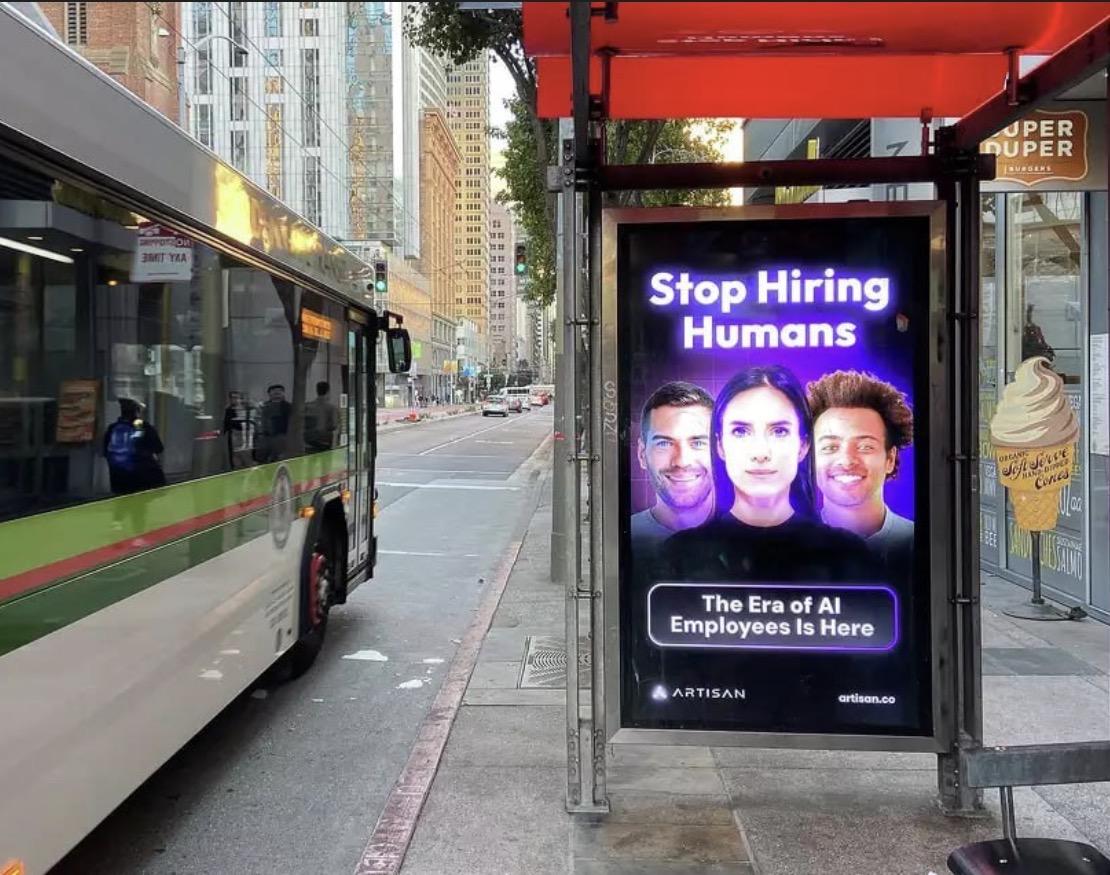
I do not share that perspective because I believe such slogans are not necessarily predictors of the future. Silicon Valley has always traded in disruption, provocation, and exaggeration. But I do think these moments require us, as adults, to look forward on behalf of our children and ask difficult but necessary questions.
What kind of world are they moving into? What capacities will matter most? What distinctly human qualities will become even more valuable as automation increases? And perhaps most importantly: what kind of education will position our children to not merely survive this change, but to shape it?
There are no quick answers to those questions. Anyone who claims to have them is likely oversimplifying a deeply complex reality. But I do believe that building awareness matters. Paying attention matters. Remaining curious matters. Because adults who are awake to the changes around them are far better positioned to lead young people wisely through them.
This is one of the reasons we continue to speak so often at BMGS about creativity, empathy, collaboration, critical thinking, adaptability, communication, courage, and deep learning. These are not educational buzzwords for us. They are increasingly human capabilities in a world where many technical tasks are likely to eventually become automated.
Our responsibility as educators and parents is not simply to prepare students for the world we grew up in. It is to thoughtfully and courageously prepare them for the world they are likely to inherit.
My hope is that one day, when our students are adults navigating a future we can only partially imagine today, they will look back and thank us, not because we predicted everything correctly, but because we had the courage to look ahead, ask hard questions, and build learning that positioned them for invention, contribution, adaptability, and possibility.
That work matters deeply. And it is work worth doing together.
Warm regards
Steven Coote
Principal
This document has been reviewed for spelling and grammar. Please note that as such, it may identify some content as being generated by AI.