
Mental Health And Wellbeing
Understanding Friendship Conflict and Bullying at School
At school, friendships are a huge part of children’s lives. Friendships bring joy, connection, belonging and support but they can also bring misunderstandings, disagreements and conflict. As a school, we believe it is important to help families understand the difference between normal friendship conflict, mean or rude behaviour, and bullying.
What is Bullying?
There is a new nationally agreed definition of bullying which all Australian schools now use:
Bullying is an ongoing and deliberate misuse of power in relationships through repeated verbal, physical and/or social behaviour that intends to cause physical, social and/or psychological harm. It can involve an individual or a group misusing their power, or perceived power, over one or more persons who feel unable to stop it from happening.
Bullying can happen in person or online, via various digital platforms and devices and it can be obvious (overt) or hidden (covert). Bullying behaviour is repeated, or has the potential to be repeated, over time (for example, through sharing of digital records).
Bullying of any form or for any reason can have immediate, medium and long-term effects on those involved, including bystanders. Single incidents and conflict or fights between equals, whether in person or online, are not defined as bullying.
The 3 main features of bullying are:
- The misuse of power in a relationship
- It is ongoing and repeated
- It involves behaviours that can cause harm.
Bullying can include:
- repeated teasing or name-calling
- excluding someone on purpose over time
- spreading rumours
- physical intimidation or aggression
- online harassment
Bullying is not a single disagreement or one-off incident. There are also some behaviours, which, although they might be unpleasant or distressing, are not bullying:
- Mutual conflict that involves a disagreement, but not an imbalance of power. Unresolved mutual conflict can develop into bullying if one of the parties targets the other repeatedly in retaliation.
- Single-episode acts of nastiness or physical aggression, or aggression directed towards many different people, is not bullying.
- Social rejection or dislike is not bullying unless it involves deliberate and repeated attempts to cause distress, exclude or create dislike by others.
Bullying can happen at school, at home or online. It is never okay and it is not a normal part of growing up. All reports of bullying are taken seriously and investigated carefully.
Mean, Rude or Bullying - What’s the Difference?
Children are still developing their social and emotional skills. Sometimes they say or do things that are unkind, impulsive or hurtful. While this behaviour still needs to be addressed, it is not always bullying.
Rude Behaviour
Rude behaviour is when someone inadvertently says or does something that hurts someone else. Examples may include interrupting, speaking in an unfriendly tone, forgetting manners and blurting out hurtful comments without thinking. It could look like burping in someone’s face, jumping ahead in the line or bragging about achieving the highest grade.’ On their own, any of these behaviours could appear as elements of bullying, but when looked at in context, incidents of rudeness are usually spontaneous, unplanned inconsideration, based on thoughtlessness, poor manners, or narcissism, but not meant to actually hurt someone.
Mean Behaviour
Mean behaviour is purposefully saying or doing something to hurt someone once (or maybe twice). The main distinction between ‘rude’ and ‘mean’ behaviour has to do with intention; while rudeness is often unintentional, mean behaviour very much aims to hurt someone. Kids are mean to each other when they criticise clothing, appearance, intelligence, coolness, or just about anything else they can find to denigrate. Meanness also sounds like words spoken in anger, impulsive cruelty that is often regretted in short order.
Meanness in kids sounds an awful lot like: “I hate you”, “You are fat/ugly/stupid.”
These situations can be upsetting, but they are often part of children learning how to manage emotions, repair relationships and navigate friendships.
The distinction between the three (bullying, mean or rude) matters because the way adults respond should match the situation. Conflict requires support, coaching and problem-solving, while bullying requires a more intensive and protective response.
Friendship Conflict is Developmentally Normal
Children are still developing the executive functioning skills needed to manage friendships successfully. Executive functioning includes skills such as emotional regulation, flexible thinking, impulse control, perspective taking and problem solving. These skills continue developing throughout childhood and adolescence.
As adults, we often manage friendships on our own terms. We might see friends once a month, choose when we socialise, or take space when we need it. Children, however, see their peers every day at school. They learn, play, work and problem-solve together constantly. Often while still developing the skills needed to navigate these relationships successfully. Because of this, friendship conflict at school is normal and expected.
This does not mean we dismiss children’s feelings or experiences. Instead, we see these moments as opportunities to support students in learning how to communicate respectfully, manage disappointment, repair relationships, solve problems collaboratively and build resilience and empathy.
At school, our role is not only to respond to conflict, but also to scaffold and guide students through it, so they can develop healthy relationship skills over time.
What Our Students Are Telling Us
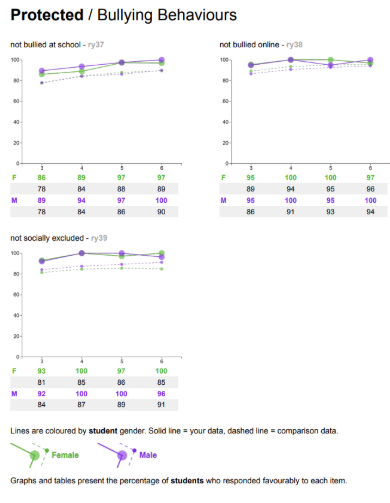
We are incredibly proud of the positive culture at our school and the data reflects this (see below). Recent student survey data (conducted Y3 to Y6) showed extremely high percentages of students reporting that they do not feel bullied at school, do not experience bullying online and do not feel socially excluded.
These results demonstrate that the vast majority of our students feel safe, connected and supported at school. They also suggest that students have a strong understanding of what bullying is and can identify the difference between bullying and normal friendship conflict.
How We Foster a Safe School Environment
At Murrumbeena Primary School, student safety and wellbeing are a priority. We foster a safe and supportive environment through the following practices:
- Encouraging all students to seek support if they are feeling unsafe, upset, worried, or concerned about friendships or peer interactions.
- Regularly reminding students that they can speak to:
- Their classroom teacher
- Mrs Plumb
- Mrs Sewell
- Ms Kurts (Mental Health and Wellbeing Leader)
- Mrs Hahn (Inclusive Education Practices Leader)
- Any other trusted staff member (likewise if your child tells a parent, please let the teacher know)
- Providing a confidential student wellbeing survey once each term, allowing students to share concerns, worries, friendship issues, or requests for support.
- Conducting regular daily wellbeing check-ins through (for example):
- Thumbs up/thumbs down check-ins
- Sharing a word to describe how they are feeling during roll call
- Informal conversations throughout the school day
- Intentionally monitoring student wellbeing by:
- Greeting and observing students as they arrive at school
- Checking in with students after recess and lunch
- Noticing signs of distress, withdrawal, or changes in behaviour
- Prioritising individual support for students who appear upset or require additional assistance.
- Holding regular Circle Time sessions and class meetings to:
- Build positive relationships
- Strengthen classroom connections
- Provide opportunities for student voice
- Foster a sense of belonging
- Conducting regular classroom walk-throughs by the Wellbeing Team to:
- Check in with students and staff
- Identify students who may require additional support
- Provide timely assistance, guidance, and intervention when needed
- Teaching explicit wellbeing and social-emotional learning through:
- The Resilience Project
- Respectful Relationships
- Explicitly teaching students how to:
- Recognise bullying behaviour
- Respond safely to bullying behaviour
- Report bullying behaviour
- Seek help from trusted adults
- Reinforcing that all reports of bullying are:
- Taken seriously
- Followed up promptly
- Thoroughly investigated
- Addressed in accordance with school processes
- Maintaining a clear whole-school expectation that bullying is not tolerated at Murrumbeena Primary School.
Bullying is not tolerated at Murrumbeena Primary School, and we are committed to ensuring every student feels safe, supported, and connected at school. We want every child to know that their voice matters and that support is always available.
Working Together
When concerns arise, we encourage families and schools to work together with curiosity, calmness and a shared focus on supporting children’s social growth. By helping students understand relationships, emotions and conflict resolution, we are building skills that will support them far beyond the classroom.
Please find our policies related to this topic on the school website.
https://www.murrumbeenaps.vic.edu.au/page/9/Policies,-Forms-and-Documents
References:
https://www.vic.gov.au/what-bullying
Ms Emily Kurts
Mental Health & Wellbeing Leader