
Wellbeing update
My name is Louisa and I’m the Learning Specialist - Mental Health and Wellbeing at SKiPPS this year. It’s been great getting to know more families across the school after working in Year 3 in 2025.
First, a brief reminder…
Talking The Talk Parent Session - Human Sexuality, Consent and Protective Safety On Monday, 27 April at 8pm, all parents (Foundation to Year 6) are invited and encouraged to join the online information session. Please book your free tickets at the following link, so we can get an idea of numbers: https://events.humanitix.com/sexuality-ed-stkilda-park-ps-26. |
2026 Wellbeing priority
A current priority at SKiPPS is to embed a consistent, whole-school approach to wellbeing, inclusion and engagement. This involves building a collective understanding of evidence-based practice in wellbeing, grounded in trauma-informed practice and Behaviour Science.
Defining children’s mental health and wellbeing
The World Health Organisation uses the following definitions:
- Mental health is a state of mental wellbeing that enables people to cope with the stresses of life, realise their abilities, learn well and work well, and contribute to their community. Being mentally healthy is an essential part of overall health and is understood as a basic human right.
- Wellbeing encompasses quality of life and the ability of people and societies to contribute to the world with a sense of meaning and purpose.
Mental health can be represented on a continuum that includes the full range of mental health experience, including positive states of wellbeing through to states of ill health. Recognising that mental health moves back and forth on the continuum helps us understand how to meet different needs at different times.
Some simple tools already being used in classrooms
Those who were able to attend the Parent Information Sessions earlier this term will know that all teachers are consistently using tools for self-regulation, drawn from the Berry Street Education Model. These tools include:
- Regular brain breaks - quick, teacher-led movement or mental challenges to proactively manage sensory input and potential overwhelm
- Ready to Learn Scales - a way for students to self-report how engaged they are feeling throughout the day, enabling teachers to make timely decisions to support wellbeing and its impact on learning
Mental Health in Primary Schools (MHiPS)
A key element of the school’s 2026 goal is the participation in Mental Health in Primary Schools (MHiPS). In my role as Mental Health and Wellbeing Leader, I will:
- build the capacity of staff to identify and support students with emerging mental health concerns;
- create clear internal (within school) and external (community services) referral pathways for students identified as requiring further mental health support;
- coordinate targeted mental health support for students in consultation the Wellbeing and Leadership Teams, teachers, parents, carers and external organisations; and
- advocate for student voice and agency in their wellbeing and mental health needs.
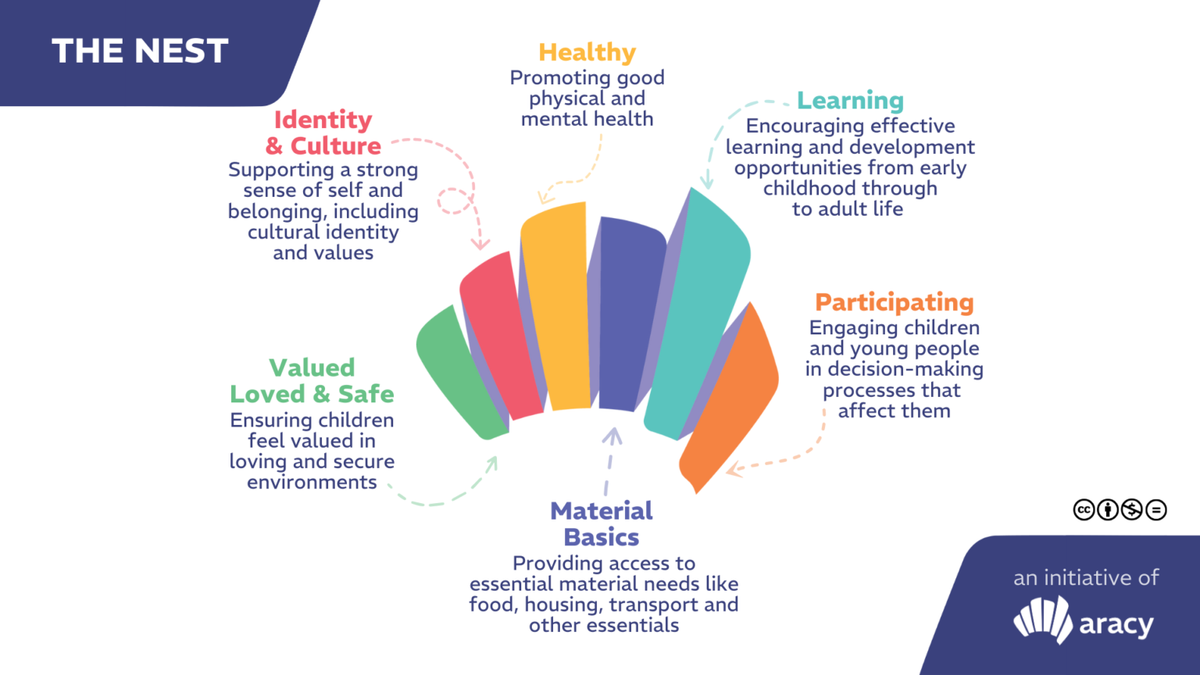
The Nest
The Nest conceptualises how children’s wellbeing can be supported through six dimensions. These dimensions were developed by Australian Research Alliance for Children and Youth (ARACY) after extensive consultation with over 4,000 children, families and experts. As a staff, we’ve started to consider what SKiPPS is doing well in each dimension, and where we see opportunities for improvement.
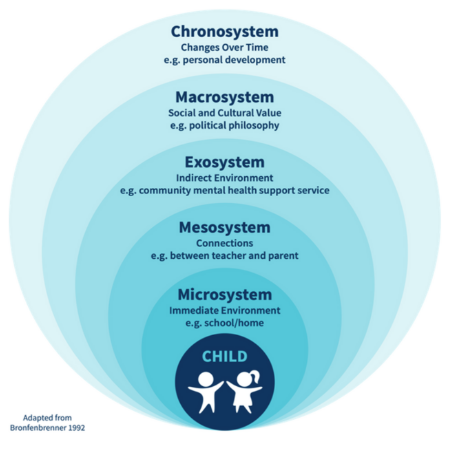
Bronfenbrenner’s framework places the young person in the centre of the different system levels that impact on development. MHiPS considers how the levels interact and impact students in order to determine appropriate support. The system levels include:
- The microsystem – the relationships in the young person’s immediate environment
- The mesosystem – the connections between these immediate environments, such as engagement between the home and school, or home and peer group
- The exosystem – the young person’s indirect environment, such as the parent’s workplace or community mental health services
- Macrosystem – the young person’s cultural environment, including social conditions, national customs, cultural values, political philosophy and economic patterns
- Chronosystem – the dimension of time in relation to a person’s development, including events that are unique to a particular generation
To more inclusively capture culture’s role in a young person’s wellbeing, the below model of social and emotional wellbeing (SEWB) was originally developed by Gee et al. (2004) and then validated by 300 Indigenous participants at a national conference for Aboriginal and Torres Strait Islander social and emotional wellbeing (Dudgeon & Kelly, 2012-2013). It demonstrates clearly how the social and emotional wellbeing of Aboriginal and Torres Strait Islander peoples is fostered by healthy connections to seven distinct and inextricably linked domains:
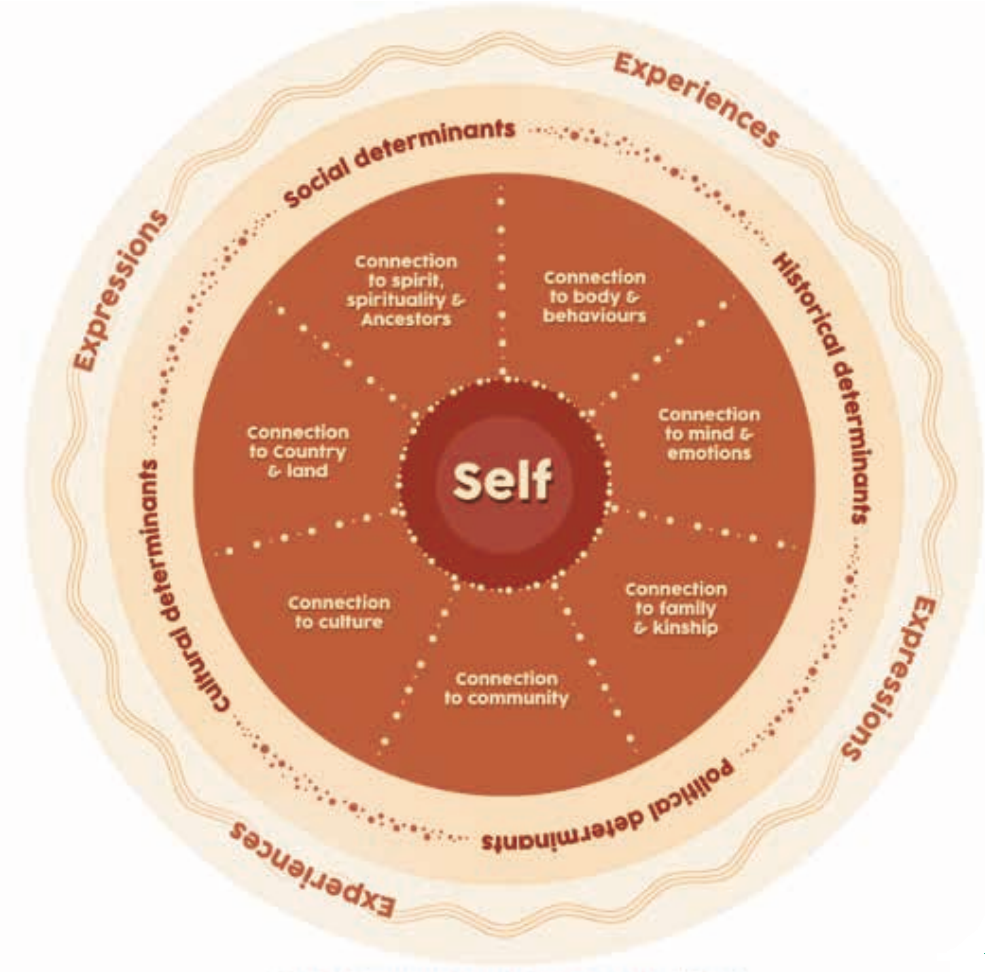
Underpinning this framework are nine guiding principles when considering the mental health of young Aboriginal and Torres Strait Islander people:
- Aboriginal and Torres Strait Islander health is viewed in a holistic context
- The right to self-determination, which needs to be central to any services provided
- The need for cultural understanding
- The impact of history in trauma and loss, and the inter-generational trauma resulting from colonisation
- Recognition of human rights
- Impact of racism and stigma
- Recognition of the centrality of kinship
- Recognition of cultural diversity of Aboriginal and Torres Strait Islander language groups and settings
- Recognition of Aboriginal and Torres Strait Islander strengths, creativity and endurance
These evidence-based frameworks are among those that guided the development of the MHiPS learning pathway. More information about MHiPS can be found here: https://www.vic.gov.au/mental-health-primary-schools.
We have a dedicated and passionate staff, whose enthusiastic engagement in the learning so far puts us in good stead to embed our school-wide goals. I’ll keep the school community updated about the school’s work in the mental health and wellbeing space.
Louisa Di Pietro
Learning Specialist - Mental Health and Wellbeing