Term 2, 2025
Curriculum News - Prep
Term 2, 2025
Curriculum News - Prep
Welcome to Term 2! The Prep Teachers are so proud of the progress the students have made during Term 1. They are doing an amazing job!
Term 2 focuses on furthering the student’s academic development now that they have settled into the daily routines of school life, with the continuation and enhancement of many of our programs. Our ‘How We Express Ourselves’ Unit of Inquiry has a Science focus and the students will be involved in a variety of fun, hands on experiments such as ‘Edible Slime’ and ‘Popcorn Observations’. Learning about, ‘Where We Are In Place and Time’ also has many highlights including Grandparents’ Day and Old Fashion Dress Up Day.
We have a very engaging and exciting term ahead!
Senses help people explore the world
Family histories provide an insight into culture
This term the Prep students will be introduced to the notion of being ‘Open-minded’ and ‘Balanced’ through the use of the Learner Profile Action Board. We will discuss ways to be a good listener such as looking at the person who is talking, asking relevant questions and using a clear ‘talking voice’.
English - Literacy Skills Development
In Term 2, we continue to focus on laying the groundwork for literacy skills through engaging, hands-on activities that promote a love for reading, writing, speaking, and listening.
Reading & Viewing
Letter and Sound Recognition
We will begin with the alphabet, focusing on both upper and lowercase letters. Students will learn the corresponding sounds for each letter, using activities such as letter tracing, sound matching games, and singing alphabet songs. A systematic synthetic phonics approach is used to explicitly teach the relationship between sounds and letters, in line with the science of reading.
Phonemic Awareness
Early literacy development will focus on understanding sounds in words. Students will engage in activities like rhyming, identifying the first sound in words, and segmenting sounds (e.g., breaking "cat" into /c/ /a/ /t/). The students will participate in daily Heggerty Phonemic Awareness activities.
Sight Words
Early exposure to high-frequency sight words will help build fluency.
Reading Comprehension
We will explore simple stories and books to build comprehension. Students will talk about what they think is happening in the story, make predictions, and identify characters and settings. Guided reading sessions will support their development in recognising familiar words and understanding the meaning of the text.
Letter Formation
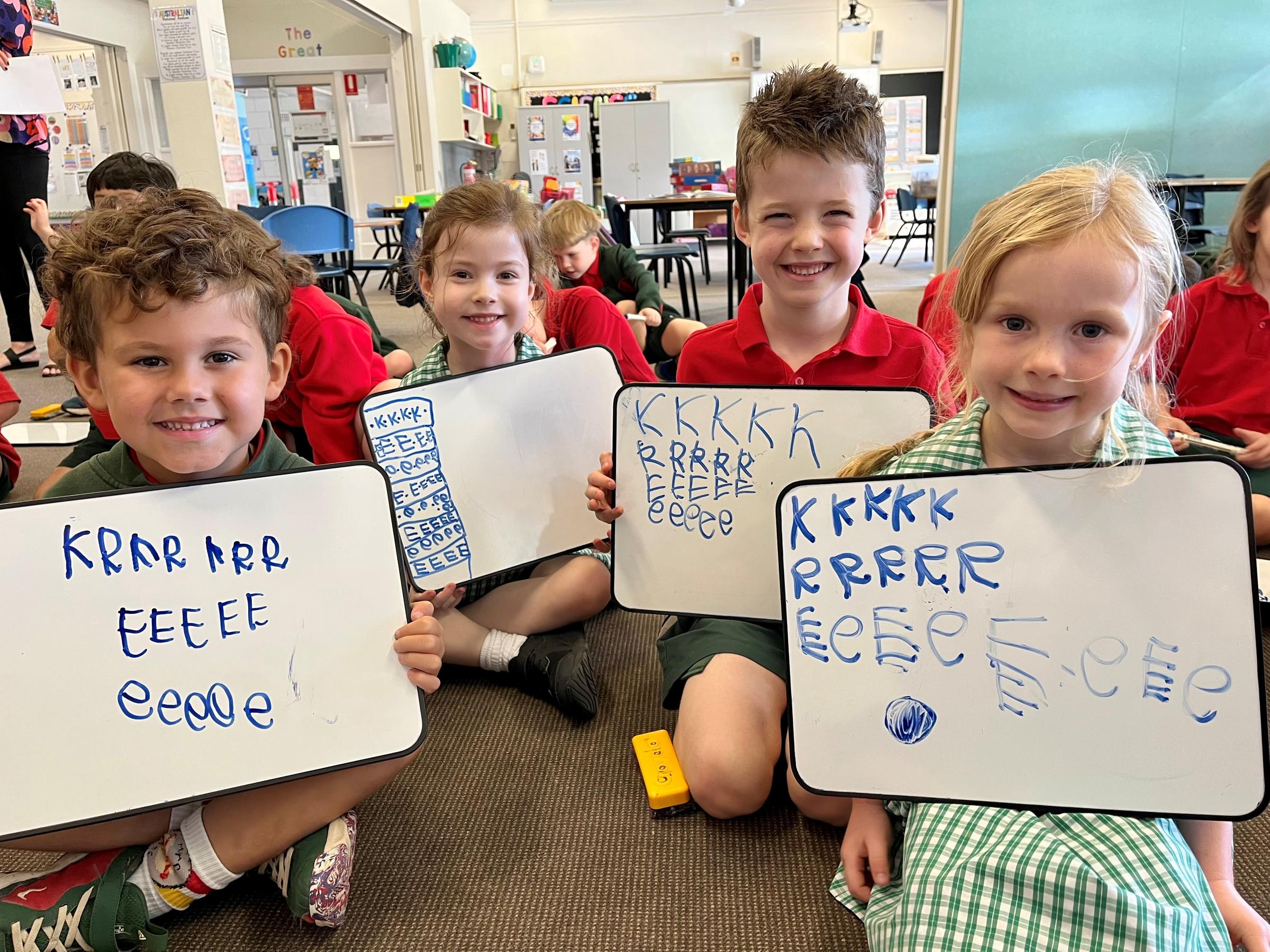
Early writing will focus on correct letter formation and the development of fine motor skills. Through activities like sand writing, tracing, and using different writing tools (e.g., pencils, markers, crayons), students will practice writing both letters and their own names.
Emergent Writing
Students will begin to write simple words and short sentences. They will start by using familiar sight words and phonetic spelling. Encouraging independent writing through drawing, labelling, and dictation will allow students to express their ideas and stories.
Shared Writing Activities
Teachers will model writing strategies by creating collaborative stories or class messages. This will show students how to form sentences, use punctuation, and construct simple stories with correct structure.
Oral Language Skills
Through daily conversations, children will develop their speaking and listening skills. We will engage in show-and-tell sessions, where students can talk about objects, experiences, and ideas with their peers.
Listening Comprehension
Listening to stories, songs, and instructions will help students develop their listening skills. Activities like "Simon Says" or following verbal directions will support their ability to understand and process information.
Interactive Discussions
Students will engage in structured group discussions where they practice asking and answering questions, making comments, and respecting others' contributions.
As we enter Term 2, our Prep students will continue to develop their mathematical skills through engaging and hands-on learning experiences. This term, we will continue to build foundational skills in both Number and Space, providing students with a strong basis for their mathematical development.
Number
Counting and Place Value
Students will extend their counting skills by counting forwards and backwards from 1 to 20. They will explore how numbers are made up of tens and ones, understanding the value of each digit. Activities will include using number lines, ten frames, and hands-on counting objects to support their learning.
Part-Whole
In this unit, students will investigate part-whole relationships in numbers. They will learn how numbers can be split into smaller parts and how these parts come together to form a whole. Through activities like using counters, blocks, and drawings, students will begin to understand simple addition and subtraction concepts, which are fundamental for future mathematical operations.
Space
Shapes
Students will explore and identify 2D shapes, such as circles, squares, triangles, and rectangles. They will learn the properties of these shapes, including the number of sides and corners. Activities will include shape sorting, drawing shapes, and creating patterns. Students will also explore how shapes fit together and form larger patterns, enhancing their spatial awareness.
Respectful Relationships
In Term 2 Prep students will continue participating in activities from the Respectful Relationships Program. These lessons are designed to develop students’ social, emotional and positive relationship skills.
Topics covered this term include:
Personal Strengths
Children and young people need a vocabulary to help them recognise and understand strengths and positive qualities in themselves and others. This topic provides learning activities to build this vocabulary and to use it when discussing personal, social and ethical challenges.
Positive Coping
Learning activities in this topic provide opportunities for students to identify and discuss different types of coping strategies. When children and young people develop a language around coping, they are more likely to be able to understand and deliberately utilise a range of productive coping strategies and diminish their use of unproductive coping strategies. Activities introduce students to the concept of self-talk and practice using positive self-talk to approach and manage challenging situations.
Understanding the Zones of Regulation
The Zones of Regulation, developed by Leah Kuypers, is a systematic framework that helps individuals, especially children, understand and manage their emotions. It categorises emotions and states of alertness into four color-coded zones:
Blue Zone (low alertness)
Green Zone (optimal alertness)
Yellow Zone (heightened alertness)
Red Zone (extremely high alertness).
By fostering emotional awareness, teaching self-regulation strategies, creating a Zones-friendly environment, and using visual supports, we empower children with essential skills for emotional well-being and self-control.
Thursday 24 April - ANZAC Service 10am
Friday 25 April - ANZAC DAY Public Holiday
Wednesday 7 May - Mother’s and Special Friends Celebration
Friday 9 May - Mother's Day Stall
Wednesday 21 May - National Simultaneous Storytime
Friday 6 June - Pupil Free Day
Monday 9 June - Kings Birthday - Public Holiday
Tuesday 10 June - Curriculum Day
Wednesday 18 June - Grandparent’s Morning
Wednesday 2 July - Old Fashioned Dress Up Day
Friday 4 July - Term 2 ends 2.30pm