
And now a word from
Mrs Richards...

And now a word from
Mrs Richards...
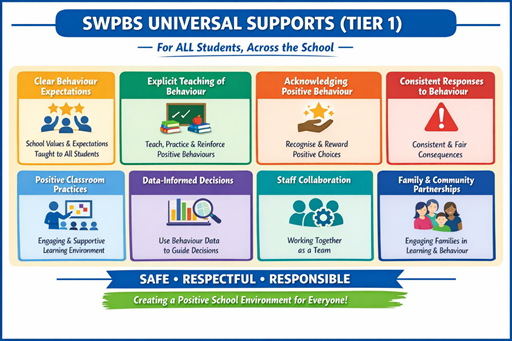
This year our school is beginning an important journey as a School-Wide Positive Behaviour Support (SWPBS) school. SWPBS is a whole-school framework that helps schools create safe, supportive and inclusive learning environments where positive behaviour is explicitly taught, acknowledged and reinforced.
Rather than focusing only on responding to challenging behaviour, SWPBS supports schools to teach students the behaviours that help everyone learn and feel safe. It uses evidence-based practices to promote respectful behaviour, clear expectations and consistent responses across the entire school community.
At PPS we have established a dedicated SWPBS committee made up of staff members who will lead this work. The committee will guide the implementation process, review behaviour data, and work with staff to develop consistent practices across classrooms and playground spaces.
We are also very fortunate to be working alongside a trained SWPBS coach, who will support our staff and leadership team as we build our knowledge and implement the framework effectively over time.
A key aim of adopting SWPBS is to build consistency across our school. This means that students will experience clear and predictable expectations wherever they are — in classrooms, in the playground, and during school events. Staff will also use consistent approaches when:
Acknowledging positive and expected behaviour
Responding to inappropriate behaviour
Teaching and reinforcing our school values
By focusing on positive behaviour, clear expectations and supportive responses, we aim to create an environment where all students feel safe, respected and ready to learn.
Over time, we will continue to share updates with families about our progress and ways you can support these expectations at home. We are excited about the positive impact SWPBS can have on student wellbeing, behaviour and learning across our school community.
Learning to read is one of the most important skills children develop in their early years of schooling. In the Foundation to Grade 2 years especially, children are building the foundations that will support all future learning. One of the most powerful ways families can support this learning is by reading with their child every day and hearing them read aloud.
While teachers work hard to support every student’s reading development, it is simply not possible for a classroom teacher to hear every child read individually every day. Junior school teachers hear all children on a rotation but regular reading practice at home makes an enormous difference to a child’s progress.
Research consistently shows that frequent reading practice helps children develop fluency, vocabulary, comprehension and confidence. In fact, children who read regularly are exposed to millions more words each year than those who read less often, which significantly supports their language development and understanding of texts.
Here are some simple ways to support your child’s reading at home:
Make reading part of the daily routine: Choose a regular time each day such as after school or before bed.
Take turns reading: You might read a page and then let your child read the next. This keeps the experience enjoyable and less overwhelming.
Talk about the story: Ask simple questions such as:
What do you think will happen next?
Who was your favourite character?
What was the most interesting part?
Celebrate effort, not just accuracy: Learning to read is challenging. Praise your child for trying hard.
Re-read favourite books: Reading the same book several times helps children build fluency and confidence.
Some children need a little extra encouragement. These ideas can help:
Let your child choose books that interest them, including comics, magazines or fact books.
Keep reading sessions short and positive – even a few pages is valuable.
Try reading together in a comfortable space such as the couch or a special “reading corner”.
Model reading yourself – children who see adults reading are more likely to see reading as important and enjoyable.
Use lots of praise and encouragement to build confidence. Incentivize reading with stickers etc.