
Mathematics
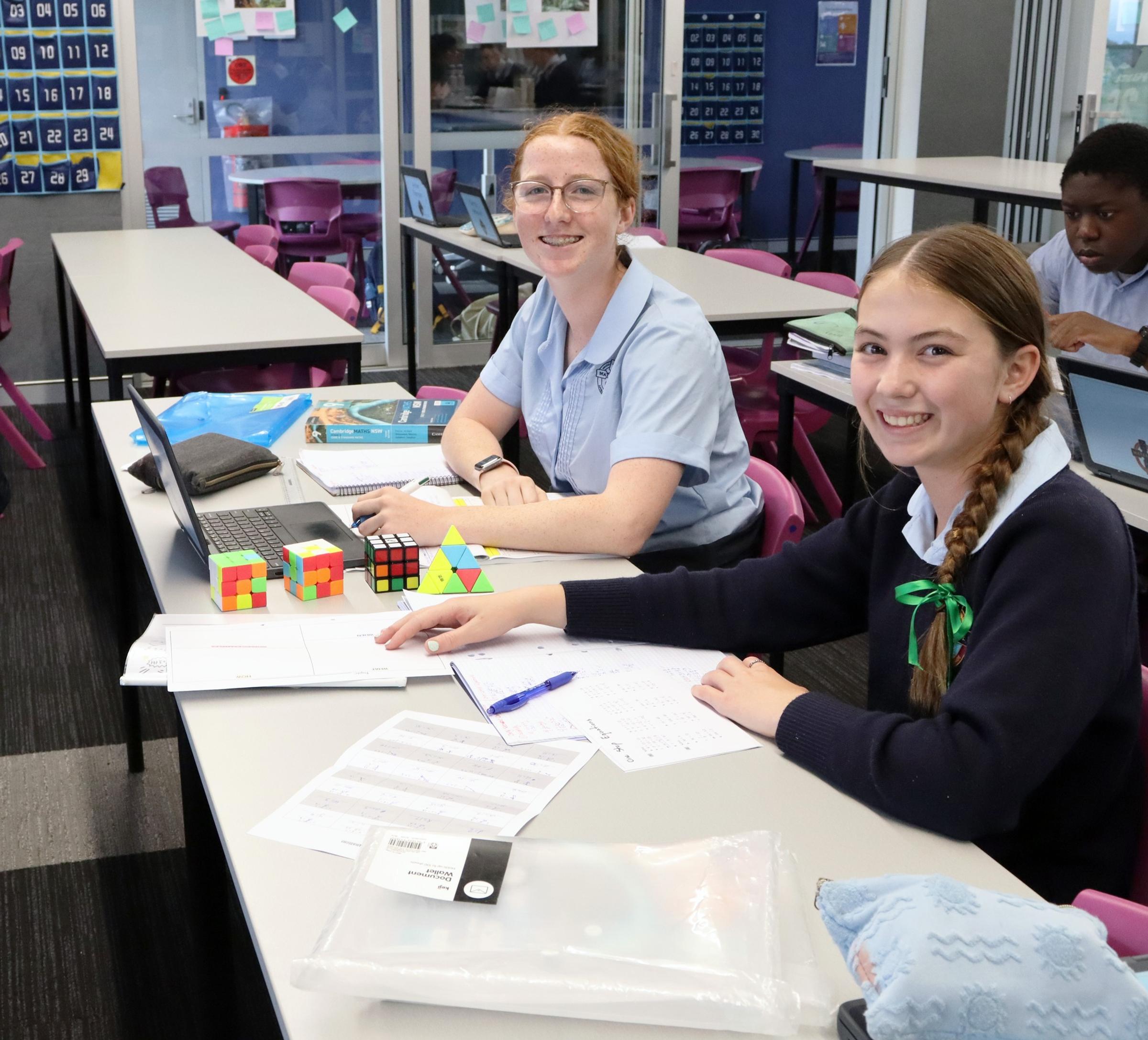

Parents, when looking to support their child in Mathematics, frequently ask the question ‘what can I be doing to assist them with their learning?’. My response is to:
Make sure that you know the homework requirements set out by the teacher
Ensure they have a quiet space in which to complete this work
Check to see that all of the questions have been completed with required working out shown.
Research shows us that Mathematics homework which is regular, concise practice, ideally "little and often", significantly boosts academic performance and is vital for learning. It facilitates retrieval practice and spaced repetition, which help combat the "forgetting curve" by requiring students to actively recall and apply concepts independently outside the initial classroom environment.
For your reference, each of the homework requirements of the stages across the college have been listed below:
Stage 4 (Years 7 and 8)
Students are required to ensure the completion of:
Learning Logs and the module notes started that lesson
All of the associated questions within the allocated module, with fully worked solutions
Where students have completed all of the tasks above they could:
Start an additional module
Re-read over Learning Log and/or add in additional detail
Practicing Numeracy activities on Canvas
Stage 5 (Years 9 and 10)
Students are expected to:
Finish off the questions from the sub-topic taught that day. They will need to either complete the Core + Foundation or Core + Extension questions.
Ensure the 4 components of their Learning Log are completed.
Where students have completed all of the tasks above they could:
Interleaving - Revisit a previous lesson in another topic and complete the set questions
Complete ‘Extra’ section on the Canvas page
High Potential Learners- Access to Advanced resources
Read over Learning Log- Create flash cards
- Re-do Informal Topic Tests
- Access resources from the Assessment Revision Tool Kit
Stage 6 (Years 11 and 12)
Students are expected to:
- Finish off the questions from the sub-topic taught that day
Where students have completed all of the tasks above they could:
- Timed HSC practice papers
- Access resources from the Assessment Revision Tool Kit
- Re-read over Lesson notes- Create flash cards
- Borrow revision book (Excel, ATAR Notes etc) from the Resource Centre
All homework is due the following lesson that the students have Mathematics.
Instructive

Stage 4 students at Mater Dei Catholic College use Instructive as a vehicle to study Mathematics. The main purpose for the use of Instructive is to allow each student to be able to achieve individual success. This is due to the fact that each student receives differentiated work that is suited to their particular needs in that area of maths. The differentiated work is delivered concurrently with the year based outcomes given by NESA.
A brief explanation has been provided below with the main features of how students study Mathematics.
Diagnostic -All students start Year 7 with a Diagnostic with the idea that students will be given work that is appropriate and at the level that they are ready for. This diagnostic pinpoints exactly where the student is in their maths learning journey against the whole maths curriculum.
Teacher Led Instruction - Each lesson, students are able to learn from an experienced teacher who will lead them through the core mathematical concepts appropriate to that lesson. This is accompanied by the opportunity to collaborate with their peers and complete a series of practice questions which will demonstrate a level of mastery of the content taught.
Personalised Learning - Students will experience a truly differentiated classroom where they will be given the capacity to work effectively and independently. We look to ensure that all students maximise their mathematical potential by giving them access to modules they are ready for. Each module is part of a coherent sequence of learning that ensures students are building a deep understanding as they progress.
Rich Tasks - Class-wide rich learning tasks that aim to get your child excited and engaged in problem solving using the maths skills they’ve developed, alongside their friends.
Homework - Students will be expected to complete any work that they did not finish in class at home. Even if they have finished the set work from class, they have bonus modules to complete for extra revision.
Mr Kurt McPherson | Mathematics KLA Leader