Special Religious Education Information

What is Christian SRE?
Special Religious Education (SRE), also known as Scripture, is the time set aside in Public Schools where parents/carers can choose to have their children educated in the faith of their family and cultural background.
The NSW Education Act (1990) allows for the local community to make this contribution to public education, via annually approved providers responsible for authorising age appropriate lessons, training and authorisation of teachers.
Christian SRE begins with the understanding that we were created by a loving God. Children are encouraged to see themselves as God sees them, full of gifts and potential to act for good in our world. As such, Christian SRE contributes to positive self-image, identity and resilience, forming young people in their understanding of the morals and values from the teaching of Jesus.
The Christian SRE program takes various forms in different schools and regions. In some schools individual denominations provide specific class options (eg. Anglican, Catholic, Orthodox). At Ardlethan Central School (ACS) a community curriculum will be delivered in Combined Christian SRE classes.
Who teaches SRE?
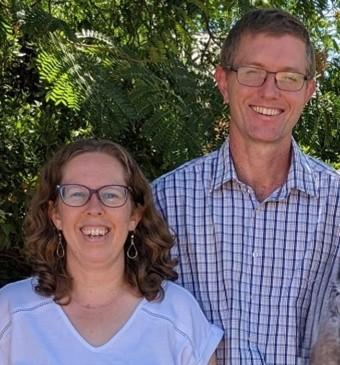
Tamara and Anthony Webb
Tamara and Anthony Webb
SRE teachers are people from local Christian Churches, some are paid, most are volunteers. At ACS the volunteer teachers will be Anthony and Tamara Webb from Ariah Park Baptist Church. They have been teaching both Primary and Secondary SRE classes at Ariah Park Central School (APCS) for about 10 years. Their family moved to the area in 2016, when Anthony commenced as the Pastor of Ariah Park Baptist Church. Anthony and Tamara have two girls attending APCS (Year 12 and Year 9), and one daughter in second year university in Wagga.
There are other local SRE teachers who may also join them on occasions. All SRE teachers have mandatory Working With Children Checks, as well as ongoing training in child protection and classroom management, lesson preparation, and the appropriate use of authorised curriculum materials.
What is taught?
Christian SRE teachers follow an authorised curriculum enabling students to question, explore, and discover more about the Christian faith by examining the Word of God, church teaching, and the faith experience of others. It helps students to grasp what it means to live well, to be in a relationship with God, and to embrace a life of service of others.
SRE teachers are encouraged to use a variety of teaching activities including writing, craft, class discussion, songs, drama, storytelling, games and new learning technologies. You can access an outline of the authorised curriculum used in SRE on the school website.
How do we choose SRE?
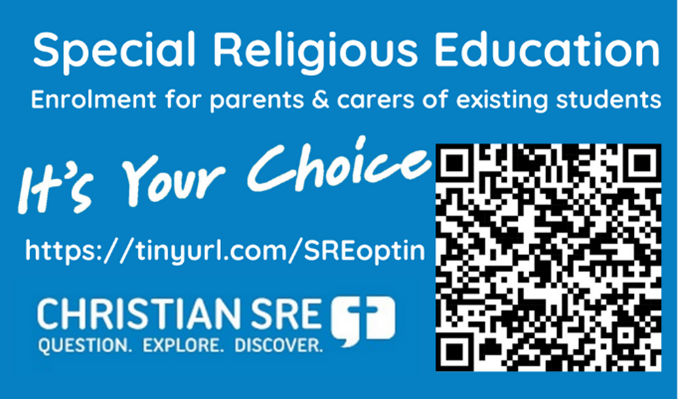
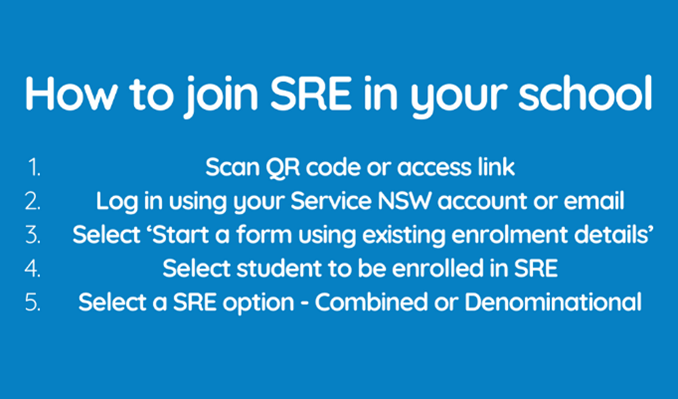
ACS's available SRE option can be selected via the Participation Letter which was sent home at the beginning of term, or you can contact ACS directly. SRE options can also be updated online through your school's Online Enrolment System. A parent/carer can also alter their choice at any time by sending a note to the school Principal.
Communication
On occasion and with pre-approval from the Principal, teachers may send information home about local church services and programs, and annual seasonal celebrations, as part of ongoing communication with parents/carers. There are clear processes available at a school level and via SRE providers to enable parents/carers to have dialogue, to ask questions, or to make a complaint if they have concerns about SRE.
Why choose SRE?
Christian SRE helps students to become successful learners, confident and creative individuals, and active and informed citizens. It aids them to 'have a sense of self-worth and personal identity that enables them to manage their emotional, mental, spiritual, and physical wellbeing'.
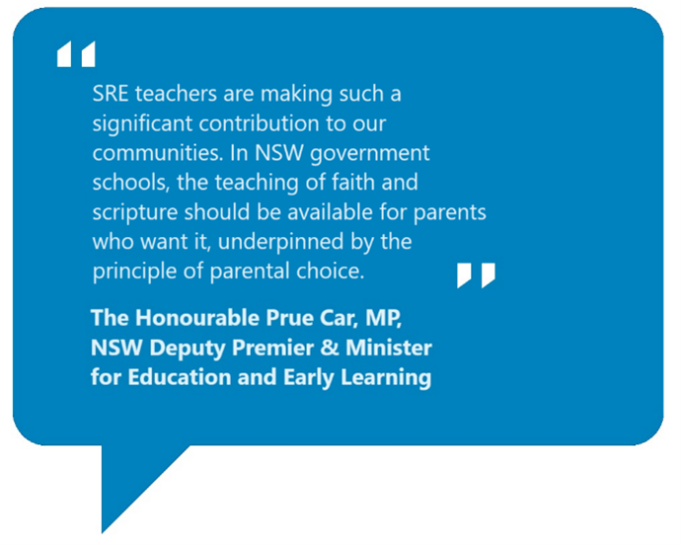
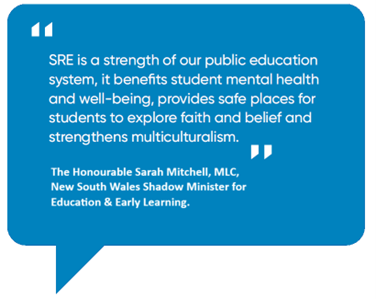
The NSW Government published the independent SRE review findings and recommendations in 2017. These highlighted how SRE positively contributes to students' understanding of their cultural heritage, is an avenue for their spiritual care, builds tolerance in schools, promotes multiculturalism, contributes to a well-rounded education, and connects schools with their local community.