Grade 1 News

Dear Year 1 Parents/Guardians,
Learning Focuses- Below is what we have been focusing on with our learning the past three weeks.
English
Phonics
Our focus has been on revising sounds with alternative spelling patterns to strengthen students' reading and writing skills. The English language is made up of many sounds, some of which can be tricky because they can be spelled in multiple ways.
Recently students have been learning about the placement of alternative spellings patterns for the long e sound /ee/. This includes: /e/, /ee/, /y/, /ea/.
Examples:
/e/ - Be
/ee/ - Seen
/y/ - Loudly
/ea/ - Each
Morphology
We have been learning about some of the rules of morphology, specifically how we modify base words when adding certain suffixes and prefixes. Understanding these rules helps students spell more accurately and boosts their reading comprehension.
When adding the suffixes -ion (after t), students have learnt that -ion can be used to create a noun
- fict + ion = fiction
- sect + ion = section
- nat + ion = nation
- opt + ion = option

Students have also been working on Irregular High Frequency words which may not follow the regular sounding out strategies.
Example: because, was, people, here
Syntax
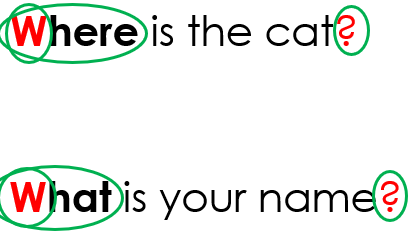
Students have been learning about unscrambling ‘statement and question sentences’
Statement sentence-
This includes who or what and what it is doing or being. It needs to include a capital letter at the beginning of a sentence and end with a full stop.
Example:

Question sentence-
A question asks for information and requires an answer. A question often starts with Who, What, Where, When, Why, How. A question must begin with a capital letter and end with a question mark.
Story Champs
We’ve been exploring the key components of a non-fiction text, students are helping break down each part of an overall information report. Here’s what we’ve been focusing on:
Main idea: Tell us what the text is about. E.g. This nonfiction text is about the ‘Arctic Fox’ and their features.
Key details: Provide us with important information about the nonfiction text. E.g. Physical features, Habitat, Food and other interesting facts.
New term: Include any new vocabulary which is related to the text. E.g. A newborn fox is called a pup.

Retelling in Their Own Words: We encourage students to retell information using the key elements, which helps them improve their speaking and writing skills. They’ve been practising this in pairs, small groups, and even as a class.
Knowledge
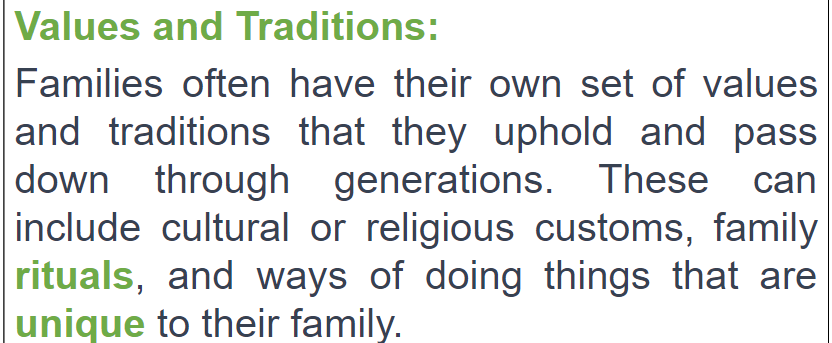
In Knowledge students have been learning about Changing Families. We have been exploring what makes a family. This includes identifying and describing roles and responsibilities within families, investigating the different structures and features of families, the similarities and differences between families, family traditions and family life over time.
Students are exploring the importance of their own relationships in family and how through support, encouragement and guidance can provide support.
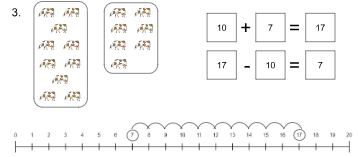
Maths - In Maths lessons have been learning about addition and subtraction.
- Addition: Students have been learning to represent addition within 20 using ten-frames, number bonds, bar models and number lines. We have been practising to create picture stories, number sentences and number phrases to solve the problem in different ways.
- Subtraction: Students have been learning to represent subtracting within 20 using ten-frames, number bonds, bar models and number lines. Together we have been practising creating picture stories, number sentences and number phrases to solve the problem in different ways.
SEL - In Social and Emotional learning students are learning to discuss the types of situations in which they would be best to seek adult assistance.
Home Learning Ideas
Some ideas of things you can work on at home this week:
Phonics
- Reading Together: Encourage your child to read a variety of books at home, paying attention to different spellings of familiar sounds. Point out tricky words and discuss the sounds and their spellings together. (Remember we have the LIttle Learners Online Platform)
- Sound Games: Play sound games such as “I Spy” with a focus on spelling patterns. For example, “I spy something with the sound /ee/.”
- Word Hunts: During reading or everyday activities, have your child spot words with the sounds they are learning. This reinforces their understanding of the sound-to-spelling connections.
Morphology
- Reading and Spotting Patterns: As you read together, point out words with these suffixes and discuss how the base word changes. This will help reinforce their understanding.
Syntax
- Sentence Practice: Challenge your child to come up with a statement, question, exclamation and command sentences, take turns creating sentences and see how many different sentence you can create
- Add the conjunction: Practise using the following conjunctions into a sentence. (but, because and so). e.g. The boy was tired because he was asleep
- Editing sentences: Checking that a sentence has capital letters and punctuation in the correct places.
Story Champs
- Read and Retell: After reading a nonfiction text, ask your child to retell it using the key elements. You can prompt them with questions like, “What was the main idea?” or “What are some key details about the text?”
- Justifying the fact:: Encourage your child to recall an important/interesting fact from a non-fiction text. Ask them to justify their thinking. e.g. Why do you think…?
Maths
- Students can play Mastermind practising place values up to three digit numbers. Take turns guessing what the number can be, encouraging stating the number and also saying the place value of each digit. e.g. 146 is 1 hundred, 4 tens and 6 ones.
- Use items you have at home (like toys or snacks) to help your child practice adding and subtracting. Here are a few ideas:
- Addition: Give your child a number up to 20 (for example, 12) and ask them to add another number (like 5) to find the total.
- Subtraction: Give your child a number up to 20 and ask them to take away a smaller number. For example, if you give them 15, ask them to take away 7 and find the answer.
- Finding the Difference: Pick two numbers (like 12 and 8) and help your child find the difference. They can either add to the smaller number until it reaches the larger one, or they can subtract from the larger number until they reach the smaller one.
- Remember that you can use Essential Assessment to support some learning at home through My Numeracy, Jetpack Algebra and Sunset Maths
SEL
- Remember to have conversations about the different ways we can support each other and include others in our community. Also discuss how we treat others nicely as that is the way we would like to be treated. Also discuss with students about the importance of seeking help from a trusted adult when a problem isn’t able to be solved independently.