
Resource Centre
How to Help Your Child Choose an Enjoyable Book to Read for Pleasure
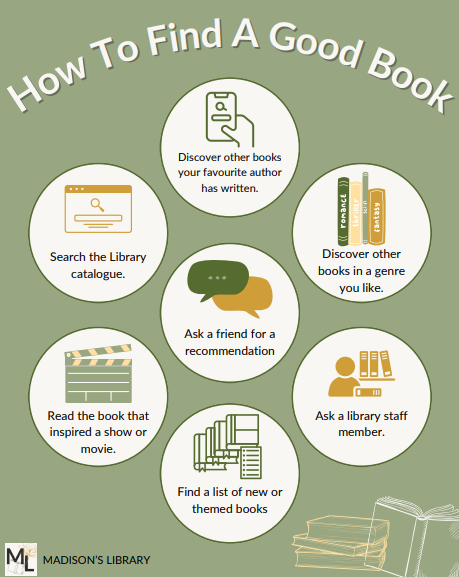
When students are browsing the Library collection, they are encouraged to choose materials that:
Are of interest to them.
Questions that are asked of students when they cannot locate reading materials include:
- What interests you? Sports/hobbies?
- What movies or TV shows do you enjoy watching?
What types of books would you normally read?
These questions allow staff to guide students to books that are related to their interests.
Megan Daley has her own versions of these questions in her book Raising Readers: How to Nurture a Child’s Love of Books, as well as other questions and strategies to assist students in self-selecting books.
Five Finger Rule
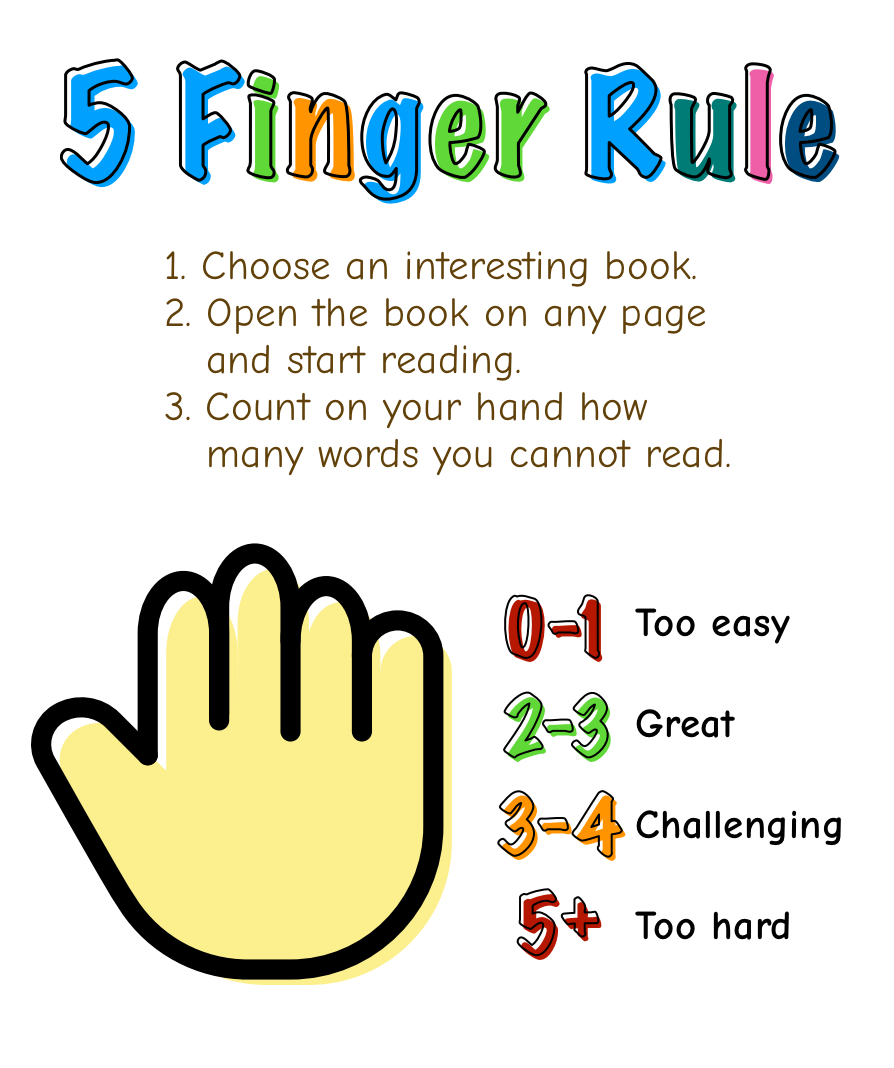
The ‘Five Finger Rule’ is one of the quickest and easiest ways to gauge whether a book is too hard. Students are encouraged to choose any page in the book and start reading aloud. As they read, if they come to a word that is tricky or they are unfamiliar with, they hold a finger up. If, by the end of the page, they have:
- 0–1 fingers up — the book is too simple
- 2–3 fingers up — the book is just right
5 fingers up — the book is too difficult, and the child has spent more time concentrating on difficult words than on reading the story and will have lost the storyline of the book.
Children's Book Council Of Australia(CBCA)
The CBCA provides recommendations for high-quality books for students to engage with.
New South Wales Premier's Reading Challenge

New South Wales Premier's Reading Challenge Book lists (K-2, 3-4,5-6, 7-9)
Read Australia

Wilderness Society Environment Awards
DANZ Diversity in Australia and Aotearoa New Zealand children's book award
Your Kids Next Read
An online community where people can ask for recommendations of books for their child, with advice from parents, teacher and other bookish people.
Beanstack

Beanstack is our new reading challenge website that our Year 5, 6, and 7 students will have access to.
Beanstack uses competition, recognition, and proven gamification principles to motivate students to read and develop a lifelong love of reading. Whether your student chooses fiction, nonfiction, graphic novels, or articles online, any and all reading counts in Beanstack! By tracking their daily reading, your student will begin to build healthy reading habits and become a more confident reader.
When students log their reading via Beanstack’s web or mobile app, they:
- Earn digital badges as they reach milestones
- Compete on leaderboards and build streaks for reading every day
Track everything they read on their virtual bookshelf
For a glimpse of what your students will experience with Beanstack, click here!
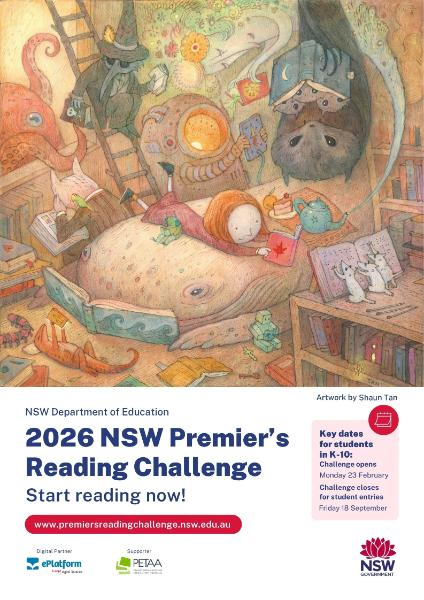
Premier’s Reading Challenge
Key Dates
Challenge opens: 23 February
Challenge closes: 18 September
Once student passwords are received, we will communicate these through your child’s diary or via email. I am currently registering students who are new to the PRC NSW, and hope to have login credentials issued soon to all those waiting.
Finding Books for the Challenge
There are several easy ways for you and your child to locate books from the PRC Booklist:
Through Your Child’s PRC Account
Once logged in, students can access a direct link to the booklist for their Challenge level (K–2, Years 3–4, Years 5–6, Years 7–9, Years 10+).
On the PRC Website
You can browse the full booklists online: https://online.education.nsw.gov.au/prc/booklist/home.html
In Our School Library
PRC books are available in clearly labelled tubs and on display for easy access.
Challenge Rules (Rules 12-14)
Adapted from the PRC website
12. Gold and Platinum certificates will be sent to the school in Term 4 with students’ names printed, along with PRC medals.
13. Schools must ensure that parents and carers are aware that, by entering the Challenge, students may receive a PRC certificate with their name and school printed. The Premier’s Reading Challenge no longer publishes an Honour Roll of student names, though there may be opportunities for recognition through media publications or the school’s own newsletters and communications. No student names or details will be published without prior consent from parents or carers.
14a and 14b are not applicable to Moama Anglican Grammar students.
Kids’ Lit Quiz – 2026 Newsletter Update
“Reading is to the mind what exercise is to the body.” — Joseph Addison
We will participate in the Virtual Heat on 28 April, held at school from 9.45 am.
In the last week, students have been supplied with practice questions, and other activities will be sent home before the competition.
The Kids’ Lit Quiz turns reading into a sport, giving students the chance to test their knowledge of all things literary. For more information, you can watch a short video about the challenge, recorded in 2006: https://www.youtube.com/watch?v=vjf4MS30qJo
You can also explore the official website:https://www.kidslitquiz.com/demo-video.php
Keep your eyes out for an email with more information.
Australian E‑Sport League (AEL) – Minecraft Building
This year marks the second time we are entering Secondary teams in the Australian E‑Sport League. We have one team competing in the Year 7–9 build, Medieval Marvels, and another team in the Year 10–12 build, Structure Collapse.
Once we have held our team meeting, we will inform families of the days and times students will be meeting each week.
https://ael.org.au/minecraft/ is where you can find some information about the project students will be working on.
Important details
Opening Hours:
| Day | Time |
|---|---|
| Monday - Thursday | 8.30 am - 4.30 pm |
| Friday | 8.30 am - 4.00 pm |
Passwords
If you haven’t received your new password yet, please contact the Resource Centre at library@moamagrammar.nsw.edu.au. We’ll ensure your password is sent to you as soon as possible.
Borrowing and Returns
Students may borrow and return books before school, at recess, lunchtime, and after school. Primary School students also have the opportunity to borrow during their fortnightly Library lessons, with books due back at their next session. Students in Years 7–9 have now begun visiting the Resource Centre regularly. Their books are due two weeks after the date of borrowing.
Borrowing Permissions
If students are requesting to borrow books above their age level, we request parents to write a letter regarding their permission for their child to borrow and read a specific book, which will be reviewed by library staff.
Renewals
Students may renew their books for an additional two weeks by speaking to staff at the Library Circulation Desk. If a further extension is required after this period, students must bring the book with them so staff can sight it before approving the renewal. Students may also renew their books by emailing the Library or by logging on to the school Library website, which is accessible through their SEQTA account.
Requests
If your child would like to borrow a specific book and the title is not included in our current catalogue, we will add this to our purchase wishlist.
Overdue notices
If you receive an overdue notice, there is a chance that the books may have been processed through our system after the email was sent. We encourage all parents to follow up on any issues by emailing the Resource Centre at library@moamagrammar.nsw.edu.au
Reading Permissions
Due to our shared space catering for students from Kindergarten to Year 12, our library collection is organised to help students easily find books with protagonists close to their own age. For example, in the Upper Primary section, most of the characters are between 11 and 13 years old. This approach ensures that themes and content remain age-appropriate, and also supports students in reading independently and with confidence.
When deciding where books are placed within the collection, we are guided by author and publisher recommendations.
If you have any other enquiries, issues or concerns, please do not hesitate to contact us via phone by ringing the main office or via email address at library@moamagrammar.nsw.edu.au
Keep reading everyone!
Kind regards,
Ms Height and Ms O’Neill
Resource Centre Team